

Public health infrastructure serves as the indispensable backbone of societal well-being, providing the foundational support required to prevent disease, respond to emergency crises and promote long-term wellness across populations. Whether a city is implementing routine immunization schedules, monitoring regional air quality or coordinating a rapid response to a viral outbreak, these operations rely entirely on an underlying framework of resources, technology and trained professionals.
Understanding public health infrastructure is essential for evaluating how health policy translates into direct community impact. Without robust infrastructure, even well-designed wellness initiatives struggle to reach vulnerable neighborhoods effectively. A breakdown in communication channels, data systems or staffing can leave an entire region unprepared for emerging health threats.
What Is Public Health Infrastructure?
At its foundation, public health infrastructure refers to the underlying organizational systems, resources, digital networks and specialized workforce that enable public health agencies to plan, deliver and evaluate services that protect population health.
This infrastructure operates across interconnected federal, state and local levels. Federal organizations establish national guidelines and distribute funding. State health departments oversee regional regulatory compliance, and local public health offices work directly on the ground to serve neighborhood needs. Together, these networks form cohesive public health systems capable of safeguarding communities nationwide.
What Is Infrastructure in Healthcare vs. Public Health?
Understanding the distinction between infrastructure in healthcare and public health is critical, as the two terms are frequently confused. While both sectors are essential, their scopes and primary goals differ significantly.
Healthcare infrastructure focuses on individual clinical treatment across facilities like hospitals, clinics and private practices. Clinical workforce roles center around physicians and nurses aiming to diagnose and treat active illness or injury in individual patients.
In contrast, public health infrastructure addresses population-level prevention, disease monitoring and health promotion through public health laboratories, community health centers and research agencies. It relies on epidemiologists, biostatisticians, health educators and public health leaders to advance health equity across communities.
Despite these differences, the two sectors remain deeply interconnected. Modern healthcare systems rely on public health networks to track infectious disease trends, while public health agencies depend on clinical care providers to report diagnostic data, administer vaccines and deliver direct care during emergency responses.
What Are the Components of Health Infrastructure?
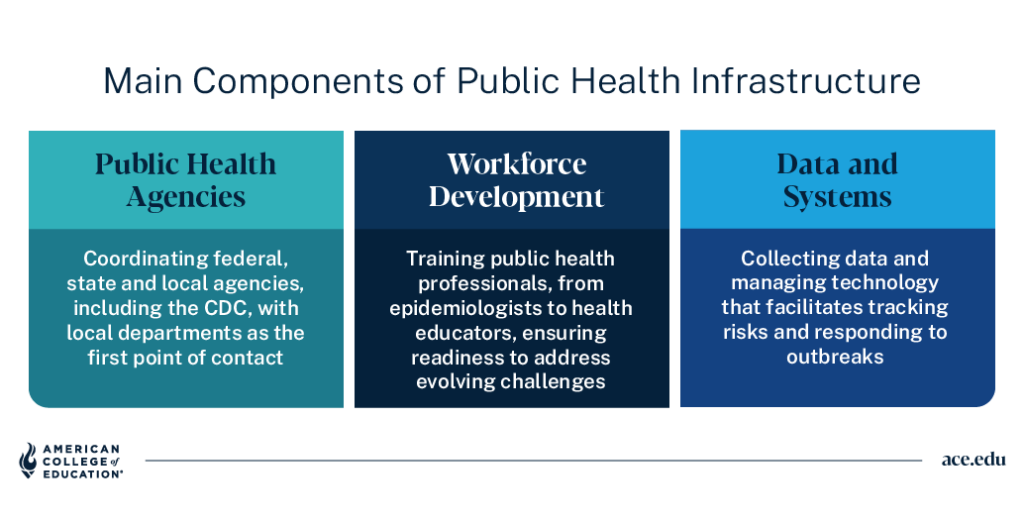
Health infrastructure components include three primary, interdependent pillars: organizational agencies, a trained professional workforce and advanced data systems.
Public Health Agencies
Organizational agencies provide structural oversight and administrative leadership. At the federal level, institutions like the Centers for Disease Control and Prevention (CDC) establish national benchmarks, conduct epidemiological research and distribute grant funding. State health departments adapt these directives to manage regional trends, while municipal and county local public health departments serve as the primary point of contact for daily community needs.
Workforce Development
Sustained workforce development ensures that agencies are staffed by qualified, highly trained individuals, including epidemiologists, biostatisticians, environmental health specialists and public health nurses. Ongoing education and professional training are critical for helping public health leaders and field staff keep pace with evolving threats, such as emerging viruses, environmental contaminants and shifting demographic patterns.
Data and Information Systems
Modern public health operations depend heavily on robust data collection and digital communication technologies. Specialized information technology platforms allow agencies to track disease surveillance metrics in real time, monitor hospital capacity and identify localized health risks before they spiral into widespread crises. Electronic laboratory reporting and automated syndromic surveillance systems enable public health authorities to detect potential outbreaks earlier, execute rapid contact tracing and deploy targeted interventions with remarkable precision.
The Essential Public Health Services Framework
To understand the practical elements of public health, practitioners rely on the 10 Essential Public Health Services framework established by national public health authorities. This structure outlines the core responsibilities that every strong public health system must deliver to its community.
The ten essential services fall under three overarching core functions:
- Assessment involves systematically collecting, analyzing and making information available on community health assets and risks. Under this function, public health systems assess and monitor population health status while actively investigating, diagnosing and addressing health hazards.
- Policy development focuses on exercising leadership to foster scientific knowledge in building comprehensive public health policies. This function includes informing and educating people about health, strengthening community partnerships, creating laws that impact health, and utilizing regulatory actions designed to protect public well-being.
- Assurance guarantees that necessary services are provided to achieve community health goals. This includes assuring equitable access to care, building a diverse public health workforce, evaluating functions through research and maintaining a strong organizational infrastructure.
Whenever an agency implements public health campaigns, conducts disease surveillance or deploys targeted public health interventions, it relies directly on these essential public health services to guide its execution.
How Public Health Infrastructure Supports Community Health
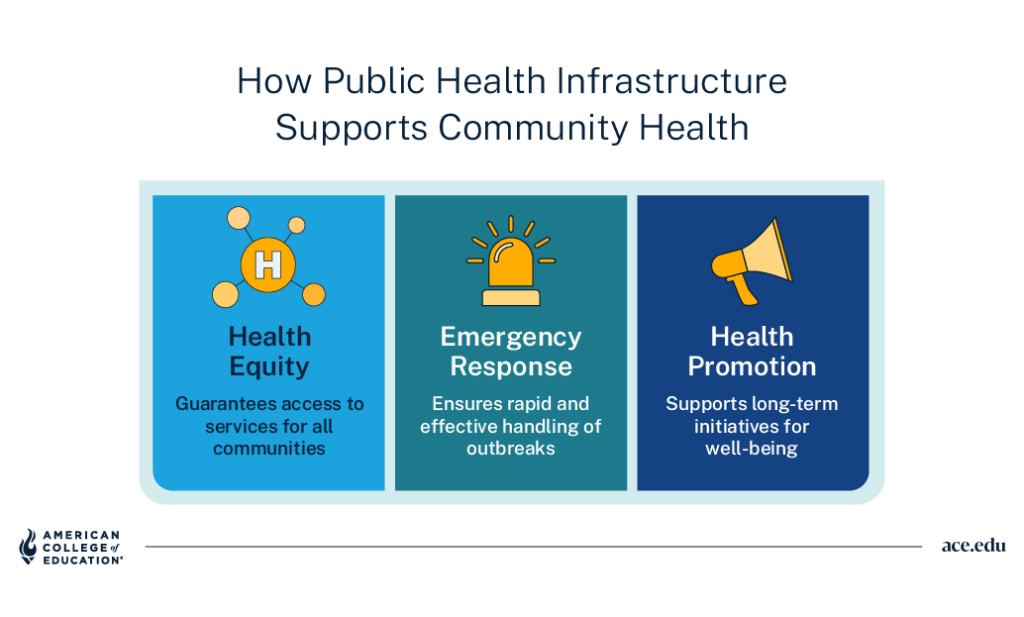
Strong infrastructure translates directly into practical, lifesaving outcomes for everyday citizens across several core areas of community health.
Emergency Preparedness and Rapid Disease Response
When disease outbreaks or environmental emergencies strike, pre-existing infrastructure allows authorities to react immediately. Established communication networks, emergency supply chains and trained personnel enable public health authorities to set up mobile testing sites, distribute medical countermeasures and issue clear public guidance within hours.
Sustainable Health Promotion and Disease Prevention
Beyond crisis management, infrastructure supports ongoing health promotion efforts that prevent illness before it occurs. Robust agency networks run vaccination drives, conduct water quality testing, manage maternal wellness initiatives and implement chronic disease prevention campaigns. These continuous health efforts can lower overall disease rates and reduce strain on local hospitals.
Advancing Health Equity in Underserved Populations
A central mission of modern public health is advancing health equity by ensuring quality resources reach marginalized populations. Well-maintained infrastructure enables agencies to analyze neighborhood-level demographic data, identify structural barriers to care and direct targeted community health outreach to historically underserved zip codes.
Challenges Facing Public Health Infrastructure
Despite its vital importance, public health infrastructure faces continuous operational hurdles that threaten its long-term stability.
Funding Volatility and Resource Constraints
Public health funding in the United States historically follows a chaotic cycle of panic and neglect. Agencies frequently receive emergency capital during active disease outbreaks, only to face severe budget cuts once the immediate crisis wanes. This unpredictability makes it difficult for health departments to maintain modern equipment or sustain long-term programs addressing chronic health issues.
Critical Workforce Shortages
Public health agencies nationwide face chronic staffing shortages, particularly in rural and economically distressed urban areas. High rates of professional burnout, competitive salary pressure from private healthcare corporations and an aging workforce nearing retirement have left significant gaps in critical roles like epidemiology, public health nursing and environmental inspection.
Outdated Data Infrastructure and Cybersecurity Risks
Many local health departments continue to operate legacy software systems that lack interoperability with private hospital networks. Incompatible data formats delay outbreak detection and complicate multi-jurisdictional reporting. Furthermore, managing confidential digital medical records requires sophisticated cybersecurity protocols that underfunded agencies struggle to maintain.
Innovations Strengthening Public Health Infrastructure
To overcome systemic hurdles, innovative technology and cross-sector partnerships are transforming how public health infrastructure is built and sustained.
Technology-Driven Surveillance and Telehealth Expansion
Modern public health agencies are adopting high-quality digital analytics, automated electronic case reporting and artificial intelligence models to predict disease transmission patterns. Additionally, the widespread expansion of telehealth platforms allows rural public health departments to offer specialized medical consultations, nutrition counseling and mental health services to geographically isolated residents.
Cloud-Based Data Systems and Interoperability
Federal and state investments are driving the transition toward cloud-based public health data architecture. These modern platforms allow real-time, secure data sharing between private health systems, public health laboratories and federal agencies, enabling faster outbreak surveillance and streamlined reporting.
Cross-Sector Public-Private Partnerships
To supplement constrained budgets, public health organizations are increasingly collaborating with nonprofit foundations, academic research institutions and private technology corporations. These strategic partnerships expand resource availability, support community outreach initiatives and accelerate the development of innovative public health tools.
Why Public Health Infrastructure Matters
At its core, public health infrastructure – agencies, a dedicated workforce and modern data systems – form the invisible foundation that keeps society safe, resilient and healthy. When these structural components are well-funded, properly staffed and technologically integrated, communities are equipped to withstand unexpected health crises while systematically reducing the burden of chronic disease.
Investing in public health infrastructure directly enhances an organization’s capacity to deliver essential public health services efficiently and equitably. Building modern, resilient public health systems remains one of the most critical priorities for future societal well-being.
FAQs
How does public health infrastructure differ at the federal, state and local levels?
Federal agencies set national health policies, conduct high-level research and distribute funding. State departments manage regional health regulations, while local public health departments deliver direct community services like immunization clinics, restaurant inspections and local outbreak investigations.
What role do public health laboratories play in the broader infrastructure?
Public health laboratories provide specialized diagnostic testing for infectious diseases, analyze environmental samples for toxic contaminants, monitor foodborne illness outbreaks and generate high-quality surveillance data used by epidemiologists.
How does public health infrastructure support emergency preparedness?
Strong infrastructure establishes emergency operation centers, stockpiles medical supplies, trains surge response personnel and maintains secure communication networks to ensure rapid, coordinated responses during natural disasters or disease outbreaks.
What careers involve working directly within public health infrastructure?
Key career paths include epidemiologists, public health administrators, biostatisticians, environmental health officers, public health nurses, health educators and healthcare data analysts.
American College of Education offers affordable healthcare programs designed to help professionals pursue career advancement and make a difference in healthcare spaces globally.