
Career Guide: Epidemiologist
Here’s what you need to know.
Toggle Navigation
Our Enrollment Counselors are here to answer your questions and walk you through the enrollment process.
Epidemiologist Career Overview
When communities face unexpected health challenges, there are professionals working behind the scenes to understand what is happening and how to respond. From identifying patterns in widespread illness to helping guide prevention efforts, these moments highlight the importance of informed, data-driven decision making.
Epidemiologists are at the forefront of this effort. What is an epidemiologist? They study patterns of disease and injury, analyze data, and support strategies that guide disease control and prevention. Their work helps communities respond with confidence and prepare for future challenges.
If you are considering this path, this guide will walk you through what an epidemiologist does, how to become an epidemiologist, and what to expect in terms of education requirements and career outlook.
What Is an Epidemiologist?
It’s important to understand that epidemiology goes beyond research. An epidemiologist is a public health professional who studies how diseases and health issues affect populations. These professionals play a key role in deducing how diseases spread, who is most at risk and what strategies can improve health outcomes.
Epidemiologists work to support disease control and prevention by analyzing data, identifying patterns and recommending solutions. Their work helps guide decisions that protect communities and improve overall health.
You may find epidemiologists working in government agencies, research institutions or healthcare organizations. Many also collaborate with groups such as the Centers for Disease Control to address large-scale public health challenges.
What Do Epidemiologists Do?
If you are exploring what epidemiologists do, their work combines research, analysis, and collaboration to understand health trends and inform decisions that impact communities. They take on a range of responsibilities that support both immediate response efforts and long-term public health strategies. Their work additionally involves both independent research and collaboration with other professionals.
Core Duties and Responsibilities
- Investigating disease outbreaks: You might help track the source of an outbreak, identify patterns and determine how it is spreading within a population
- Collecting and analyzing health data: You’ll study data related to infectious diseases and chronic disease conditions to better understand health outcomes
- Designing research studies: You’ll develop studies that explore causes of disease and potential prevention strategies
- Monitoring health trends: Tracking changes in health issues over time helps identify emerging risks and inform early intervention efforts
- Collaborating with organizations: You’ll often work with healthcare professionals and government agencies to support public health initiatives
- Developing prevention strategies: Findings help shape policies and programs focused on disease control and prevention
Work Environment Variations
- Government agencies: Public health departments and national organizations often focus on large-scale disease control and prevention efforts
- Research institutions: These environments emphasize data analysis and long-term studies on health issues
- Hospitals and healthcare systems: Epidemiologists may support infection control and patient safety initiatives
- Nonprofit and global health organizations: Many professionals work on international health challenges and community-based programs
- Academic institutions: Some epidemiologists teach or conduct research in universities
Skills & Traits That Make a Successful Epidemiologist
To succeed in this field, epidemiologists rely on a combination of analytical thinking and practical communication skills. These abilities help them interpret data, collaborate with teams and communicate findings clearly.
Essential Soft Skills
Strong soft skills allow epidemiologists to translate complex data into meaningful insights that others can act on.
- Analytical thinking: Understanding patterns in data is central to identifying health trends and risks
- Communication skills: Epidemiologists must explain findings to public health officials, policymakers and other stakeholders
- Attention to detail: Small data points can reveal important insights about disease and injury patterns
- Collaboration: Working with interdisciplinary teams supports more effective solutions
- Ethical judgment: Handling sensitive health data requires professionalism and responsibility
Important Technical Skills
In addition to interpersonal abilities, epidemiologists depend on technical expertise to carry out their work effectively.
- Data analysis tools: Statistical software helps professionals interpret large datasets and identify trends
- Research methods: Strong study design ensures accurate and reliable results
- Public health knowledge: Understanding disease transmission and prevention supports effective analysis
- Technical reporting: Clear documentation helps communicate findings and recommendations
How These Skills Apply on the Job
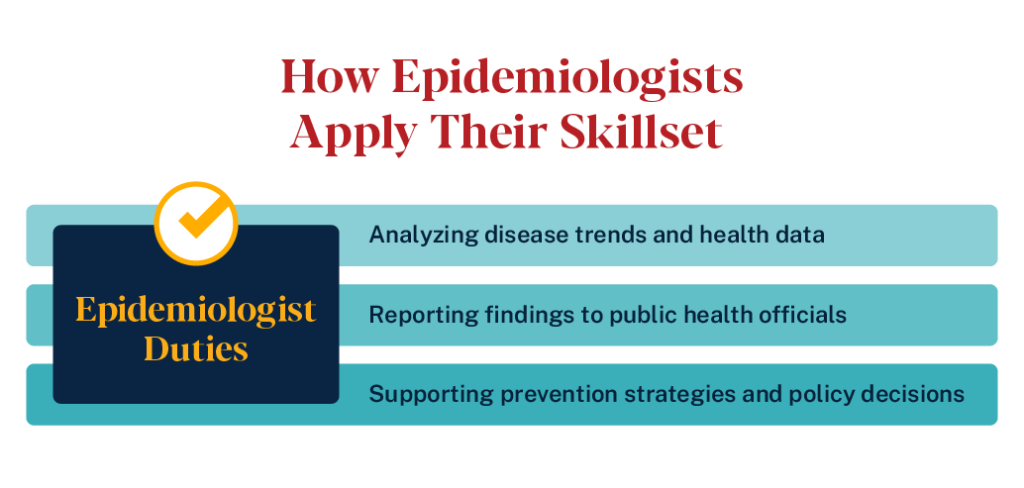
These skills come together in daily work. You might analyze data to identify trends in infectious diseases, present findings to public health officials or contribute to strategies that improve health outcomes. Over time, this work supports more informed decisions and stronger public health systems.
Epidemiologist Education Requirements
If you are exploring how to become an epidemiologist, understanding the education pathway is an important first step. To become an integral part of this field, you’ll need a strong foundation in science, research and data analysis.
Minimum Education Requirements
Most entry-level roles require a bachelor’s degree in public health, biology or a related field. This stage helps you build foundational knowledge in health sciences and research methods.
Preferred Education Pathways
Many epidemiologists pursue a Master of Public Health or a related graduate degree. This level of education provides specialized training in epidemiology, biostatistics and data analysis, which are essential for advanced roles.
Certifications and Training Options
Some professionals choose to pursue public health certifications or additional training in disease control and prevention. Continuing education can also help you stay current with evolving tools and research methods.
How to Become an Epidemiologist
Becoming an epidemiologist is a step-by-step process that builds your expertise over time. Each stage helps you develop the knowledge and experience needed to contribute meaningfully to public health. In many cases, entering the field involves the following steps:
- Earn a Relevant Bachelor’s Degree
Your journey typically begins with a bachelor’s degree in public health, biology or a related field. This stage helps you build a strong foundation in health sciences, research methods and data analysis. As you progress, you will begin to understand how health issues are studied at the population level and how data can be used to identify patterns and risks.
- Pursue a Graduate Degree
Most epidemiologist roles require a graduate degree, often a Master of Public Health or a specialized program in epidemiology. This is where your knowledge becomes more focused and practical. You will explore topics such as biostatistics, disease transmission and research design, all of which are essential for working in public health and disease prevention.
- Gain Research or Field Experience
Hands-on experience is an important part of preparing for this career. You might participate in internships, research projects, or roles within government agencies or healthcare organizations. During this stage, you may work with real data, support ongoing studies or contribute to public health initiatives that address current health issues.
These experiences help you build confidence, develop technical skills and better understand how epidemiologists work in real-world settings. - Apply for Epidemiologist Jobs
Once you have the necessary education and experience, you can begin applying for epidemiologist roles. Opportunities exist in government agencies, healthcare systems and research organizations, where you may focus on areas such as infectious diseases, chronic disease or broader public health concerns.
As you enter the field, you will continue to refine your skills and contribute to efforts that support disease control and prevention. - Optional: Advance With Higher Education
For those interested in advanced research or academic roles, pursuing a doctoral degree can open additional opportunities. This path is often suited for individuals who want to lead large-scale studies, teach at the university level or contribute to the advancement of epidemiological research.
Day-in-the-Life & Real-World Scenarios
What is life as an epidemiologist like? Understanding what daily work looks like can help you decide if this career is the right fit for you. While responsibilities can vary depending on your role and organization, epidemiologists often balance data analysis, research and collaboration throughout the day. Their work is both structured and responsive, especially when addressing emerging health issues.
A Typical Workday
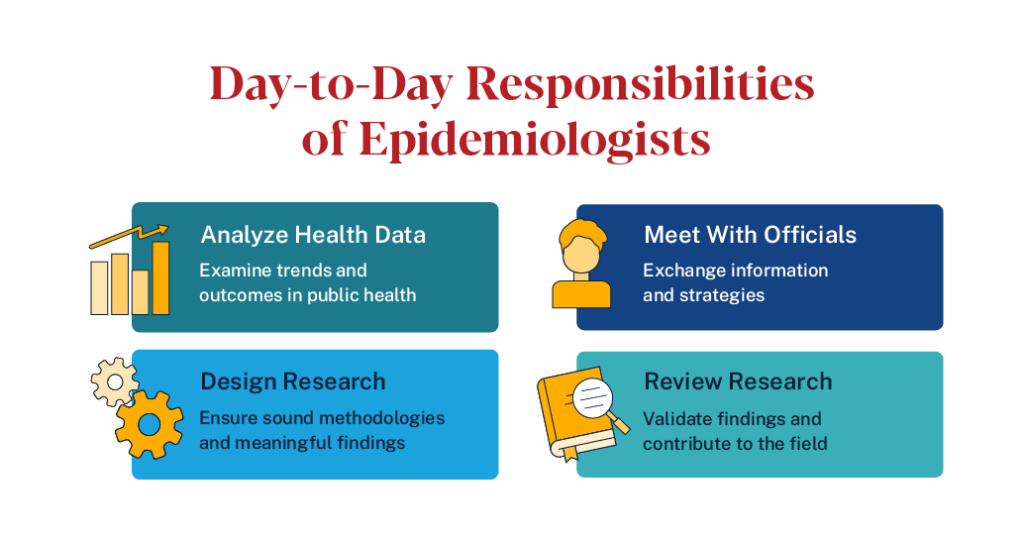
A typical day might begin with reviewing health reports or analyzing new data related to disease and injury trends. You may look for patterns in infectious diseases or track changes in chronic disease rates to better understand how health issues are evolving.
Throughout the day, you might meet with public health officials or colleagues to discuss findings, share insights and plan next steps. Time is also spent designing research studies, evaluating prevention strategies or refining data collection methods to ensure accuracy and reliability.
Real-World Examples
In practice, the work of an epidemiologist often connects directly to real-world challenges. For instance, you might investigate a disease outbreak by identifying patterns, tracing sources and determining how it spreads within a population.
In large-scale health events, epidemiologists play a key role in tracking cases, analyzing trends and helping guide public health responses. Their work helps inform decisions that protect communities and reduce risk. A great example is the global COVID-19 pandemic.
What Success Looks Like in the Role
Success in this field is often measured through impact. You may see it when data leads to earlier detection of health issues or when prevention strategies reduce the spread of disease. Over time, success also includes contributing to stronger public health systems, supporting informed policy decisions and helping improve health outcomes for entire populations. These outcomes reflect the meaningful role epidemiologists play in protecting and improving community health.
Epidemiologist Salary & Job Outlook
Epidemiologists play a critical role in public health, and their compensation reflects the level of expertise required for the field. According to the United States Bureau of Labor Statistics, the median annual salary for epidemiologists was $83,980 as of May 2024.*
Beyond salary, this career offers long-term stability and meaningful impact. As global health challenges continue to evolve, the need for professionals who can analyze data, respond to disease outbreaks and support prevention efforts remains strong.
Employment for epidemiologists is expected to grow by 16% from 2024 to 2034, roughly translating to 800 job openings each year.* Ongoing efforts in disease control and prevention, along with increased attention to global health challenges, are driving the need for skilled professionals in this field.
Advancements in data analysis and a growing emphasis on evidence-based decision making also contribute to this demand. As healthcare systems and government agencies rely more heavily on data to guide their strategies, epidemiologists play an increasingly important role in shaping those decisions.


FAQs
Do epidemiologists work directly with patients?
Most epidemiologists focus on population-level data rather than direct patient care.
What tools and software do epidemiologists use?
Epidemiologists often use statistical software and data analysis tools to help them interpret health data.
How do epidemiologists investigate disease outbreaks?
They collect and analyze data, identify patterns, and collaborate with public health organizations to determine causes and solutions.
What is the difference between an epidemiologist and a public health analyst?
Public health analysts often focus on policy and program implementation. Meanwhile, epidemiologists focus more on research and disease patterns.
Play a Leading Role in Public Health
Epidemiologists are vital professionals who work to protect communities and improve health outcomes. Through research, analysis and collaboration, they help address some of the most important health challenges facing society today.
If you are ready to take on this kind of impact, pursuing your degree with American College of Education (ACE) can help you build the knowledge and skills needed to get there. With online programs designed for working adults, you can begin your journey toward a meaningful career in public health.