Artificial intelligence (AI) is accelerating change across nearly every part of education. From K-12 classrooms to higher education and workforce development, institutions are rethinking not only how learning is delivered but how educators are prepared for a profession that continues to evolve.
These themes were central to a recent conversation on the MindShare TV Podcast hosted by Robert Martellacci, featuring American College of Education (ACE) President and CEO Geordie Hyland. The discussion explored how AI is reshaping teacher preparation, why lifelong learning is becoming essential for educators, and how institutions can respond more effectively to changing workforce and classroom needs. The conversation also reflected ACE’s broader engagement in education innovation discussions across North America, including sponsorship of the upcoming Canadian EdTech AI Summit.
Throughout the interview, Hyland framed AI as an opportunity for institutions to become more adaptive, affordable and responsive to the human side of learning.
About Geordie Hyland
Before leading ACE, Hyland built a career spanning higher education and K-12 workforce development. A Toronto native and former hockey player who later attended Harvard University and the London School of Economics, he described sports as an important foundation for many of the lessons that continue to shape his leadership approach today.
Hyland pointed to teamwork, hard work and resilience as skills that extend well beyond athletics. He also emphasized the importance of learning how to respond to mistakes, something he said becomes especially important during periods of rapid change and uncertainty.
That mindset carried throughout the discussion. Rather than framing AI as something institutions should resist, Hyland consistently returned to the importance of adaptability, continuous learning and thoughtful implementation.
Why Teachers Matter More in the Age of AI
From Information Delivery to Sense-Making
For decades, teacher preparation operated within relatively stable instructional models. In an AI-enabled environment where information is constantly accessible, however, Hyland argued that educators are increasingly shifting from information delivery to sense-making and from standardized instruction to adaptive design.
That evolution is changing how teachers support students inside and outside the classroom. In many cases, educators are becoming mentors, coaches and designers of learning experiences while placing greater emphasis on reasoning, originality and critical thinking.
Hyland suggested that this shift may ultimately make teachers more important, not less.
Human Skills Still Matter
While AI can craft routine explanations, practice exercises and administrative tasks, it cannot replace the human skills that sit at the center of effective teaching. Judgment, relationship-building, leadership and adaptability all become more valuable in environments where information is abundant, but discernment matters.
The conversation emphasized that AI implementation must remain grounded in the realities educators face every day. Reflecting on conversations at the ASU+GSV Summit earlier this year, Hyland noted that many discussions focused on the importance of building tools with educators, not just introducing more technology into classrooms.
How ACE’s Model Supports Faster Innovation
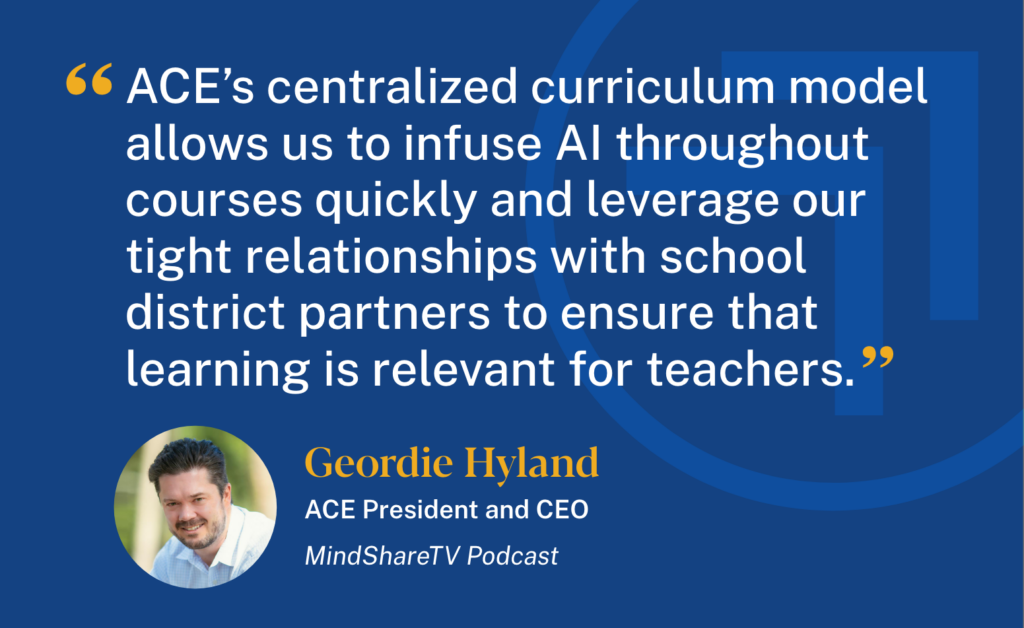
According to Hyland, ACE’s online model allows the institution to respond to changing workforce and classroom needs. Through its centralized curriculum model, ACE can incorporate AI across courses more quickly while giving faculty greater visibility into student progress and support needs.
That responsiveness is becoming increasingly important as educators look for programs aligned with current classroom realities, evolving technologies and career advancement opportunities. Hyland also emphasized the importance of maintaining close relationships with school district partners to help ensure learning remains practical, relevant and connected to workforce needs.
A Student-Centered Online Learning Experience
ACE has also emphasized creating a student-centered online learning experience designed around working adult learners balancing careers, families and professional responsibilities. Its approach to AI similarly focuses on responsible implementation that supports teaching and learning outcomes.

One of the great things about online education is the ability to see data, leverage it and then intervene for students at the right time with the right intervention.
Geordie Hyland, ACE President and CEO
Learn More About GeordieAffordability Is Part of Innovation
While many discussions about innovation focus heavily on technology, Hyland emphasized that reducing barriers to graduate education is equally important.
Traditional higher education models often leave educators balancing professional development with significant student debt. In a profession already facing workforce shortages and burnout challenges, that financial burden can discourage teachers from pursuing advanced credentials and leadership opportunities.
During the interview, Hyland explained that ACE has intentionally focused on creating lower-cost pathways designed to reduce borrowing. ACE does not participate in the Title IV federal debt program and instead emphasizes affordability as part of its broader approach to access and workforce mobility.
At the time of the discussion:
- Most master’s programs cost less than $10,0001
- Doctoral programs cost less than $25,0001
- 87% of ACE students graduate student debt-free2
ROI Matters for Adult Learners
Hyland also referenced third-party research showing that for every $1 invested in ACE tuition, students receive $19.20 in future career earnings.
For working educators balancing full-time careers, family responsibilities and continuing education, flexibility and affordability are essential. That accessibility becomes especially important in an environment where educators are expected to continuously adapt to new technologies and evolving classroom demands.
If lifelong learning remains a permanent part of the profession, institutions must create realistic pathways that make ongoing education both financially sustainable and beneficial.
Lifelong Learning Is the New Model for Educators
Throughout the conversation, Hyland emphasized that teacher preparation can no longer be a one-time credentialing process. Education is moving toward a more continuous learning model where professional development, graduate education and career advancement become increasingly connected.
Creating Flexible Pathways for Educators
At ACE, that approach includes creating pathways that allow educators to progress from paraprofessional or teacher assistant roles into licensed teaching, leadership and doctoral-level programs. Hyland noted that some master’s-level credits can apply toward doctoral pathways, helping reduce both time and cost for returning students.
ACE also works with professional development partners like K12 Coalition and Lexia® LETRS® Professional Learning to evaluate workplace experiences for college credit. These partnerships help connect career-relevant learning to degree pathways while reducing duplication for working teachers.
The larger point throughout the discussion was clear: In an AI-enabled education landscape, learning does not stop after certification.
Teachers, administrators and educational leaders will likely need ongoing opportunities to build new skills, adapt instructional practices and respond to changing technologies throughout their careers. Institutions, in turn, will need to create more flexible pathways that support continued professional growth.
AI Implementation Requires Thought
Hyland emphasized that schools and institutions must remain focused on solving real challenges rather than simply adding more technology. That concern is becoming increasingly relevant as districts navigate growing numbers of digital platforms and tools.
Instead of introducing new systems as an attempt at innovation, Hyland emphasized the importance of thoughtful implementation strategies grounded in educator and student needs, noting that “the temptation and the challenge” is “just throwing money at technology.”
Throughout the discussion, technology was framed less as an end goal and more as part of a broader support system intended to help educators personalize learning and improve student outcomes.
That same philosophy also shapes how ACE approaches partnerships and internal operations. Hyland discussed how AI-supported workflows and communication systems can help reduce administrative burdens while allowing faculty and staff to focus more deeply on student support and human connection.
AI can handle more of the routine explanations and practice, but it also elevates the importance of the teacher as a creator of judgment. If we're creating solutions for teachers, we need to involve teachers in those solutions.
Geordie Hyland, ACE President and CEO
Learn About AI at ACEA More Adaptive Future for Teacher Preparation
Looking ahead, Hyland predicted that teacher preparation will become more experiential, integrated and data-informed over the next several years.
AI-powered simulations may play a larger role in pre-service training, while real-time data could allow for more targeted coaching and support during clinical experiences and student teaching. At the same time, online learning environments may continue improving personalization by giving educators better visibility into how and when students need assistance.
When data and AI are used thoughtfully, institutions can better identify where students may be struggling and intervene at the right time with the right resources.
Still, Hyland cautioned against assuming technology itself is the solution, noting that sometimes “less is more.”
AI Is Both a Disruption and an Opportunity
Like the internet before it, AI is already reshaping how institutions operate, how students learn and how educators teach. The pace of change is faster with AI, and the implications reach far beyond technology alone.
Throughout the discussion, the future of education was framed not as a choice between innovation and human connection, but as an effort to balance both responsibly.
As schools and institutions continue adapting to AI-enabled learning environments, the organizations best positioned for long-term success may be those that remain focused on accessibility, affordability, adaptability and the relationships that sit at the center of learning.
American College of Education (ACE) offers innovative, affordable education programs that can equip educators for success in technology-driven classroom environments.
1This is an estimated value of the cost for tuition and fees. Amounts may vary depending on number of transfer credits applied to the selected program hours, the pace and satisfactory completion of the selected program, receipt of institutional scholarship and/or grant amounts, or adjustments to tuition or fees as described in the Catalog Right to Modify Tuition section. State sales and use tax will apply where required by law.
2Internal research completed in November 2025