Essential Transparency About Tuition Costs
Higher education is facing growing pressure to prove its value. Rising tuition costs, concerns about graduate student debt and increased scrutiny around student outcomes have pushed colleges and universities into a broader conversation about affordability and return on investment (ROI). For many adult learners, the question is no longer whether education matters, but whether today’s higher ed business model supports long-term student success.
Institutions are also rethinking how programs are designed, delivered and priced. Conversations about the future of higher education increasingly focus on flexibility, workforce relevance and whether online graduate programs can help students advance their careers without taking on unsustainable debt. These ideas connect closely with broader discussions American College of Education (ACE) has explored around rising college costs and how online education can optimize affordability.
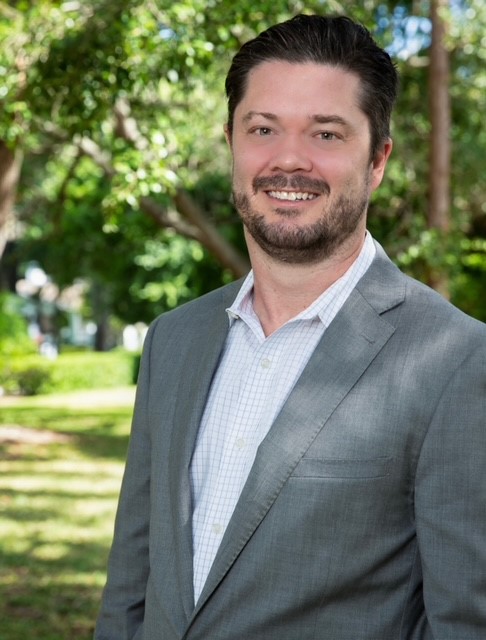
In a recent “The Higher Ed Geek” podcast episode recorded live at ASU+GSV, host Dustin Ramsdell and ACE President and CEO Geordie Hyland explored how institutions can rethink affordability, operational efficiency and the student value proposition in ways that better serve today’s students. The episode then raised a larger question for higher education leaders: What would colleges and universities look like if affordability, student ROI and career relevance were treated as foundational design priorities instead of challenges to solve after the fact?
Affordable Graduate Degrees From Day One
ACE was founded in 2005 with the goal of creating a more affordable pathway to graduate education for working educators. Over time, that mission expanded beyond education programs to include business, nursing, healthcare and other professional fields, but the core operating principle remained the same: Affordability should be built into the institution itself, not added later as a financial aid strategy.
Today, ACE serves more than 14,000 active students and has continued to position affordability as part of its long-term model. Most of the college’s master’s degrees cost less than $10,0001 while doctoral degrees are available for less than $25,000.1 Additionally, 87% of ACE students graduate with no student debt.2
The episode with Hyland reinforced that affordability is not treated as a secondary initiative at ACE. It influences decisions across operations, program delivery and institutional strategy. In many ways, that focus reflects a broader shift happening across higher education as institutions face growing pressure to demonstrate clearer student ROI and long-term value.
Third party research solidified ACE’s proactive focus on ROI, estimating that for every $1 ACE students invest in their education, they receive $19.20 in higher future earnings.
Costs Based on Value, Not Borrowing Capacity
One of the most distinctive parts of ACE’s model is its decision not to participate in Title IV federal student loan programs. During the podcast conversation, Hyland discussed how dependence on federal funding and student borrowing can shape institutional pricing models across higher education.
Rather than designing programs around borrowing capacity, ACE built its model around what students can realistically afford. That approach connects closely with broader ideas around the long-term impact of student debt on career mobility and financial stability.
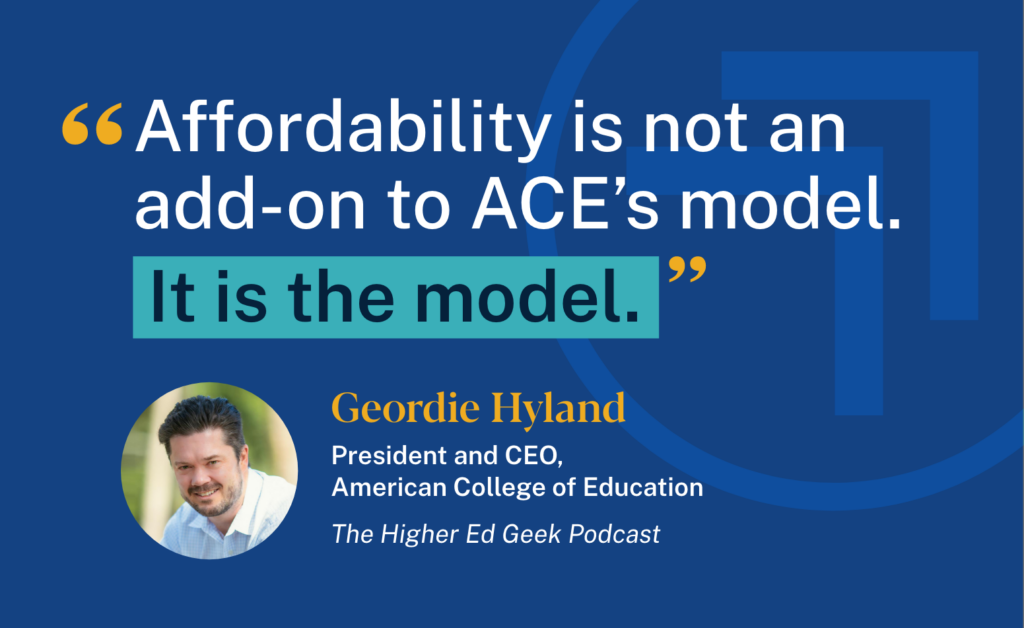
When programs are priced around what students can borrow, debt becomes part of the design. ACE flips that logic by pricing around what students can afford.
Geordie Hyland, ACE President & CEO
Learn More About Our ProgramsThe larger takeaway in this episode is that higher education leaders may need to examine how pricing decisions connect to student outcomes. When affordability becomes part of institutional design as opposed to a downstream concern, it can change how programs are built, delivered and evaluated.
Online Learning: A Cost and Quality Strategy
ACE’s fully online structure was another major topic of discussion. Hyland emphasized that online education is not simply about convenience. When designed intentionally, it can also support affordability, operational efficiency and stronger student support.
For adult learners balancing careers and personal responsibilities, graduate programs with online coursework create greater flexibility while allowing institutions to track student progress, identify challenges earlier and continuously improve the learning experience. Instead of treating online learning as a compromise, ACE positions it as a strategic model built around accessibility and student success.
In-House Curriculum and Faster Feedback Loops
Another important part of ACE’s approach is its decision to develop curriculum internally rather than relying heavily on outside publishers. During the podcast, Hyland described how curriculum ownership gives institutions greater flexibility to update programs, respond to workforce trends and maintain stronger alignment with employer needs.
Building curriculum in-house can also help reduce content costs while creating faster feedback loops between faculty, students and institutional leaders. Because courses are continuously reviewed and updated, programs can evolve alongside industry expectations instead of remaining tied to slower publishing cycles.
ACE’s model also emphasizes practitioner-informed instruction, helping ensure coursework remains practical and career relevant for adult learners already working in their fields. This student-centered approach connects closely with ACE’s broader focus on continuous improvement and responsive online learning design.
Employer Partnerships Support the Student Experience
Employer partnerships were another central theme Ramsdell and Hyland explored. ACE works with school districts, healthcare organizations and other employers to help create pathways that support both workforce development and student advancement.
These partnerships create value across multiple groups. Students benefit from career-connected learning opportunities that align with real workforce needs. Employers gain opportunities to support, retain and upskill employees. Institutions also receive direct feedback that can help strengthen curriculum relevance and student outcomes over time.
The discussion reinforced the idea that career relevance becomes stronger when institutions remain closely connected to the industries and communities their students already serve. For adult learners especially, education is often tied directly to professional growth, advancement and long-term career mobility.
What Traditional Institutions Can Learn
Hyland and Ramsdell probed broader questions about higher education cost structures and institutional priorities. The discussion focused on how institutions can evaluate whether their operational decisions directly support student value.
That conversation raises important questions for higher education leaders:
- Are programs priced around student value or borrowing capacity?
- Which costs directly improve teaching, learning and student outcomes?
- Do programs demonstrate clear ROI for students?
- Are employer needs meaningfully informing curriculum and program design?
The larger lesson is not that every institution should look the same but that higher ed may need to rethink long-standing assumptions about cost and student value.
Student ROI should not be a vague promise. It should be something institutions can calculate, validate and improve.
Geordie Hyland, ACE President & CEO
Learn More About Tuition and ROI at ACEThe Human Impact of Student Debt
Toward the end of the episode, Hyland returned to a broader point that continues to shape national discussions around higher education affordability: the long-term impact of student debt. While debt is often discussed through institutional metrics and policy debates, its effects extend far beyond monthly payments.
For many graduates, student debt influences career choices, family planning, homeownership and decisions about pursuing additional credentials. It can shape professional opportunities and financial stability for years after graduation. For adult learners already balancing work and personal responsibilities, affordability can determine whether continuing education feels possible at all.
The discussion framed affordability as something larger than a pricing strategy. It is closely tied to access, opportunity and long-term student success. As higher education leaders continue evaluating the future of the industry, the question may not simply be what students are willing to pay, but whether institutions are creating models that genuinely improve students’ lives.
Student Value as the North Star
Throughout the conversation, one specific idea was made clear: Higher education institutions should remain focused on the student value proposition. As concerns around affordability, graduate student debt and ROI continue shaping the future of higher education, institutions are being challenged to evaluate their models’ support of long-term student success.
ACE’s approach demonstrates that affordability, quality, employer relevance and strong student outcomes do not have to compete with one another. With the right operating model, those priorities can work together to create more accessible and career-connected pathways for adult learners.
American College of Education offers affordable programs designed for working adults to advance their careers without breaking the bank.
1This is an estimated value of the cost for tuition and fees. Amounts may vary depending on number of transfer credits applied to the selected program hours, the pace and satisfactory completion of the selected program, receipt of institutional scholarship and/or grant amounts, or adjustments to tuition or fees as described in the Catalog Right to Modify Tuition section. State sales and use tax will apply where required by law.
2Internal research completed in November 2025