Higher education is facing growing pressure to demonstrate its value. Rising tuition costs, increasing student debt and rapid advances in artificial intelligence (AI) are prompting institutions to rethink how they serve students and prepare them for the workforce.
These challenges were the focus of a recent conversation between Dr. J.P. Novan and American College of Education (ACE) President and CEO Geordie Hyland on The Plexuss Presidential Podcast. Drawing on ACE’s experience serving adult learners, Hyland shared his perspective on affordability, career-focused education, online learning and the role AI may play in the future of higher education.
A Student-Centered Model Built for Working Adults
Founded to Help Busy Professionals Succeed
Since being founded in 2005, ACE has focused on serving working professionals balancing education with careers, family responsibilities and other commitments. Unlike many traditional institutions that expanded into online learning after establishing a campus-based model, ACE was designed as an online institution from the beginning.
That distinction shapes the student experience. Many ACE students are teachers, nurses, education leaders and other professionals who are working full time while pursuing advanced education. As Hyland explained, ACE’s goal is to help these students advance in their careers without stepping away from the responsibilities they manage every day.
Affordability as a Foundational Strategy
Affordability is a central part of ACE’s approach to higher education, reflecting growing demand for affordable online degrees that support career advancement without significant debt. Hyland noted that most master’s degree programs cost less than $10,0001, while doctoral programs are available for less than $25,000.1
He also shared that many students pay for their education term by term rather than relying on loans. As a result, 87% of ACE students graduate without student debt.2
At a time when student debt continues to shape conversations about the value of higher education, ACE’s model reflects a different approach to helping working adults advance their education and careers.
Student Value as a Top Priority
Throughout the podcast, Hyland argued that higher education institutions should remain focused on the outcomes students receive from their investment of time and money.
That philosophy influences how ACE operates. Hyland noted that the institution does not participate in federal Title IV student aid programs, a decision that aligns with its emphasis on affordability and limiting student debt.
He also challenged institutions to consider whether they’re optimizing for the student value proposition or the institutional value proposition, arguing that affordability, quality and outcomes should remain central to the higher education experience.
Why Higher Education’s Value Proposition Is Being Questioned
Declining Public Confidence in College
Hyland noted that public confidence in higher education has declined in recent years, citing survey data that shows growing skepticism about the value of a college degree.
For colleges and universities, that skepticism presents a challenge: how to clearly demonstrate the value they provide to students.
Student Value Proposition vs. Institutional Value Proposition
Hyland drew a distinction between the student value proposition and the institutional value proposition. He argued that students are increasingly focused on outcomes, including career advancement, earning potential and the skills needed to succeed in the workforce.
For Hyland, return on investment is one way to measure that value. He pointed to third-party research that found that ACE students receive an estimated $19.20 in future earnings for every $1 invested in tuition.
Making Debt Part of the Conversation
Hyland challenged higher education leaders to look beyond debt relief and examine the factors that contribute to student borrowing in the first place.
While debt relief remains important for many graduates, Hyland pointed to recent policy debates around borrowing limits for teachers and nurses as an example of how higher education often focuses on managing debt after it occurs rather than proactively reducing the need for debt.
Career-Focused Education and Workforce Alignment
Programs Designed for Career Advancement
Hyland emphasized that education should support career progression, not simply serve as a standalone credential. He highlighted several pathways at ACE that are designed to help working professionals advance in their fields.
For educators, that may mean moving from a paraprofessional role into the classroom, earning a master’s degree or pursuing credentials that support advancement into school and district leadership. For nurses, it can mean developing the leadership and management skills needed to move into new roles within healthcare organizations.
Feedback That Keeps Curriculum Relevant
Hyland explained that ACE maintains relationships with thousands of employer partners and uses their feedback to inform curriculum development and continuous improvement efforts.
As workforce needs evolve, those employer insights help ensure programs remain relevant and aligned with the skills students need to advance in their careers.

Given the changes in technology, employer expectations are changing for employees, and we train employees. So, making sure we're getting that strong feedback loop from employers and quickly infusing it into our curriculum helps us maintain relevance and our student value proposition.
Geordie Hyland, ACE President & CEO
Connecting Learning to Real-World Practice
Hyland emphasized the importance of connecting coursework to real-world practice. He noted that assignments and learning activities should help students apply new concepts directly to their jobs rather than treat education as something separate from their professional responsibilities.
For working adults, that immediate application can make learning more relevant while helping them develop skills they can use in their careers right away.
Online Learning Requires Intentional Design
Online Education vs. Emergency Virtual Learning
Hyland drew a clear distinction between intentionally designed online learning and what many institutions delivered during the early stages of the COVID-19 pandemic, which he described as “emergency remote learning.”
While that rapid shift helped students continue their education, Hyland pointed out that effective online learning requires much more than moving classroom instruction to a virtual environment. High-quality online programs are intentionally designed to support learning, engagement and student success.
Centralized Curriculum and Continuous Improvement
One of the advantages of a purpose-built online institution is the ability to take a centralized approach to curriculum development. ACE develops curriculum internally, allowing academic teams to align course content with learning outcomes and make updates as workforce needs evolve.
Hyland also highlighted the role of continuous improvement. Feedback from students, faculty and employer partners helps inform curriculum updates and supports the ongoing relevance of ACE programs.
Faculty as Practitioners and Student Supporters
Hyland emphasized that faculty remain central to the online learning experience. ACE uses a practitioner faculty model, meaning instructors bring real-world professional expertise into the classroom and help connect course concepts to workplace application.
He also noted that faculty have visibility into student engagement and progress through the college’s learning management system. That insight can help instructors identify challenges early and provide support when students need it most.
AI in Higher Education: From Disruption to Opportunity
AI Literacy in Career Readiness
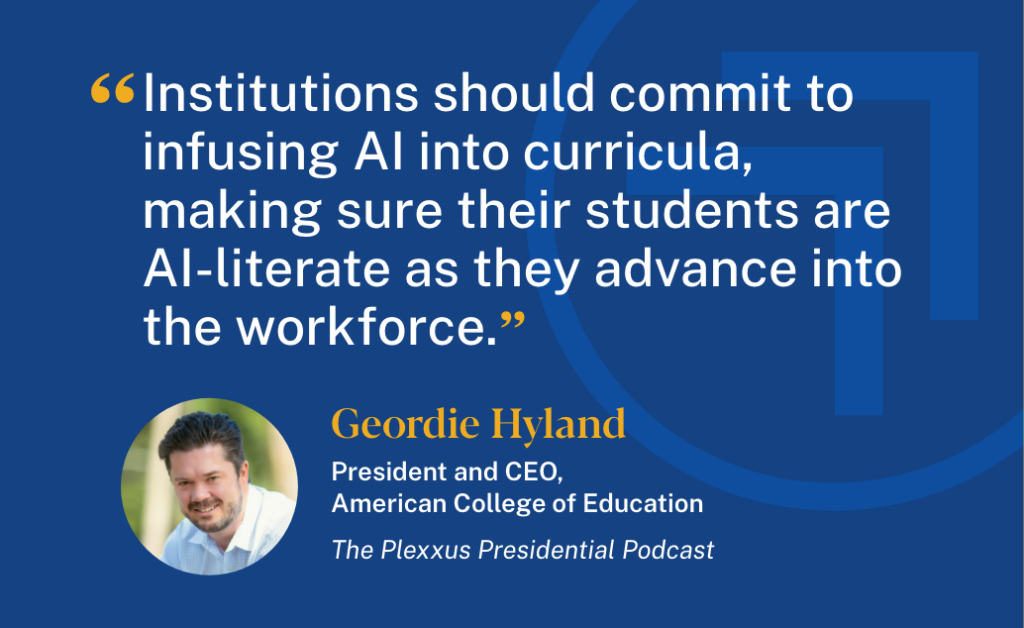
Hyland emphasized that higher education institutions have a responsibility to prepare students for a workforce increasingly shaped by AI. As organizations adopt these tools across industries, AI literacy is becoming an important part of career readiness.
That preparation goes beyond understanding how AI works. Students also need to learn how to use it responsibly, evaluate outputs and apply professional judgment when incorporating it into their work.
AI Integration for University Operation Efficiency
Hyland discussed several ways AI can support university operations, including helping prospective students navigate the enrollment process, supplementing student support services and reducing administrative burdens.
He also noted that AI can help institutions access and analyze data more efficiently, making it easier to identify trends and respond to challenges. Ultimately, Hyland sees AI as a tool that can free faculty and staff to focus more of their time on supporting students and other high-value work.
The overall vision is to take off as much administrative work as possible, so our faculty can focus on supporting students and also for staff to be able to focus as much as they can on valuable tasks.
Geordie Hyland, ACE President & CEO
AI and Rethinking Assessment
As AI tools make it easier to generate polished work, educators face new questions about how to evaluate student learning and demonstrate mastery.
Hyland emphasized the importance of assessing reasoning, originality, process and application rather than focusing solely on finished outputs. He also highlighted backward design and scaffolded learning as ways to help students develop and demonstrate mastery over time.
Lifelong Learning as a Career Requirement
Continuous Upskilling for Working Professionals
Hyland shared how lifelong learning is becoming increasingly important as AI and other technologies continue to reshape the workplace. He pointed specifically to educators, who must adapt to new tools, changing student behaviors and evolving expectations.
How Credit for Prior Learning Reduces Barriers
Hyland discussed ACE’s approach to evaluating professional development experiences and awarding credit for prior learning when academically appropriate. By recognizing learning that has already occurred, institutions can help students reduce the time and cost required to complete a degree.
Creating Opportunities to Build on Prior Learning
Hyland also emphasized the importance of creating pathways that build on prior learning. Rather than treating each credential as a separate destination, ACE designs programs that can support continued academic and professional growth. Students in select master’s programs can transfer credits into a doctoral program, helping reduce both the time and cost required to earn an advanced degree.
A Student-Centered Vision for the Future of Higher Education
The conversation between Dr. J.P. Novan and Geordie Hyland underscored the importance of keeping students at the center of higher education. From affordability and career advancement to AI readiness and lifelong learning, Hyland repeatedly returned to the idea that institutions should focus on the value they deliver to students.
As higher education continues to evolve, students are likely to place greater emphasis on outcomes, flexibility and return on investment. Institutions that can help learners build skills, advance their careers and pursue continued education without taking on significant debt may be better positioned to meet those expectations.
For Hyland, that future begins with a simple question: Are institutions focused on the student value proposition or the institutional value proposition? The answer may play an increasingly important role in shaping the future of higher education.
FAQs
What was the main topic of the podcast episode?
The episode explored how higher education can remain relevant in a rapidly changing environment. Dr. J.P. Novan and Geordie Hyland discussed affordability, student debt, AI, workforce readiness and why institutions may need to place greater emphasis on student outcomes, career mobility and lifelong learning.
Why is affordability important in higher education?
Many students are weighing the cost of a degree against the opportunities it can create. Lower-cost programs can make higher education more accessible while helping students pursue career advancement without taking on significant debt.
How is AI changing higher education?
AI is changing how institutions teach, assess learning and support students. It’s also creating new opportunities to streamline administrative processes, improve access to data and prepare students for workplaces where AI literacy is becoming increasingly important.
What makes high-quality online learning different from Zoom-based remote learning?
High-quality online learning is intentionally designed to support student success. Rather than simply moving classroom instruction online, it relies on thoughtfully developed curriculum, engaged faculty, clear learning outcomes and ongoing course improvement.
Why is lifelong learning becoming more important?
As technology and workplace expectations continue to evolve, professionals need ongoing opportunities to build new skills and stay current in their fields. Lifelong learning supports career growth by helping individuals adapt to change and prepare for new opportunities.
American College of Education is committed to offering an accessible, high-quality education that working professionals can fit in their budgets and schedules. Explore programs that can support your career growth both now and in the future.
1This is an estimated value of the cost for tuition and fees. Amounts may vary depending on number of transfer credits applied to the selected program hours, the pace and satisfactory completion of the selected program, receipt of institutional scholarship and/or grant amounts, or adjustments to tuition or fees as described in the Catalog Right to Modify Tuition section. State sales and use tax will apply where required by law.
2Internal research completed in November 2025