

As artificial intelligence (AI) rapidly infiltrates society, it’s safe to say it’s no longer a futuristic concept in today’s workforce. AI in nursing is already embedded throughout healthcare practice in tools used every day, like electronic health records, clinical decision support, predictive analytics, smart documentation and patient engagement platforms. The question healthcare leaders and educators are asking is what responsible AI in healthcare looks like in real-world clinical settings.
American College of Education (ACE) hosted an insightful conversation with a panel of three nationally recognized nurse informatics leaders who are actively addressing responsible AI innovation in healthcare. National healthcare thought leader and ACE Ed.D. candidate Geoffrey Roche joined ACE Senior Manager of Strategic Partnerships Karilyn Van Oosten in facilitating the discussion led by the panelists:
- Dr. Olga Kagan, RN, FHIMSS, FIEL: Nurse and healthcare innovation leader who teaches graduate nursing informatics and helped shape the Healthcare Information and Management Systems Society (HIMSS) Five Rights of AI framework for healthcare professionals
- Dr. Mary Joy Garcia-Dia, RN, FHIMSS, FAAN: Nurse informatics leader, fellow of the American Academy of Nursing and 2025 HIMSS Changemaker honoree for her contributions to healthcare information technology
- Dr. Kathleen McGrow, MS, RN, PMP, FHIMSS, FAAN: Global chief nursing innovator officer at Microsoft and author of “Empowering Nurses with Technology: A Practical Guide to Nursing Informatics”
Together, they moved the conversation past the hype and into practical applications of AI in nursing at the bedside and across healthcare operations.
This blog post is inspired by the Healthcare Leadership Webinar Series hosted by ACE. We invite readers to view this impactful discussion.
Building AI Literacy: Everyone Starts as a Novice
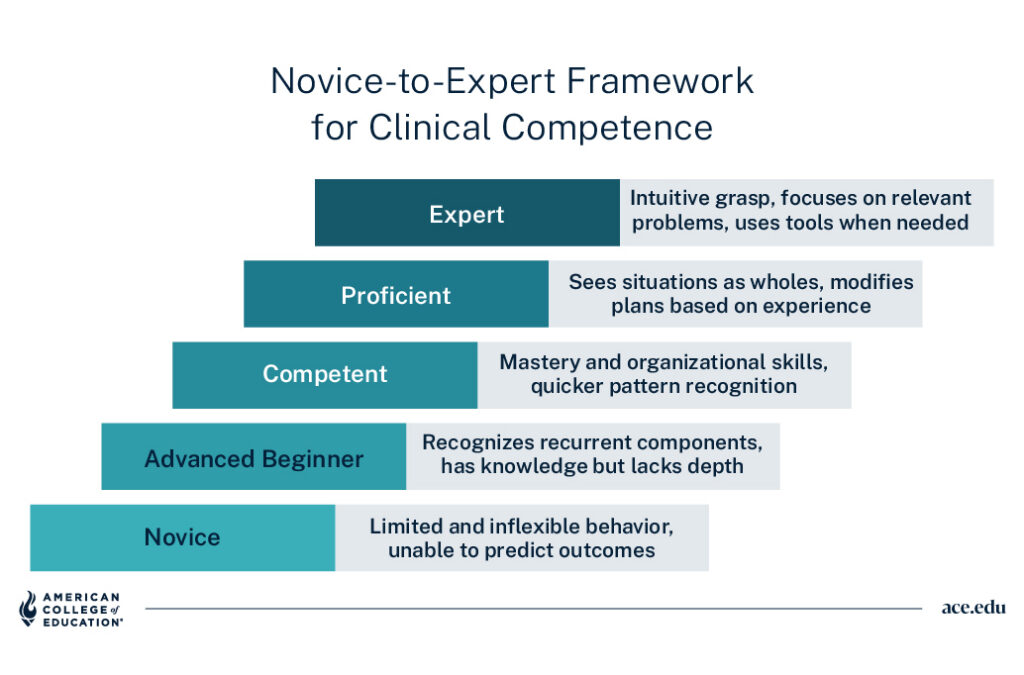
The panel opened with a reassuring premise, borrowed from nursing theorist Dr. Patricia Benner’s novice-to-expert framework that demonstrates the stages of clinical competence. AI literacy doesn’t develop overnight, but no matter where a nurse may be in their career, everyone starts as a novice.
For example, a nurse with more than 35 years of critical care experience can be a recognized expert clinician and still be a novice with AI tools. Similarly, a nursing doctoral student can have advanced clinical reasoning while discovering what AI can and cannot do.
For undergraduate students, that journey starts with foundational AI literacy and safe, supervised use. For graduate and advanced-practice learners, it expands into critical appraisal, implementation and leadership. The goal is to progress through the following stages of the novice-to-expert AI nursing competence model:
- Novice
- Advanced beginner
- Competent
- Proficient
- Expert
From Data to Wisdom: Developing AI Clinical Competence
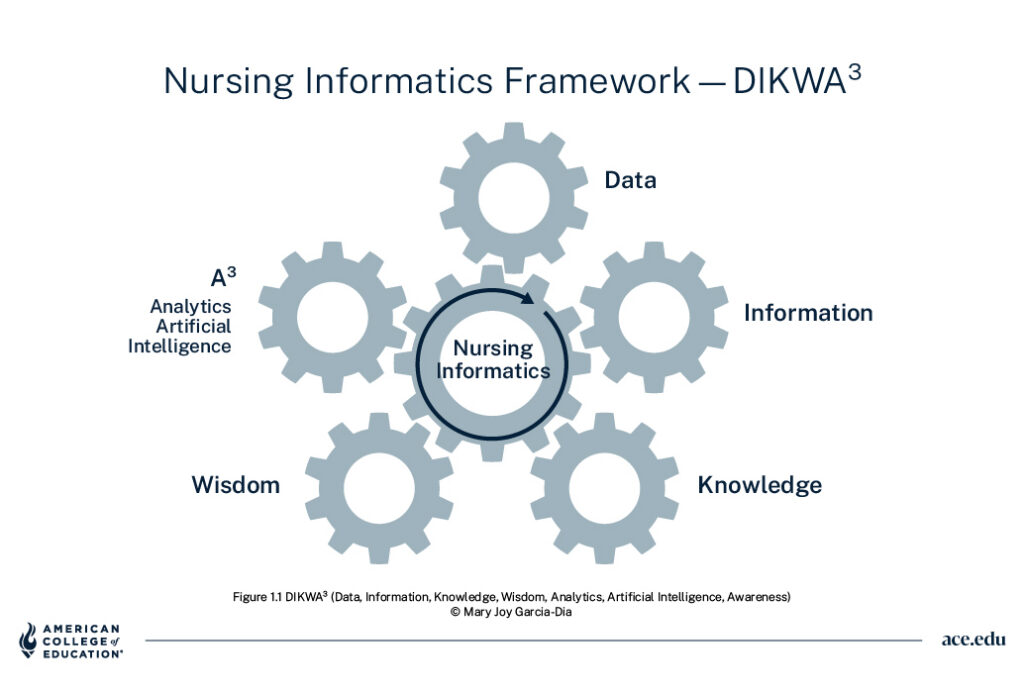
Garcia-Dia grounded the discussion in the Data-Information-Knowledge-Wisdom (DIKW) continuum, a framework that drives nursing informatics and asserts that:
- Data becomes information when it is given context
- Information becomes knowledge when patterns emerge
- Knowledge becomes wisdom when a clinician applies judgment, experience and ethical reasoning to make a decision
AI accelerates the climb from data to knowledge in simple, practical ways. For example, it can process vital signs, lab values and documentation faster and identify patterns nurses might otherwise miss. However, it’s critical to remember that AI does not have the human wisdom that nurses have. Nurses are able to understand a patient’s preferences, context and culture — capabilities that remain uniquely human.
Garcia-Dia also shared an expanded model she began developing in 2015, DIKWA³, which adds analytics, AI and awareness to the original framework. These layers reflect how nurses now work inside a digital ecosystem that still depends on human situational judgment.
Successful AI Integration Largely Depends on Data Quality
The panel unanimously agreed that AI is only as good as the data behind it. Every assessment, medication administration record and documentation entry feeds the data ecosystem that trains these systems. This means that incomplete or inconsistent documentation, as well as how demographics and populations are represented, can bake data quality and bias issues in healthcare directly into AI models.
It’s paramount for healthcare professionals to remember a simple phrase: garbage in, garbage out. Once bias enters the data layer, it’s difficult to fully correct it downstream. For nurse educators, that positions documentation competency as a teaching priority. Quality charting is not just a record of care. It’s providing training data for the next iteration of clinical AI.
The Five Rights of AI in Healthcare
To help teams evaluate any new AI tool, Kagan walked through a framework adapted from the familiar five rights of medication administration. It’s designed deliberately to feel intuitive to nurses.
- Right objective: Are we solving the right problem for the right population?
- Right approach: Does the tool fit the existing workflow, or would it be disruptive?
- Right competency: Do we have the governance, oversight and internal expertise to use this responsibly?
- Right data: Is the underlying data trustworthy, complete and reflective of the population it will serve?
- Right outcomes: Are we measuring what actually matters?
On data specifically, Kagan pointed out that patient populations differ significantly even within the same city. For example, a trauma center, pediatric unit or cancer hospital should have models trained to serve the populations and needs they actually see.
Where Nursing Informatics Already Show Up
McGrow outlined how AI touches nearly every part of the healthcare workflow, not just the clinical side.
- Clinical: Ambient documentation that reduces charting burden, decision support and risk stratification at the point of care providing imaging triage and early-warning alerts for conditions like sepsis or patient deterioration
- Operational: Scheduling, patient flow optimization and revenue cycle as well as administrative automation, staffing forecasts and supply-chain efficiency
She advised evaluating any use case, because AI tools should support people and existing workflows. They aren’t remedies for operational challenges. For every application, leaders should ask:
- What problem is being solved?
- Who benefits?
- Where is human judgment needed in the process?
AI Governance in Healthcare Is Non-Negotiable
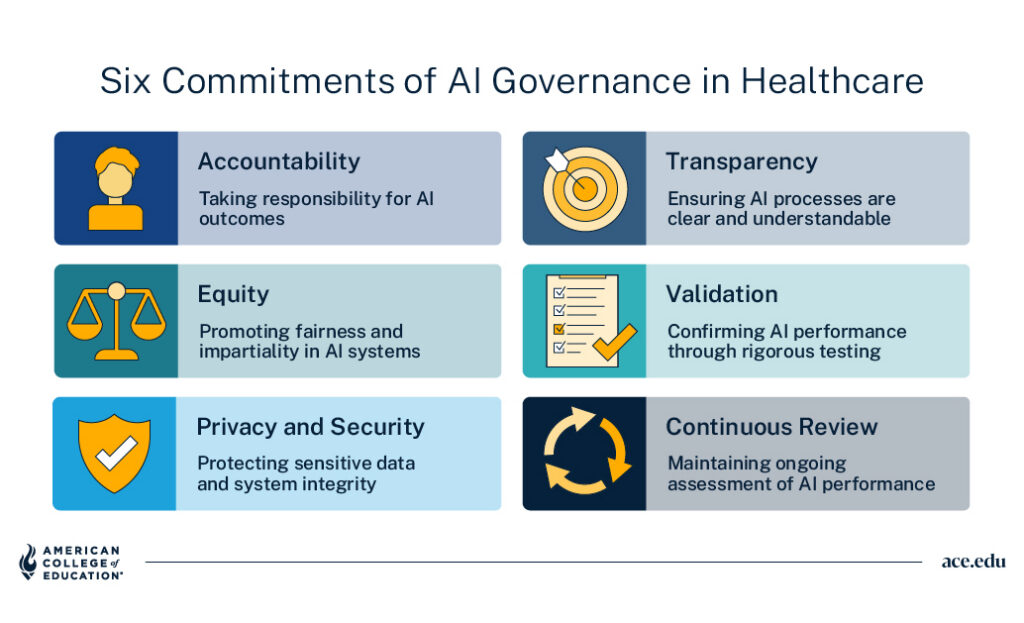
McGrow emphasized that responsible AI in healthcare involves far more than good intentions. It requires a governance model built on six commitments:
- Accountability
- Transparency
- Equity
- Validation
- Privacy and security
- Continuous review
Clear ownership, human oversight and continuous testing are paramount for successful AI integration, because workflows, data and model performance all change over time. Effective governance procedures only translate into real adoption when organizations also invest in change management.
To encourage AI adoption in a healthcare workforce, leaders can follow five steps:
- Start with the problem, not the technology.
- Involve the frontline early because the people closest to the workflow can easily identify barriers.
- Build AI literacy for nurses and other staff so they can use tools confidently and know when to question a recommendation.
- Earn trust through transparency about what a system can and cannot do.
- Iterate and sustain. Adoption is a journey, not a launch event.
Prioritize Expert Human Oversight
Kagan emphasized the importance of having not just anyone overseeing AI integration. It should be someone with real clinical expertise that enables them to recognize when AI recommendations are wrong. This is why developing expertise in the next generation of nurses matters so much before leaning on AI tools independently.
At the end of the day, nurses bear the responsibility for quality patient care, regardless of technological advancements. Even if a blood pressure reading came from an AI-enabled device, an unexpected result should still trigger a nurse to check the cuff size and placement then retake the reading before acting on it.
AI in Nursing Education: How Faculty Should Respond
The panel closed by looking at how AI is reshaping roles across healthcare. For example, the industry is seeing hybrid positions like AI champions and nurse informaticist roles that bridge care delivery and technology. Some positions require an expanding skillset built around AI and data literacy as opposed to data science. There’s also an expectation for leaders to actively evaluate and govern AI rather than simply approve its use.
Such roles indicate a response from nursing education. For nursing faculty and leaders wondering how to teach AI in nursing curricula, Kagan mentioned that failing to do so contributes to holding the profession back from technological advancement. Her broader point was about agency, not urgency for its own sake. Nurses need a seat at the table where these tools are designed, or the tools will be built without them.
American College of Education offers affordable nursing programs designed to equip registered nurses with the clinical expertise, advanced skills and evidence-based practices needed to lead in healthcare. With fully online coursework and a local practicum, these programs help busy nurses pursue career growth in a manageable way.