

A seasoned executive makes a strategic decision based on years of experience. Months later, the strategy falls short — not because the leader lacked expertise but because the market changed faster than their intuition could keep pace.
It’s a scenario playing out more often as organizations navigate artificial intelligence (AI), shifting customer expectations and constant disruption. Experience still matters, but experience alone isn’t always enough.
Should leaders trust their instincts or the growing volume of data available to them?
Think of it this way instead: Research isn’t replacing intuition. It’s providing discipline.
Applied research is no longer just an academic skill. It’s becoming a defining competency of modern C-suite decision making, helping leaders generate and use evidence-based decision making in business.
The Case for Evidence: Why Intuition Alone Is No Longer Enough
Business leaders have long been encouraged to trust their instincts. In many cases, that’s well-earned. The strongest leaders develop remarkable judgment over years of navigating uncertainty, leading people and solving difficult problems. Those instincts are often the product of pattern recognition built through experience.
The value of experience hasn’t changed, but the environment has.
Markets shift faster than they once did. Customer expectations evolve quickly. New competitors emerge with little warning, and AI is accelerating the pace of change across nearly every industry. The assumptions that informed a successful decision a few years ago may no longer hold true today.
That raises the cost of relying on instinct alone. A missed market signal, a poorly timed investment or a product launch based on outdated assumptions can have consequences that ripple across an entire organization. Experience remains essential, but experience by itself can’t always account for conditions that didn’t exist the last time a leader faced a similar decision.
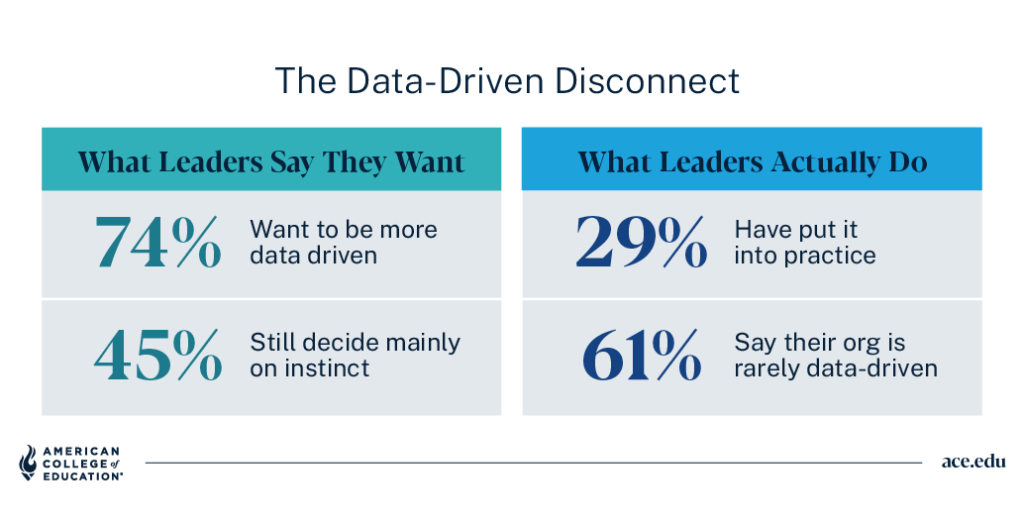
Most executives recognize this shift. According to Qlik, roughly 45% of C-suite leaders still make major business decisions based primarily on intuition, while 61% say their organizations are only slightly or rarely data-driven. At the same time, Forrester reports that 74% of business leaders want to become more data-driven, but only 29% have successfully put that goal into practice.
Data-driven culture in organizations leads to making decisions five times faster, according to HydrogenBI. Speed, in this context, comes from knowing how to interpret evidence and move forward without waiting for perfect certainty.
The challenge with data is knowing how to ask the right questions, evaluate the quality of the evidence and separate meaningful insight from background noise. As AI and predictive analytics put increasingly sophisticated tools into leaders’ hands, those skills are becoming just as important as the data itself.
The organizations that succeed won’t necessarily be the ones with the most information. They’ll be the ones led by people who know how to use it and have evolved their decision intelligence.
Applied Research and Why It Matters in the C-Suite
Applied research has an image problem. For many professionals, it brings to mind academic journals, statistical models and lengthy dissertations.
If you actually look at how leaders use data to make decisions, most executives already use pieces of applied research. They just don’t think of it that way.
Consider an organization preparing to enter a new market. An executive could rely on experience and instinct alone, or they could examine customer demand, analyze competitors, benchmark financial performance and assess potential risks before making the investment.
The same approach can guide a product pivot, inform a workforce restructuring or help leaders evaluate a major acquisition. Every one of those decisions is rooted in the principle of applied research: Gather evidence before committing to a course of action.
Every executive has faced a decision that couldn’t be settled by experience alone, which is where applied research in business earns its value. While academic research often focuses on expanding knowledge, applied research focuses on solving real-world challenges. It begins with an organizational question and works toward research-informed strategies that leaders can actually put into practice. The goal isn’t to discover something interesting; it’s to discover something useful.
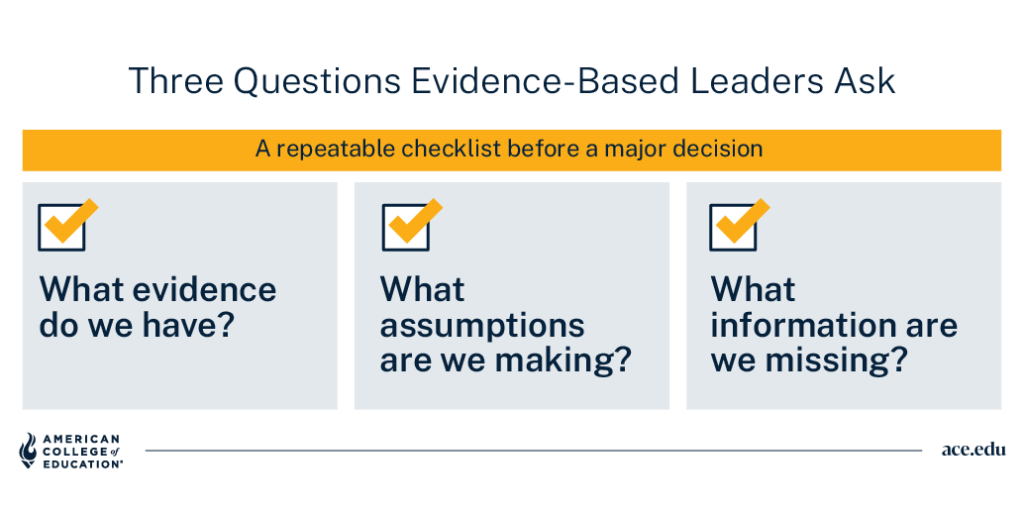
More importantly, applied research is a leadership mindset. It changes the questions leaders ask before making important decisions. Instead of beginning with, “What do I think?” they begin with, “What does the evidence tell us?” They ask: What evidence do we have? What assumptions are we making? What information are we missing?
Those questions don’t eliminate uncertainty, but they give leaders a more disciplined way to navigate it.
Access to information isn’t where most organizations struggle anymore. The challenge is knowing what to trust and what to do with it.
The Research Advantage: What Evidence-Based Leaders Do Differently
Instead of asking, “How do we prove this idea is right?” an evidence-based leader is more likely to ask, “What evidence would tell us we’re wrong?” They treat decisions as hypotheses to be tested rather than conclusions to defend.
That shift changes the conversation. It encourages curiosity over confirmation and creates space for assumptions to be challenged before they become costly mistakes.
Evidence-based leaders also know that having more data isn’t the same as having better information. Dashboards, AI-generated insights, business leadership and data analytics are tools executives use to make decisions. The advantage doesn’t come from having access to those tools but from knowing what deserves trust and what deserves scrutiny.
That means asking where the data came from, how it was collected and whether the evidence is strong enough to support a strategic decision. Rather than accepting information at face value, they evaluate source credibility, consider methodology and distinguish meaningful signals from background noise.
They also know how to synthesize information. Executive decisions rarely hinge on a single report or dashboard. Leaders have to weigh financial performance alongside customer insights, operational realities, workforce considerations and market trends, then connect those inputs into a clear strategic direction.
So, when it comes to gut feeling vs. data in business leadership, think of it this way: Experience helps leaders interpret market signals, but evidence helps determine how much weight each one deserves.
That foundation allows them to move more decisively. They understand which evidence is sufficient to support a decision and which unanswered questions represent acceptable risk. Rather than waiting for complete certainty, they move forward with confidence, knowing they have a disciplined process behind their judgment.
Leaders who consistently model evidence-based thinking influence how their organizations operate. Evidence-based management strategies lead to teams asking better questions. Proposals become more rigorous. Assumptions are challenged more constructively, and decisions become more transparent because they’re supported by evidence rather than hierarchy or opinion. Over time, that mindset becomes part of the organization’s culture, helping teams learn faster, adapt more quickly and course-correct before small problems become larger ones.
The organizational impact can be substantial. Research cited by CTO Magazine found that data-driven companies were 23 times more likely to acquire customers, six times more likely to retain them and 19 times more likely to be profitable.
One executive who understands why leaders need research skills can change the way an entire organization thinks. Over time, that translates into better decisions, greater adaptability and a more resilient business.
The Integration Argument: Intuition Still Has a Seat at the Table
It might sound as though instinct has no place in executive leadership anymore, but that’s not the case.
Great leaders develop instincts for a reason. Years of leading teams, navigating uncertainty and making difficult decisions create pattern recognition that can’t be replicated by a dashboard or an AI tool. Judgment is still essential when reading people, understanding organizational dynamics or making decisions where the evidence is incomplete.
The difference is that effective leaders pressure-test their instincts. They look for evidence that supports or challenges their initial assumptions before committing to a course of action. Experience still plays an important role in deciding which questions to ask, recognizing when data misses something that’s happening inside an organization and making the final call when the evidence points in more than one direction. Research informs those moments, but leadership still requires judgment.
Good judgment depends on knowing when experience still applies and when it’s time to question it. In an environment defined by constant change, the leaders who consistently make strong decisions are the ones willing to challenge their own thinking before the market does.
How Graduate Education Builds This Competency
Data-driven leadership is developed through practice. Reading about research can introduce the concepts, but applying them to real business challenges is what builds confidence.
The strongest graduate business programs create opportunities for professionals to investigate real organizational problems, sort through competing information, learn business analytics for executives, analyze findings and present recommendations that can defend their recommendations in the boardroom. Those experiences mirror the kinds of decisions leaders face long after graduation.
Over time, that process changes how professionals approach uncertainty. Rather than searching for quick answers or relying on assumptions, they learn how to define a problem, gather credible evidence and make informed recommendations even when every variable can’t be controlled.
One of the clearest differences is how professionals approach uncertainty after engaging in applied research. They become more comfortable asking difficult questions, more confident evaluating competing perspectives and better equipped to explain not only what they recommend but why they recommend it. Those capabilities become increasingly valuable as organizations navigate AI, economic volatility and constant change.
Doctor of Business Administration (DBA) programs are designed to strengthen those capabilities by asking experienced professionals to investigate complex challenges drawn from their own organizations and industries. The research is intended to produce practical insights that leaders can apply in the workplace, helping them address real business problems and practice predictive analytics leadership while contributing meaningful knowledge to their field.
As organizations continue to reward leaders who can turn ambiguity into direction, applied research is becoming a career advantage that extends well beyond the classroom.
A Call to Action for Today’s Executives
The expectations placed on today’s executives look very different than they did a decade ago. Experience, intuition and decisiveness remain essential leadership qualities, but they’re no longer enough on their own. Organizations need leaders who know how to make better business decisions with research to evaluate evidence, navigate ambiguity and make strategic decisions with confidence, even as the business landscape continues to shift.
That requires strengthening instinct with a disciplined approach to asking questions, testing assumptions and applying research where it matters most.
For leaders preparing for the next stage of their careers, developing those skills is one of the highest-leverage investments they can make. Whether that happens through intentional practice, graduate education or applied research in the workplace, the ability to turn evidence into action is becoming an increasingly valuable leadership advantage.
As you consider your own approach to decision-making, ask yourself one question: Is your process as rigorous as the stakes require?
American College of Education’s fully online and affordable Doctor of Business Administration program can prepare experienced professionals to become high-level leaders with strong skills in analytical thinking, data-driven problem-solving and using applied research to make strategic decisions.