

|
Getting your Trinity Audio player ready...
|
Nursing theories serve as a guide for nurses when providing care and making clinical decisions. They offer a framework for assessing patient needs, developing appropriate interventions, and promoting positive health outcomes. Whether caring for patients in a hospital, clinic, school, or community setting, these theoretical frameworks support a consistent, patient-centered approach to care.
Nursing theories also shape nursing education, research, and professional practice by connecting theory to real-world care. They guide assessment, planning, interventions, and evaluation while helping nurses provide holistic care that addresses patients’ physical, emotional, and social needs.
Why Nursing Theories Matter
Nursing theories matter because they guide nursing practice and support quality patient care for all nurses. They provide a foundation that helps nurses make informed decisions, prioritize patient needs, and deliver care consistently and in an organized manner. By applying theoretical concepts to practice, nurses can provide evidence-based care that enhances clinical decision-making, promotes high-quality patient care, and improves health outcomes.
These frameworks also influence nursing education, research, and professional development by bridging the gap between knowledge and clinical application. They encourage critical thinking and help nurses provide safe, effective, and patient-centered care while addressing the diverse needs of the patients and communities they serve.
How Nursing Theories Guide Practice
Nursing theories influence how nurses assess patient needs, plan care, implement interventions, and evaluate outcomes. They help nurses identify factors that may affect a patient’s health and select appropriate nursing interventions based on individual needs.
By using proven frameworks, nurses can provide thoughtful, evidence-based care that supports patient well-being and improves health outcomes.
The Relationship Between Theory, Nursing Process, and Clinical Judgment
Nursing theories provide the conceptual framework for both the nursing process and the development of clinical judgment by assisting nurses in organizing, interpreting, and applying knowledge in practice. From assessment through evaluation, these frameworks help nurses identify patient needs, develop individualized care plans, and evaluate the effectiveness of interventions.
Using these theories alongside the nursing process, also known as the Nursing Clinical Judgment Model, promotes thoughtful, evidence-informed decision-making that is patient-centered, consistent, and adaptable to varied healthcare environments.
The Evolution of Nursing Theories
Nursing theories have evolved as the profession has grown and adapted to the changing needs of patients and communities. Today, they continue to guide patient care, nursing education, and clinical practice across a variety of healthcare settings.
Early Foundations of Nursing Theory
The development of nursing theory helped shape nursing into the profession it is today. As nurses took on greater responsibilities in healthcare, early nursing theories helped define the role of nurses and establish a foundation for modern practice. They also provided guidance for patient care and clinical decision-making.
The Role of Nursing Research
Nursing research advances the profession and improves patient care by identifying best practices and evaluating the effectiveness of interventions. It also helps ensure nursing care is supported by current evidence and reflects the evolving needs of patients and communities.
Grand Nursing Theories
Grand nursing theories provide a broad perspective on nursing practice, patient care, and health. Rather than focusing on specific clinical situations, they establish a foundation for understanding the nursing profession and continue to influence nursing education, research, and practice.
Characteristics of Grand Nursing Theories
These theories are broad in scope, focusing on the relationships among nursing, health, patients, and the environment. Rather than addressing a specific condition or clinical situation, they explain the fundamental concepts that shape nursing. A defining characteristic of grand nursing theory is that every theory addresses four concepts – person, health, environment, and nursing – in some interrelated way.
How Grand Theories Influence Nursing
The impact can be seen throughout the nursing profession, especially in nursing education, research, and the development of professional standards. By providing a broader understanding of patient care, they continue to influence how nurses approach their practice.
Middle-Range Nursing Theories
Middle-range nursing theories were developed to address specific areas of patient care. Unlike broader nursing frameworks, they focus on concepts nurses encounter in everyday practice and can be applied to real-world situations.
Characteristics of Middle-Range Nursing Theories
A key feature of middle-range nursing theories is their focus on specific aspects of patient care. Rather than addressing nursing as a whole, they concentrate on situational concepts, behaviors, or experiences that affect health. Their practical approach makes them useful for guiding nursing practice, supporting research, and improving the quality of patient care.
Examples of Areas Addressed by Middle-Range Theories
These theories have been used to better understand topics such as patient comfort, health promotion, chronic disease management, and communication. They help nurses identify factors that may affect health and develop strategies to address patient needs.
Their practical nature makes them valuable across a variety of healthcare settings and patient populations.
Influential Nurse Theorists
Florence Nightingale
Florence Nightingale is often referred to as the founder of modern nursing. She recognized that factors like cleanliness, fresh air, nutrition, and a safe environment could influence a patient’s recovery.
Her work established standards for patient care that continue to influence nursing practice today.
Virginia Henderson
Virginia Henderson believed one of the primary goals of nursing is to help patients achieve as much independence as possible. She emphasized assisting individuals with activities they would perform on their own if they had the strength, knowledge or ability.
Her ideas continue to support patient-centered care by encouraging nurses to promote patient independence whenever possible.
Dorothea Orem
Dorothea Orem’s work focused on the importance of self-care and patient independence. She believed patients should be encouraged to participate in their own care whenever possible.
Her theory reminds nurses that education and support help patients manage their health and make informed decisions.
Jean Watson
Jean Watson emphasized the human side of nursing and the importance of caring for patients as individuals. She believed compassion, empathy and meaningful nurse-patient relationships could have a positive impact on health and well-being.
Her work continues to remind nurses that caring is an essential part of quality patient care.
Hildegard Peplau
Hildegard Peplau recognized the importance of communication in nursing practice. She believed trust and collaboration between nurses and patients are essential to effective care.
Her theory highlights the value of building strong relationships that encourage patients to actively participate in their healthcare.
Examples of Nursing Theory in Practice
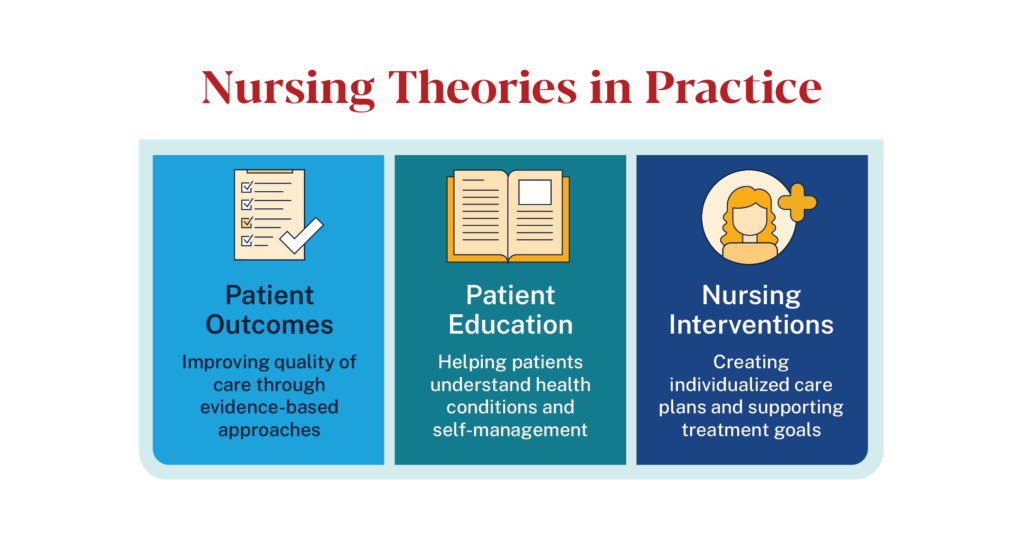
Nursing theories are evident every day, even if nurses don’t always realize they’re using them. These theories guide decision-making, patient education, and nursing interventions across a variety of healthcare settings.
Supporting Patient Education
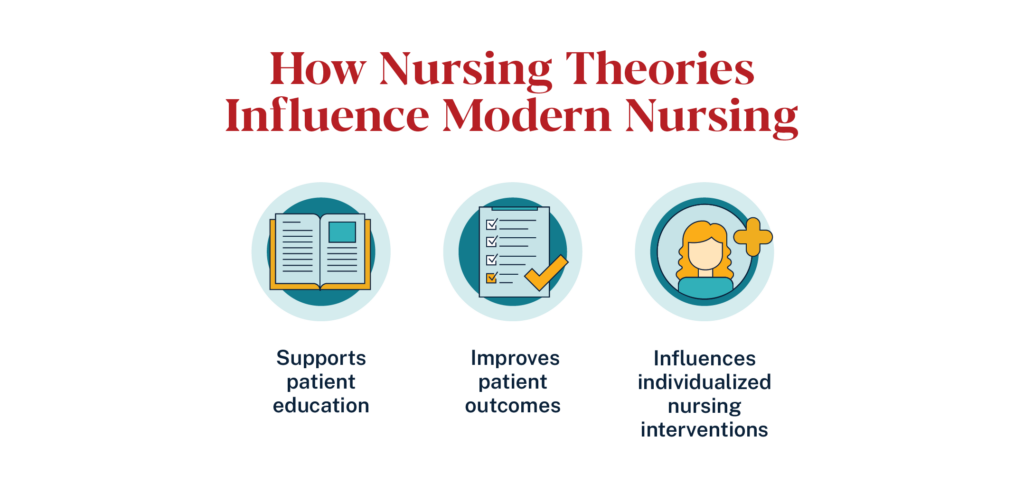
Patient education is one of the most practical applications of nursing theoretical frameworks. Models like Dorothea Orem’s Self-Care Deficit Nursing Theory encourage nurses to help patients develop the knowledge and confidence to manage their own health. Nurses apply these principles when explaining diagnoses, reviewing medications, and teaching lifestyle changes.
Developing Nursing Interventions
Individualized nursing interventions often stem from theories. By providing a framework for assessing physical, emotional, and environmental factors, they help nurses select interventions that address each patient’s unique needs.
Applying theoretical concepts throughout the nursing process helps nurses deliver consistent, evidence-informed care while adapting interventions as patient needs change.
Improving Patient Outcomes
Proven theoretical frameworks improve patient outcomes by supporting thoughtful clinical decision-making and consistent care. Applying these theories alongside evidence-based practice helps nurses enhance the quality of care.
How Nursing Theories Shape Modern Healthcare
Although many nursing theories were developed decades ago, they continue to influence modern healthcare. Their principles support patient-centered care, guide professional practice, and help nurses navigate increasingly complex healthcare environments.
Supporting Clinical Decision-Making
Theories guide assessments, prioritize patient needs and identify appropriate interventions. Using a theoretical framework also promotes consistency across healthcare settings, helping nurses evaluate changing conditions and provide coordinated care.
Advancing Nursing Education
Theories remain an important part of nursing education because they help students connect foundational knowledge to patient care. They also help nurse educators teach critical thinking, clinical judgment, ethical decision-making, and professional responsibility, preparing future nurses for a variety of healthcare settings.
Strengthening Professional Practice
Theories establish standards that strengthen professional practice. They provide a common approach for nurses, support accountability and reinforce the values that define the profession.
They also help nurses evaluate new evidence and refine their practice as healthcare continues to evolve.
Nursing Theories and Evidence-Based Practice
Nursing theories and evidence-based practice work together to guide patient care. While these frameworks provide a structure for understanding patient needs, evidence-based practice ensures nursing interventions are informed by current research, clinical expertise, and patient preferences.
Using Research to Inform Practice
Nursing research helps expand the profession’s understanding of effective patient care. By studying clinical outcomes, evaluating interventions, and identifying best practices, it provides evidence that nurses can apply in everyday practice.
Connecting Theory and Outcomes
Evaluating patient outcomes helps nurses measure the effectiveness of their approaches. Nursing theories provide a framework for care, while patient outcomes help determine whether interventions are achieving the desired results.
Supporting Innovation in Nursing
As healthcare evolves, theories continue to guide nurses through new technologies, changing patient populations, and emerging health challenges. They also support ongoing professional development by providing a foundation for lifelong learning and evidence-based practice.
FAQs
Do nurses use more than one nursing theory at a time?
Yes. Nurses often draw from multiple nursing theories depending on the patient’s needs, practice setting, and clinical situation. Different theories may guide communication, patient education, self-care, or clinical decision-making to support individualized patient care.
How do nursing theories differ from medical models?
Medical models primarily focus on diagnosing and treating disease, while nursing theories emphasize the patient’s overall well-being. They consider physical, emotional, social and environmental factors that influence health, helping nurses deliver more holistic care.
Are nursing theories used in all healthcare settings?
Yes. Nursing theories can be applied in hospitals, outpatient clinics, schools, community health programs, long-term care facilities, and many other settings. Although their application may vary, the same underlying principles guide nursing practice wherever patient care is delivered.
Can nursing theories evolve as healthcare changes?
Absolutely. Nursing theories continue to evolve as healthcare advances and new research becomes available. Existing theories are often refined to address emerging healthcare needs, advances in technology, and changes in patient populations.
Which nursing theories are most taught in nursing programs?
Many nursing programs introduce students to influential theories developed by Florence Nightingale, Virginia Henderson, Dorothea Orem, Jean Watson, and Hildegard Peplau. They also introduce grand nursing theories and middle-range nursing theories that guide nursing practice.
How do nursing theories support interdisciplinary healthcare teams?
Nursing theories help nurses communicate patient needs, coordinate care and collaborate with interdisciplinary healthcare teams. This shared approach supports more consistent, patient-centered care.
Take the next step in your nursing career with American College of Education. We offer affordable nursing programs that feature fully online courses and a local practicum – a great fit for a busy nurse’s budget and schedule.