
Deciding to pursue a doctoral degree is exciting but choosing which program to pursue can introduce a new set of questions. Different doctorate degree programs can prepare you to conduct research, lead organizations, solve complex problems or contribute new knowledge to your field. The right path depends less on which degree sounds most impressive and more on what you hope to accomplish with it.
When comparing a DBA vs. Ph.D. or an Ed.D., understanding each degree’s purpose can make that decision clearer. While all three represent advanced doctoral study, they differ in research focus, program structure and career paths they commonly support. Understanding the differences can help you make an informed decision about which aligns best with your professional goals.
What Is a Ph.D.?
A Doctor of Philosophy (Ph.D.) is a research-focused doctoral degree designed to advance knowledge and theory within a particular field. Although the name includes “philosophy,” a Ph.D. degree can be earned in disciplines ranging from education and business to science, humanities and social sciences.
Research is at the center of most Ph.D. programs. Students learn advanced research methods before conducting original research intended to contribute new knowledge to their field. This work traditionally culminates in a substantial written dissertation that students must formally defend before a committee.
Because of this emphasis, Ph.D. graduates commonly pursue careers in academia, research institutions, think tanks and other settings where they can conduct research, publish scholarship or teach at the postsecondary level. A Ph.D. can also support careers outside higher education, depending on the field and an individual’s goals.
What Is a DBA?
A Doctor of Business Administration (DBA) is a professional doctorate focused on applying advanced research to real-world business problems. Rather than concentrating primarily on developing new academic theory, DBA students typically examine challenges relevant to organizations, industries and business leadership.
DBA programs are often designed for working professionals who already have significant business or leadership experience. Students can apply research methods to challenges involving organizational strategy, operations, management or leadership, allowing their experience to inform their doctoral work.
Admissions requirements vary by institution. Many programs require or prefer candidates with a master’s degree, such as an MBA, while work experience may also play an important role in admission. A DBA offers a pathway forward for seasoned business professionals interested in executive leadership, consulting, applied research or teaching business.
What Is an Ed.D.?
A Doctor of Education (Ed.D.) is a professional doctorate centered on applying research to challenges within educational and organizational settings. While a Ph.D. emphasizes generating original scholarly knowledge, an Ed.D. degree generally prepares professionals to use research and evidence to improve policies, practices, programs and organizations.
Ed.D. students may investigate practical issues such as improving student outcomes, developing organizational leaders, evaluating educational programs, or implementing policy and professional growth initiatives. This applied focus can make the degree particularly impactful for those pursuing leadership roles in K-12 education, higher education and related organizations.
Many Ed.D. programs are structured with working professionals in mind. Flexible program formats can allow students to continue their careers while strengthening their leadership and research abilities to then apply what they learn to challenges at work.
DBA vs. Ph.D.: Key Differences
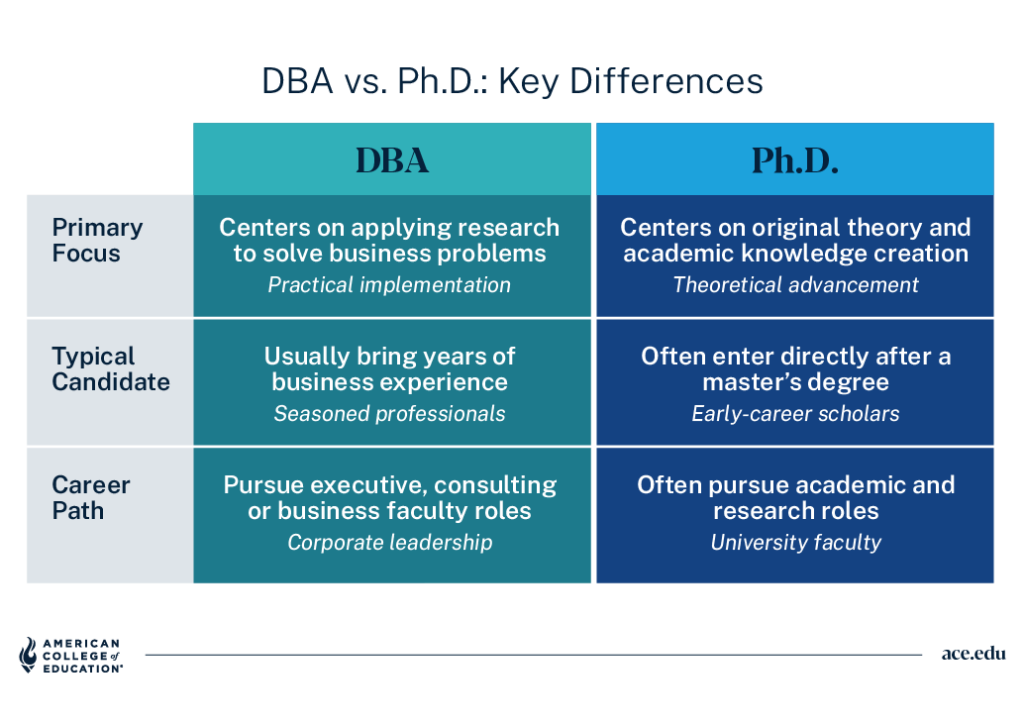
When comparing a DBA vs. a Ph.D., it’s important to know what students are trying to accomplish through their research. A Ph.D. generally focuses on developing original knowledge and contributing to academic theory. A DBA emphasizes applying research to practical business problems. Both require advanced research skills, but those skills serve different purposes.
The students attracted to each path may differ as well. Ph.D. students may pursue doctoral study as part of a path toward academic research, while DBA candidates are often experienced working professionals looking to deepen their expertise. Those priorities can carry into their careers: DBA graduates may pursue executive leadership, consulting or business faculty positions, while Ph.D. graduates commonly pursue academic and research-focused roles.
The difference between a Ph.D. and DBA degree, then, is not a matter of which is the higher credential. It is a question of whether your interests lean more toward creating scholarly knowledge or applying research to business challenges.
DBA vs. Ed.D.: Key Differences
A DBA vs. Ed.D. comparison can be challenging because both are professional doctorates with a strong applied focus. Students in either type of program can use research to address real-world organizational needs.
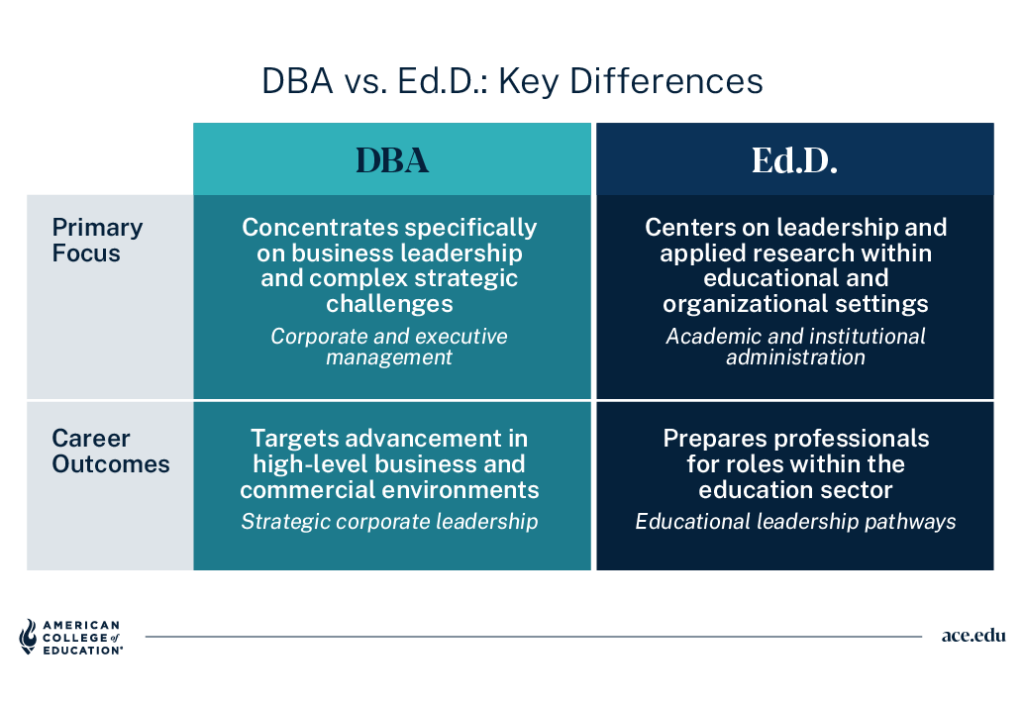
The difference is where applied research is used. A DBA centers on business administration, strategy and organizational performance, making it particularly relevant to those interested in business leadership, consulting or management.
An Ed.D. focuses more broadly on educational and organizational leadership, policy, and problems of practice. It can prepare professionals to lead change in schools, colleges, nonprofit organizations and other professional settings.
Both degrees can support advanced leadership roles, but the setting in which you want to work and the problems you want to study can help point you toward one or the other.
Ed.D. vs. Ph.D.: Key Differences
When comparing an Ed.D. degree vs. Ph.D., consider what you want your research to contribute to. A Ph.D., including a Ph.D. in education, generally emphasizes original research intended to contribute to scholarly knowledge and address gaps in existing literature.
An Ed.D. takes a more applied approach, preparing professionals to use research to address challenges involving educational practice, administration, leadership or policy.
Traditional Ph.D. programs are often well suited to those pursuing research-intensive academic careers. Ed.D. programs frequently serve those who want to strengthen their ability to lead change in education.
These paths can overlap. Ed.D. graduates may teach or conduct research in higher education, while Ph.D. graduates can pursue leadership roles outside academia. Neither degree confines graduates to a single type of career.
Comparing Time Commitment and Program Structure
Earning a doctoral degree requires a significant investment of time, but program length and structure can vary considerably. Ph.D. programs often take approximately four to seven years to complete because of their intensive research requirements.
Ed.D. and DBA programs often take roughly three to five years, although timelines for all doctoral degree programs depend on the institution, enrollment status, research requirements and individual student progress.
Program format matters, too. Because Ed.D. and DBA programs frequently serve working professionals, flexible and online options are common. These formats can make it possible to continue building professional experience while completing advanced coursework and research.
Career Paths After Each Doctoral Degree
A doctorate can support a variety of professional opportunities. The path that makes the most sense depends on how you want to use your subject matter expertise, research skills and professional experience.
Career Paths for Ph.D. Graduates
For graduates interested in research and scholarship, opportunities may include tenure-track faculty positions, academic research, work at research institutions or think tanks, and other roles requiring advanced research expertise. Opportunities outside academia can vary widely depending on the field of study.
Career Paths for Ed.D. Graduates
An Ed.D. can support leadership roles in education and organizational settings. Potential paths include school superintendent, college administrator or dean, as well as leadership, training and human resources roles outside traditional educational environments. Specific opportunities depend on a graduate’s experience, specialization and industry.
Career Paths for DBA Graduates
DBA graduates may combine their business experience with doctoral-level research skills in executive leadership, management consulting, organizational strategy or business faculty positions. These career paths can appeal to professionals who want to bring research and evidence into complex business decisions.
Common Misconceptions About Doctoral Degrees
One common misconception is that all doctoral degrees are essentially interchangeable. A Ph.D., Ed.D. and DBA all represent doctoral-level study, but their approaches to research and professional application can differ substantially.
Another misconception is that a professional doctorate such as an Ed.D. or DBA is somehow “less than” a Ph.D. All three can represent terminal degrees in their respective areas, but they serve different purposes.
Professional doctorates emphasize applying advanced research to problems of practice, while Ph.D. programs traditionally place greater emphasis on generating original scholarly knowledge.
Applied research also does not mean easier research. Ed.D. and DBA students still need to understand research methodology, analyze evidence and complete the scholarly requirements established by their programs. What varies is the purpose and application of that research.
How to Choose the Right Doctorate for You
Start with the work you hope to do after graduation. Do you want to produce original academic research, use evidence to address educational or organizational challenges, or tackle strategic business problems? Your answer can help narrow your options to a Ph.D., Ed.D. or DBA.
Then consider how you want doctoral study to fit into your life and career. Think about the time you can commit, whether theoretical or applied research interests you more, the professional experience you already have, and whether you need an online or flexible program.
You should also review individual programs closely, since curriculum, research requirements and areas of specialization can differ even among programs offering the same type of degree. The right choice should connect what you want to study with what you hope to do once you graduate.
Choosing Between a DBA, Ph.D., and Ed.D.
There is no universally “best” doctorate among these three options. A Ph.D. can prepare scholars to expand knowledge within their disciplines, an Ed.D. can help professionals address educational and organizational challenges, and a DBA can prepare business professionals to apply research to strategic problems.
Each represents a significant academic commitment with a different purpose. Rather than choosing based on the title alone, consider which degree offers the research approach, subject focus and career possibilities that fit the future you have in mind.
FAQs
Can I switch career paths after completing a doctoral degree?
Yes. A doctoral degree does not permanently limit you to one career path. Your degree, professional experience, transferable skills and field of expertise can support opportunities across different settings. For example, someone with an applied doctorate may eventually pursue teaching, while a Ph.D. graduate may move from academic research into industry or organizational leadership.
Do all three degrees require a dissertation?
Not necessarily. Ph.D. programs traditionally culminate in an original dissertation, while requirements for Ed.D. and DBA programs vary by institution.
Professional doctorates may require a dissertation, applied doctoral research project, capstone or another comprehensive scholarly experience. Prospective students should review individual program requirements before applying.
Is professional work experience required to apply to a DBA or Ed.D. program?
Requirements vary by institution and program. Because DBA and Ed.D. programs are frequently designed for working professionals, relevant professional or leadership experience may be required or preferred. Applicants should review the admission requirements for each program they are considering.
Can a DBA or Ed.D. lead to a faculty position, similar to a Ph.D.?
Potentially. DBA and Ed.D. graduates can hold faculty positions, particularly in professionally oriented fields. However, hiring requirements vary by institution, discipline and position. A Ph.D. remains a common path for research-intensive and tenure-track academic careers.
Turn Your Doctoral Goals Into Your Next Achievement
Choosing a doctorate is about more than earning an advanced credential. It’s an opportunity to develop expertise you can use to lead, solve problems and make a meaningful contribution to your field. Once you determine which doctoral path aligns with your goals, the next step is finding a program that can help you get there.
American College of Education offers online doctoral programs built with working professionals in mind. Explore ACE’s doctoral degree programs and take the next step toward turning your professional experience into greater impact.