
If you’re considering an advanced business administration degree, you may be wondering about the differences between a Doctor of Business Administration (DBA) and a Master of Business Administration (MBA). While both degrees focus on business leadership and management, they serve varying educational and professional purposes.
Understanding the difference between a DBA and MBA can help you determine which credential better aligns with your career goals, educational interests and professional background. Whether you’re looking to move into management or expand your expertise as an experienced business professional, knowing what each degree offers can help you make the right decision.
DBA vs MBA: Understanding the Basics
When comparing an MBA vs. doctorate, it’s important to understand that each degree serves a unique purpose. Both prepare business professionals for leadership, but they differ in degree level, educational focus and the professionals they’re designed to serve.
What Is an MBA?
A Master of Business Administration is a master’s-level degree designed for professionals who want to strengthen their business knowledge and prepare for leadership and/or management roles. MBA programs emphasize practical business knowledge while helping students strengthen their leadership, communication and decision-making skills.
What Is a DBA?
A Doctor of Business Administration is a terminal business degree designed for experienced professionals. Unlike an MBA, which focuses on practical business management, a DBA emphasizes advanced leadership, organizational strategy and applied research.
Comparison Between DBA and MBA
While both degrees focus on business administration, they aren’t interchangeable.
Degree Level
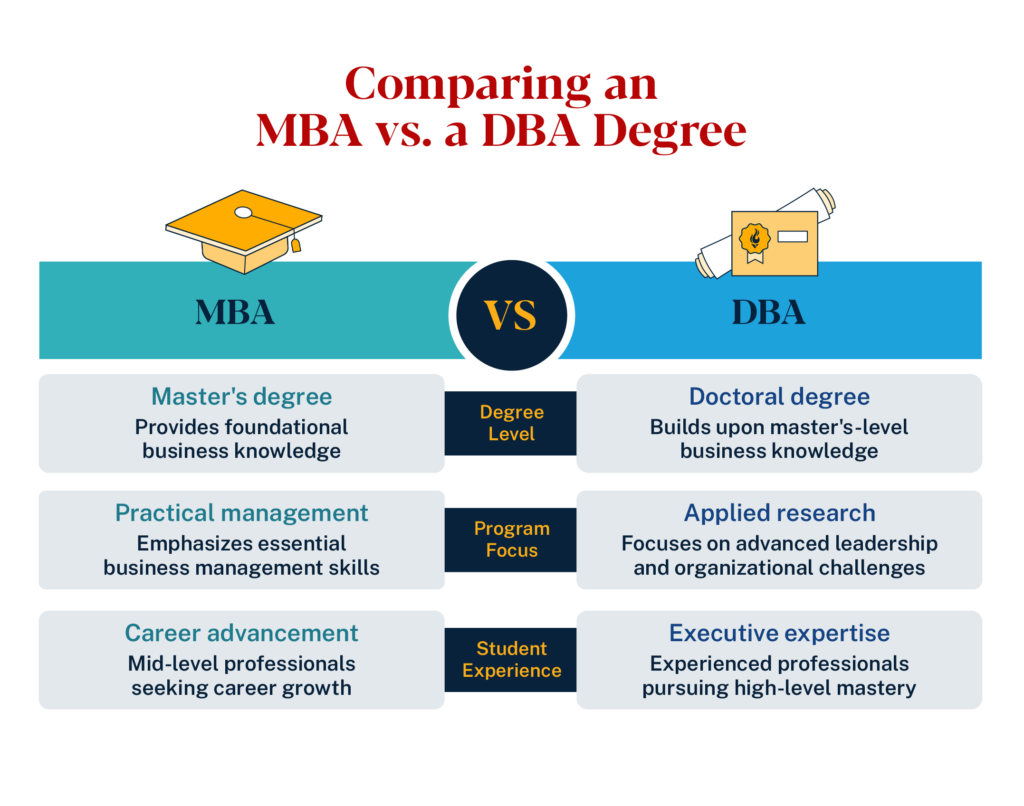
An MBA is a master’s degree that provides advanced business education beyond the bachelor’s level. A DBA is a doctoral degree that builds on master’s-level business knowledge through advanced study in leadership, strategy and applied research.
Program Focus
MBA programs emphasize practical business management skills that professionals can apply in the workplace. The focus is on preparing students to lead teams, manage business functions and make informed organizational decisions.
DBA programs focus on advanced leadership, organizational strategy and applied business research. The emphasis is on expanding strategic expertise and preparing experienced professionals to address complex organizational challenges.
Student Experience
MBA students often pursue the degree to strengthen their business knowledge, develop leadership skills or prepare for management roles. DBA students are typically experienced business professionals who want to build on that foundation through doctoral-level study.
DBA vs. MBA Curriculum
Although both degrees focus on business administration, the coursework reflects their different educational objectives.
MBA Coursework
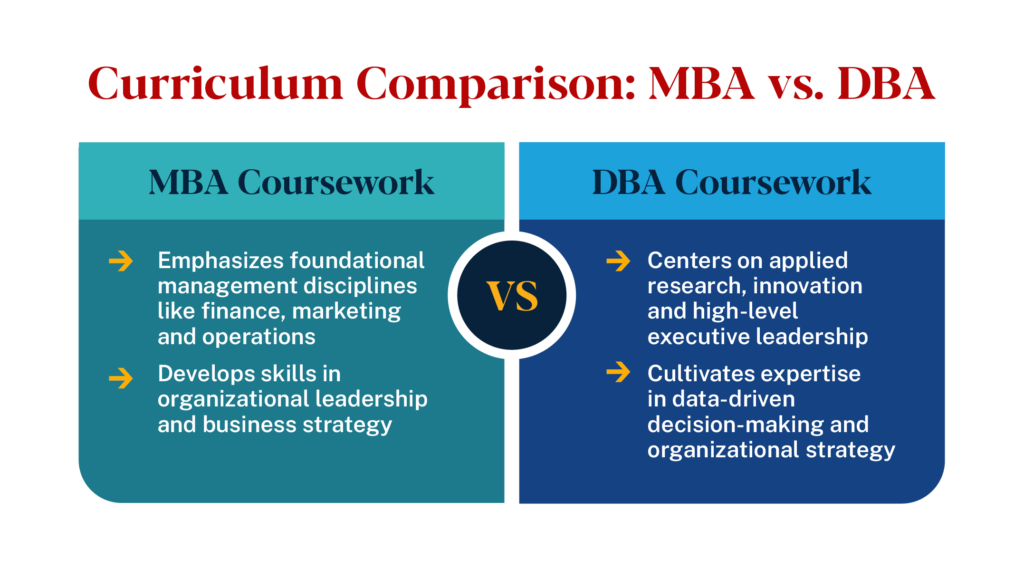
MBA coursework builds a strong foundation in core business functions while helping students develop practical leadership and management skills. Common areas of study include:
- Business strategy
- Marketing
- Finance
- Operations management
- Organizational leadership
DBA Coursework
DBA coursework builds on master’s-level business education by focusing on advanced leadership, organizational development and applied research. Common areas of study include:
- Organizational strategy
- Executive leadership
- Business innovation
- Data-driven decision-making
- Applied business research
Applied Learning vs. Advanced Research
MBA programs often reinforce classroom learning through case studies and other practical learning experiences that emphasize real-world business application.
DBA programs place greater emphasis on applied research, encouraging students to investigate organizational challenges and use research to inform strategic decision-making.
MBA vs. Doctorate: Which Degree Is More Advanced?
An MBA and a DBA represent different levels of graduate education, each designed to support targeted types of professional growth.
Master’s-Level Education
A master’s-level education focuses on developing advanced business knowledge while building the management and leadership skills needed to take on greater responsibility within an organization.
Doctoral-Level Education
Doctoral education focuses on expanding strategic expertise while preparing professionals to apply research to real-world business challenges. It emphasizes developing evidence-based solutions to complex organizational issues. As such, a DBA would be considered a more advanced degree than an MBA.
Career Opportunities for MBA and DBA Graduates
An MBA and a DBA can support leadership advancement in different ways.
Opportunities for MBA Graduates
MBA graduates often pursue leadership roles in areas such as:
- Management
- Department leadership
- Business operations
- Functional leadership in areas like finance, marketing, operations and human resources
Opportunities for DBA Graduates
DBA graduates often take on higher-level positions in areas such as:
- Executive leadership
- Organizational strategy
- Business consulting
- Executive advisory services
DBA vs. MBA: Key Factors to Consider
Choosing between an MBA and a DBA depends on your career goals, professional experience and educational interests.
Completion Times
Completion times vary by institution, enrollment status, transfer credits and program structure.
At American College of Education (ACE), the MBA program can be completed in 10 to 16 months, while the DBA can be completed in as little as three years.1 The DBA program includes a guided dissertation sequence built into the coursework to help doctoral candidates stay on track as they complete their dissertation.
Program Cost
Program costs vary significantly among institutions, making it important to consider the overall value of a program rather than tuition alone.
At ACE, the total cost is $9,109 for the MBA and $21,525 for the DBA,2 providing affordable options for professionals pursuing graduate or doctoral business education.
Career Goals
Think about the type of role you ultimately want. An MBA often aligns with management and functional leadership roles, while a DBA may be a better fit for professionals interested in executive leadership, organizational strategy or consulting.
Professional Experience
MBA programs often welcome professionals with varying levels of business experience, while DBA programs are generally designed for experienced professionals who are prepared for doctoral-level study.
Educational Interests
If you like applying practical business concepts to real-world management challenges, an MBA may align with your educational interests. If you’re more interested in strategic leadership, applied research and organizational problem-solving, a DBA may be a better fit.
Why Some Professionals Pursue Both an MBA and a DBA
For some professionals, earning both degrees is part of a long-term approach to professional development.
Building Progressive Expertise
Many professionals begin with an MBA before pursuing a DBA later in their careers as their responsibilities and professional interests evolve.
Expanding Leadership Capabilities
Pursuing both degrees allows professionals to build on the business knowledge gained in an MBA with the advanced study offered through a DBA.
FAQs
Can a DBA be earned without an MBA?
Yes. Some DBA programs admit qualified applicants without an MBA, although applicants are generally expected to hold a master’s degree. Admission requirements vary by institution and may consider factors such as previous graduate education and professional experience.
How are DBA programs different from Ph.D. programs in business?
A DBA focuses on applying research to solve real-world business challenges, while a Ph.D. in business generally emphasizes producing original academic research and preparing graduates for university teaching and scholarly careers.
Are DBA programs designed for working professionals?
Many DBA programs are designed with working professionals in mind. Program formats may offer flexible courses that allow students to continue working while completing doctoral coursework and research.
Do employers recognize DBA degrees?
Yes. A Doctor of Business Administration is a widely recognized terminal degree in business that prepares experienced professionals for executive leadership, consulting and other advanced business roles.
How does a DBA support organizational innovation?
DBA programs prepare professionals to evaluate organizational challenges, apply research to business decisions and develop evidence-based solutions that support innovation within organizations.
Can a DBA help professionals transition into consulting?
Yes. The leadership, strategic thinking and applied research skills developed in a DBA program can support professionals who want to transition into consulting, executive leadership or other business advisory roles.
American College of Education offers affordable, fully online business programs at the bachelor’s, master’s and doctoral degree levels.
1This is an estimated time to completion. Actual completion time may vary depending on the number of transfer credits applied, availability of courses, satisfactory pace, multiple course requests, successful course completion, and meeting program milestones as required.
2This is an estimated value of the cost for tuition and fees. Amounts may vary depending on number of transfer credits applied to the selected program hours, the pace and satisfactory completion of the selected program, receipt of institutional scholarship and/or grant amounts, or adjustments to tuition or fees as described in the Catalog Right to Modify Tuition section. State sales and use tax will apply where required by law.