
American College of Education (ACE) is incredibly proud of our graduates and how their impactful research contributes to various fields. Ed.D. in Instructional Technology alumna, Dr. Randi Langley, focused her dissertation on teachers’ perceptions of using artificial intelligence (AI)-assisted technology to support reading fluency and comprehension among students in grades K–2. Below is a summary of Langley’s study, and we invite readers to explore the full version.
Early literacy skills serve as the foundation for future academic success, yet many students struggle to develop reading fluency and comprehension in primary grades. At the same time, advances in AI are creating new opportunities for educators to personalize instruction and provide targeted interventions.
How do teachers perceive the use of AI-assisted technology to support young readers? Langley gathered perspectives from 15 elementary educators in a large metro Atlanta school district to explore their perceptions of Microsoft Reading Progress, an AI-assisted reading intervention tool. Her qualitative research, framed by connectivism and constructivist learning theories, explored the role of AI-assisted technology in supporting early literacy development.
Specifically, Langley sought to answer the following questions:
- Research Question 1: What are the perceptions of teachers on using AI-assisted technology to increase reading comprehension in grades K–2 in elementary schools?
- Research Question 2: What are the perceptions of teachers on using AI-assisted technology to increase reading fluency in grades K–2 in elementary schools?
Addressing Early Literacy Challenges Through AI-Assisted Learning
Reading proficiency remains a challenge for many elementary schools, and teachers continue to seek effective ways to support students who struggle with foundational literacy skills. Early literacy instruction plays a critical role in long-term academic success, making timely intervention especially important for young students. Students who struggle with reading in primary grades often face continued academic challenges as they progress through school.
Nationally, only 33% of fourth-grade students are proficient in reading. In the metro Atlanta district examined in the study, 43% of students were not reading on grade level by fourth grade. These ongoing literacy challenges highlight the need for effective interventions that support struggling readers.
To help address these concerns, schools have increasingly explored digital tools that can support reading instruction and provide additional opportunities for practice and feedback. One such tool is Microsoft Reading Progress, an AI-assisted program designed to help teachers monitor reading development and identify areas where students may need additional support.
Langley’s study explored how teachers perceive the use of Microsoft Reading Progress in supporting reading fluency and comprehension among students in grades K–2. The research also addressed a gap in the existing literature, as relatively few studies have examined AI-assisted literacy interventions for young readers in United States schools.
What Previous Research Says About Literacy, Technology and AI Interventions
Before conducting her study, Langley reviewed existing research on literacy instruction, reading development and the growing use of AI in education. This research helped establish the foundation for the study and provided context for understanding how AI-assisted tools may support reading fluency and comprehension among young learners.
Why Students Struggle With Reading
Reading proficiency depends on a combination of foundational literacy skills, including phonemic awareness, phonics, fluency, vocabulary and comprehension. When students struggle in one or more of these areas, reading development can be affected.
The literature also emphasized that reading is not a skill students naturally acquire on their own. Effective literacy instruction requires intentional teaching practices that help students understand how sounds, letters and words work together to create meaning. Because reading skills build upon one another, early intervention is often critical for helping struggling readers succeed.
The Relationship Between Reading Fluency and Comprehension
Reading fluency and reading comprehension are closely connected. Fluency involves reading accurately and with appropriate pace and expression, while comprehension focuses on understanding and making meaning from text.
Previous studies have shown that students who read more fluently are often better able to focus on comprehension. When students struggle to decode words or read accurately, it can become more difficult to understand what they are reading. Because of this relationship, many literacy interventions are designed to support both fluency and comprehension.
The Expanding Role of AI in Education
AI has become increasingly integrated into educational settings, with researchers exploring its potential to support personalized learning, adaptive instruction and automated feedback.
Many AI-supported platforms can identify learning gaps and provide targeted support based on student performance. These capabilities may help teachers better meet individual student needs while providing additional opportunities for practice and reinforcement.
Researchers have identified opportunities for AI to support teaching and learning, but the literature also noted that some teachers remain hesitant to adopt it in classroom settings. These findings suggest that successful implementation depends not only on the technology itself but also on how teachers integrate it into instruction.
Microsoft Reading Progress and AI-Assisted Literacy Support
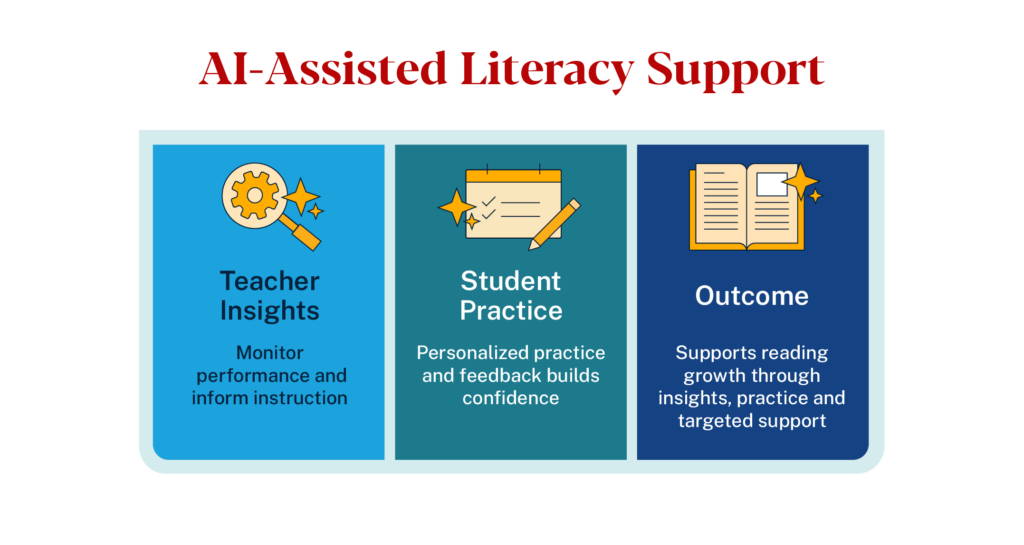
Microsoft Reading Progress is designed to support reading development through a combination of assessment, feedback and practice opportunities. The platform allows teachers to monitor student reading performance and identify areas where additional support may be needed, including fluency, accuracy and word recognition.
The tool also includes Reading Coach, which gives students opportunities to practice challenging words and build confidence through targeted support. In addition, teachers can use student performance data to help inform intervention planning and small-group instruction.
Research on computer-assisted literacy interventions suggests that technology can support reading development through personalized learning experiences and additional opportunities for practice. However, the literature revealed relatively little research examining AI specifically as an intervention tool for struggling readers, particularly among young elementary students.
Langley found that much of the existing research on AI interventions has been conducted outside the United States. The literature also revealed limited research on Microsoft Reading Progress, and relatively few studies focused on AI-assisted literacy interventions for young elementary students. These gaps helped establish the need for additional research in U.S. K–2 classrooms.
Exploring Teacher Perspectives on AI-Assisted Reading Support
Langley used a qualitative exploratory case study design to examine teacher perceptions of Microsoft Reading Progress.
The study took place within a large metro Atlanta school district and focused on teachers who were already using the platform with students in grades K–2. From a population of approximately 112 eligible teachers, 15 teachers participated in the study.
Data was collected through electronic open-ended questionnaires that allowed participants to share their experiences and perspectives in their own words. This approach enabled Langley to gather detailed information about how teachers perceived the use of AI-assisted technology in supporting reading fluency and comprehension among young students.
Identifying Themes in Educator Responses
To analyze participant responses, Langley used the PRICE model, a thematic analysis framework designed to identify recurring patterns and themes within qualitative data.
Responses were organized, coded and analyzed. Through multiple rounds of review, Langley examined participant feedback, identified recurring ideas and grouped related responses into broader categories. This process helped ensure that common perspectives and experiences were accurately represented in the data.
As themes emerged, responses were refined and organized to align with the study’s research questions. The analysis focused on identifying how teachers perceived the use of Microsoft Reading Progress in supporting reading fluency and comprehension among students in grades K–2.
What Teachers Reported About AI-Assisted Reading Support
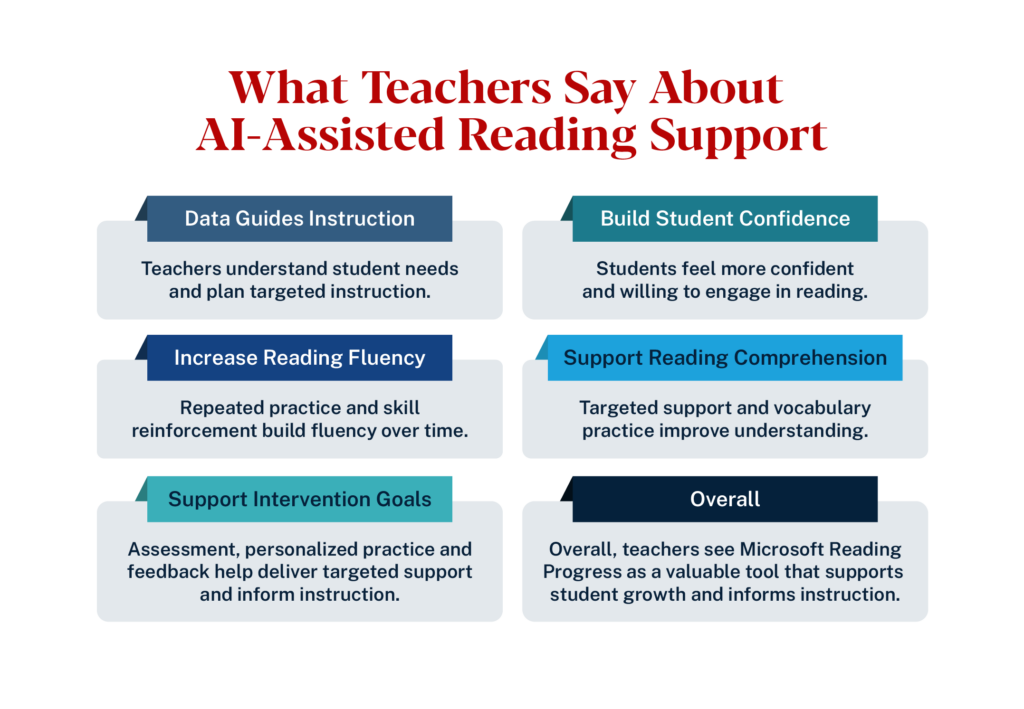
Overall, participants viewed Microsoft Reading Progress positively and perceived it as a valuable tool for supporting reading fluency, reading comprehension and targeted instructional interventions. However, a small number of teachers expressed concerns related to the time required to establish new classroom routines and implement the platform effectively.
Using Reading Data to Guide Instruction
Teachers frequently highlighted the value of the data and feedback provided through Microsoft Reading Progress. Participants reported that the platform helped them identify reading errors more efficiently and gain a clearer understanding of individual student needs. Teachers also noted that the information generated by the tool supported instructional planning, including the formation of targeted small groups and intervention strategies.
Many teachers viewed these insights as a valuable resource for monitoring student progress and making informed decisions about reading instruction.
Increased Reading Fluency
Teachers frequently associated Microsoft Reading Progress with stronger reading fluency among their students. Participants pointed to opportunities for repeated reading, skill reinforcement and ongoing practice with phonics and decoding. The platform encouraged students to revisit challenging words and continue developing foundational reading skills through regular practice.
Teachers viewed these opportunities as valuable for helping students build confidence and fluency over time.
Improved Student Confidence
Teachers reported that students appeared more willing to engage in reading activities with Microsoft Reading Progress and demonstrated greater confidence when practicing independently. The combination of immediate feedback and individualized support created opportunities for students to experience success while developing reading skills.
Many educators viewed this increased confidence as an important benefit, noting that students were more willing to participate in reading activities and continue practicing challenging skills.
Reading Comprehension Growth
Teachers also associated Microsoft Reading Progress with stronger reading comprehension among their students. Participants highlighted the role of Reading Coach in helping students strengthen vocabulary and practice challenging words. They noted that the platform provided targeted support based on individual performance, allowing students to focus on areas where they needed additional practice.
Many teachers believed these personalized learning experiences helped students better understand and make meaning from text.
Supporting Intervention Goals
Participants frequently described Microsoft Reading Progress as a valuable tool for supporting intervention efforts. Teachers reported that the combination of assessment data, personalized practice and feedback helped them identify student needs more efficiently and tailor instruction accordingly. Many teachers viewed the platform as a way to provide more targeted support while maintaining a focus on individual student growth.
Some teachers also noted challenges when the platform interpreted student speech patterns or dialects, requiring teachers to adjust sensitivity settings or review results more closely.
Limitations and Future Research
As with any study, several limitations should be considered. The research relied on a convenience sample of 15 teachers from a single metro Atlanta school district, which may limit the generalizability of the findings. The study also focused on teachers who were already using Microsoft Reading Progress and examined educator perceptions rather than direct measures of student achievement.
Langley recommends several opportunities for future research. These include:
- Expanding the study to include larger participant samples
- Conducting research across additional school districts
- Using mixed methods approaches that combine teacher perspectives with quantitative student performance data
- Examining reading assessment outcomes alongside educator perceptions
- Further exploring AI-assisted literacy interventions for young readers in U.S. schools
American College of Education (ACE) offers affordable programs designed to equip literacy educators and leaders with advanced knowledge and skills that support student success. Explore our M.Ed. in Literacy, Ed.S. in Literacy and Ed.D. in Literacy.