
American College of Education (ACE) is incredibly proud of our graduates and how their impactful research contributes to various fields. Ed.D. in Leadership graduate Dr. William Giedl focused a dissertation on the effectiveness of Read 180, an intervention program used to support students who struggle with reading. Below is a summary of Giedl’s study, and we invite readers to explore the full version.
Students who struggle with reading can face challenges in high school, where reading comprehension is essential across subjects. For students who enter ninth grade below grade level, continued intervention can help address gaps in foundational skills and support academic progress. Identifying interventions that make a meaningful difference is critical for school leaders.
Giedl examined Read 180 at a Title I high school, analyzing ninth-grade students’ reading scores across three school years. The study was guided by cognitive load theory, which focuses on how students process information, and transformational leadership theory, which considers the role of leadership in supporting meaningful change. Giedl sought to answer:
- Research Question 1: Is there a statistically significant difference between pre- and post-Lexile scores over three consecutive years on the Read 180 Reading Inventory among ninth-grade students in a Title I high school?
- Research Question 2: Is there a statistically significant difference in the pre- and post-Lexile scores over three consecutive years on the Read 180 Reading Inventory by demographic group among ninth-grade students in a Title I high school?
Why Reading Support Still Matters in High School
Reading intervention often starts early, but the need for support doesn’t always end in elementary or middle school. Some students enter high school still working on foundational skills like word recognition, decoding and fluency.
Reading skills can shape success across a student’s entire education. Strong comprehension helps students engage with material in mathematics, science, social studies and other subjects while building skills that can support college and career readiness.
The need for reading support is widespread. National Assessment of Educational Progress data showed that 34% of eighth-grade public school students nationwide were reading below the basic level. Georgia data also showed reading gaps among students preparing to enter high school.
What Previous Studies Tell Us About Reading Intervention
Before conducting the study, Giedl examined previous research on reading challenges, interventions, Read 180 and educational leadership to provide context on supporting struggling readers and the questions that still need to be explored.
Reading Challenges Can Be Complex
Reading comprehension depends on several skills working together. Students may struggle with vocabulary, decoding, fluency or understanding the meaning of a text, making targeted support important for addressing individual needs.
For students who reach high school with gaps in these foundational skills, targeted reading intervention may provide continued opportunities to build comprehension as academic expectations increase.
Individual Needs and Circumstances Matter
Socioeconomic circumstances can shape students’ access to resources and opportunities to build strong literacy skills. Students may also need different types of support based on individual learning needs, including English language learners and students with disabilities.
Understanding those differences is important when evaluating reading interventions. Some studies didn’t provide enough demographic detail to show how specific student groups responded, while research involving English language learners found limited evidence about which approaches were most effective.
Students with disabilities may face additional challenges with reading comprehension and working memory. Providing support that reflects individual needs can help schools create more equitable opportunities for students to strengthen reading skills and make academic progress.
Read 180 Use With Struggling Readers
Read 180 combines teacher-led instruction, independent reading and technology-based practice to support students at different reading levels. Studies have linked the program to growth in vocabulary and reading comprehension, although results have varied across reading skills and school settings.
Read 180 isn’t the only approach that has helped struggling readers make progress. Classroom instruction and targeted reading strategies have produced positive results, and questions remain about whether students maintain reading gains after an intervention ends.
Most Read 180 research has focused on younger students or shorter periods of time, leaving less information about what happens when the program is used with high school students over multiple years. That gap is especially important for teachers working with older students who still need support to strengthen reading skills and prepare for success beyond high school.
The Role of Teachers and School Leaders
The success of a reading intervention depends on more than the program itself. Teachers need the right training and support to use it effectively, and school leaders play an important role in making that happen.
Ongoing professional development can help teachers strengthen instructional practices, collaborate with colleagues and feel more confident using new programs.
Leadership support matters, too. Clear communication, a shared vision and continued guidance can help build teacher buy-in and encourage more consistent implementation.
How Giedl Studied Read 180
Giedl examined Read 180 at a Title I high school in Southeastern Georgia. The study focused on 141 ninth-grade students during the 2021–22, 2022–23 and 2023–24 school years.
Attendance was important because students needed consistent exposure to Read 180 to evaluate progress. Using data the school had already collected, Giedl compared students’ Lexile scores, which reflect reading ability based on the complexity of text a student can understand, to measure changes in reading performance over time.
How the Data Was Analyzed
Giedl compared students’ Lexile scores at the beginning and end of each year, providing a look at reading growth among Read 180 participants over time.
The analysis also looked at whether that growth differed among students based on gender, race and disability status. Comparing these groups provided a closer look at how students with different backgrounds and learning needs progressed while participating in the program.
Read 180 Results at the High School Level
Giedl’s findings offer a closer look at where students made progress and where questions remain for high schools supporting struggling readers.
Students Made Reading Gains Each Year
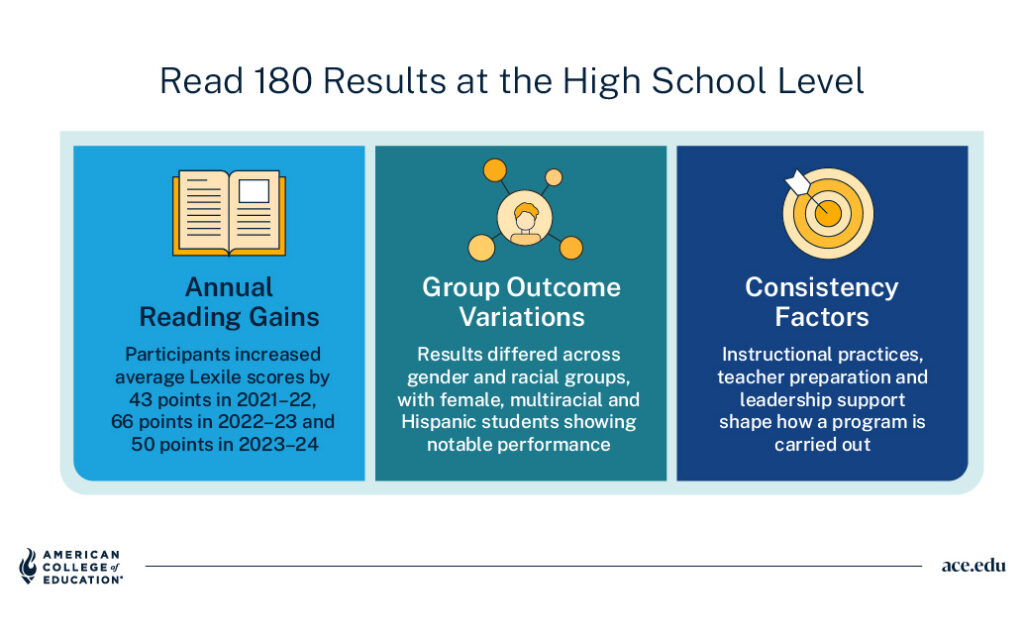
Read 180 participants increased average Lexile scores from the beginning to the end of each school year. Students gained an average of about 43 points in 2021–22, 66 points in 2022–23 and 50 points in 2023–24. Across the three years, the results showed meaningful improvement in reading comprehension among participating students.
Reading Outcomes Varied Across Student Groups
Results showed some differences across gender and racial groups, but differences between students with and without disabilities weren’t significant. Female students generally had higher Lexile scores than male students, and some of the largest increases appeared among multiracial and Hispanic students.
The results reinforce the importance of looking beyond overall averages when evaluating student progress. Understanding how different groups respond to an intervention can help schools identify where students are making gains and where additional support may be needed.
Consistency Matters
Giedl connected the results to the importance of delivering reading interventions consistently. Factors like instructional practices, teacher preparation and leadership support can shape how a program is carried out from one classroom or school year to the next.
The study didn’t measure implementation, so differences in student outcomes can’t be attributed to how Read 180 was delivered. Still, the findings highlight an important consideration for schools: Evaluating an intervention means paying attention to both student outcomes and how consistently the program is put into practice.
Limitations and Opportunities for Future Research
The study had several limitations. Giedl used existing school data, which meant the research was limited to information that was already available. Because complete post-assessment scores weren’t available for the full ninth-grade population, the study included only students who participated in Read 180. Without a comparison group, the study couldn’t determine how much of the reading growth was connected specifically to Read 180.
The research also focused on ninth-grade students at one Title I high school in Southeastern Georgia, so the results may not reflect what would happen with other grade levels, student populations or school settings. Read 180 may not have been delivered the same way across all three years, which could have affected student outcomes. Differences in testing dates, administration and proctoring could have influenced Lexile scores as well.
Giedl recommends several ways future research could build on the study:
- Compare Read 180 participants with students receiving other reading instruction to better understand the program’s impact on reading growth
- Examine how consistently Read 180 is implemented across classrooms and school years
- Explore how instructional practices influence student outcomes
- Look more closely at the role of professional development in supporting implementation
- Examining these factors alongside student outcomes could help schools better understand not only whether students are making progress but what may be contributing to that progress.
The findings also offer practical takeaways for school leaders. Clear expectations, regular monitoring and ongoing professional development can help teachers use reading interventions consistently. Collaboration among teachers, instructional coaches and administrators can also help schools use student data to identify needs and strengthen support.
Additionally, student outcomes can help leaders make informed decisions about funding. Reading interventions require an investment, making it important to consider whether that investment is translating into meaningful student progress. Giedl’s research highlights how schools and districts can use results to guide resources toward programs that best support student success.
American College of Education offers fully online literacy programs at the master’s, education specialist and doctoral levels that help teachers and leaders support student reading development.