
|
Getting your Trinity Audio player ready...
|
American College of Education (ACE) is incredibly proud of our graduates and how their impactful research contributes to various fields. Ed.D. in Curriculum and Instruction graduate Dr. Rachelle Samia wrote a dissertation on elementary school teachers’ perspectives of the methods and strategies used to teach reading comprehension. Below is a summary of Samia’s study, and we invite readers to explore the full version.
Reading a passage and understanding it aren’t necessarily the same thing, and elementary students who struggle with reading comprehension can face challenges that extend across their learning. For teachers, strengthening students’ comprehension skills includes determining which instructional approaches can best help students understand what they read.
Samia interviewed 17 elementary teachers to explore perspectives on teaching reading comprehension and the strategies used to support students. The study was guided by cognitive and constructivist theories and focused on two research questions:
- Research Question 1: What are the perceptions of elementary school teachers regarding teaching reading comprehension to their students with low reading comprehension levels in elementary Title I schools?
- Research Question 2: How do elementary school teachers perceive the strategies and their impact on their students when teaching reading comprehension in elementary Title I schools?
Reading Comprehension Is More Than Reading the Words
Reading comprehension is essential to how students learn. It allows them to draw meaning from what they read, learn new information and develop skills that support academic success. Comprehension is a complex process where reading ability doesn’t necessarily guarantee understanding.
That challenge is especially important during the elementary years, when students are developing the reading skills they’ll carry into later grades. Teachers see these challenges firsthand and are responsible for helping students build stronger comprehension skills. That makes reading comprehension not only a student learning issue but an important area of focus for elementary instruction.
What Previous Studies Say About Teaching Reading Comprehension
To better understand the challenges surrounding reading comprehension, Samia examined previous research on how students develop comprehension skills and how teachers support that development.
Readers Actively Construct Meaning
Understanding a text requires students to actively make sense of what they’re reading. New information connects with knowledge and experiences students already have, while strategies such as predicting, summarizing, drawing conclusions and using context clues can help students work through the text.
Cognitive and constructivist theories help explain this process. Both recognize students as active participants in learning, whether processing and organizing information or using existing knowledge to build new understanding.
Background Knowledge and Student Needs Matter
Reading comprehension challenges can look different from one student to another. Difficulties with word recognition, language comprehension, vocabulary and prior knowledge can all affect how well a student understands a text. Looking at a student’s performance across word, sentence and text levels can help teachers better understand where those challenges occur and what instruction needs to address.
Prior knowledge is another important piece. Students draw on what they already know to understand new information, making individual backgrounds and experiences part of the comprehension process. Student profiles can give teachers a broader view of what students bring to the classroom and what they may need to succeed.
Strategies Depend on Effective Instruction
Explicit instruction, modeling, questioning, prediction and graphic organizers can help students engage with a text, while strategies for monitoring comprehension can help them recognize when understanding starts to break down.
Teachers also need to understand how children learn and demonstrate a strategy that students can apply while reading. This knowledge helps educators adapt their approach across different texts and respond to students who need additional support.
Experience also matters. Teacher effectiveness often grows considerably during the first several years in the classroom and can continue to improve as they work with more students.
How Teachers’ Reading Comprehension Experiences Were Captured
Samia conducted a basic qualitative study with 17 teachers across three Title I elementary schools in a Maryland school district. Participants had at least one year of experience teaching reading in grades one through five and included general education teachers, special education teachers, reading specialists and English language development teachers.
The teachers completed a 13-question, open-ended survey followed by individual interviews over Zoom, sharing experiences, beliefs and approaches related to reading comprehension instruction.
Before data collection began, reading education experts reviewed and tested the questions, which Samia then revised. Participants were also given the opportunity to review interview transcripts for accuracy before the data was analyzed.
How the Data Was Analyzed
Samia used thematic analysis to find patterns across the questionnaires and interviews. After the interviews were transcribed, Samia reviewed the data multiple times before organizing and coding participant responses.
Samia then grouped related ideas, compared them with the research questions and continued refining the data. From there, themes were reviewed and narrowed to five major themes.
What Teachers Say About Reading Comprehension Instruction
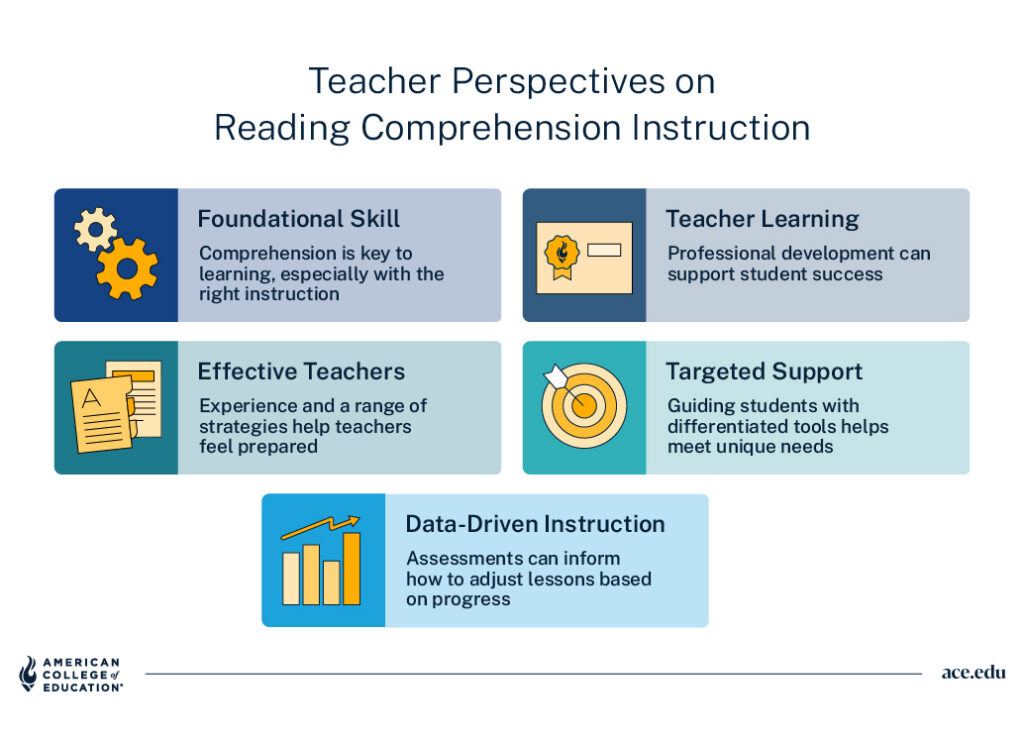
Samia’s analysis resulted in five major themes that captured teachers’ perspectives on teaching reading comprehension:
- Comprehension as a foundational skill
- Learning for student success
- Effective teachers
- Fostering reading comprehension through effective and targeted support
- Using data to drive student success
Comprehension Is a Foundational Skill
Participants saw reading comprehension as a foundation for student learning, with explicit teaching playing an important role. Strategies like predicting, questioning, visualizing, summarizing and making connections gave students practical ways to engage with a text and check their understanding along the way.
Explicit teaching gave students clear guidance on how to approach reading tasks, followed by opportunities to practice and receive feedback. Participants also stressed the importance of responding to individual needs. Even when using scripted programs, teachers still made decisions based on what students needed to understand the material.
These skills were carried into other parts of the school day. Participants described using reading strategies with science and social studies texts, including building background knowledge, summarizing and retelling.
Teacher Learning Can Support Student Success
Professional development gave participants opportunities to build knowledge, strengthen teaching practices and bring new tools into the classroom. Participants especially valued training that connected with district curriculum and state standards, making it easier to apply what they learned to reading instruction.
Curriculum and instruction programs offered another layer of support, giving teachers resources to work with students who had different learning needs. Standards also helped set consistent expectations for proficiency expectations across grade levels.
At the same time, participants acknowledged the pressure that comes with high-stakes testing. Preparing students for assessments can take time away from deeper, more meaningful work with texts, leaving teachers to balance testing expectations with the reading skills students need to develop.
Effective Teachers Bring Knowledge, Reflection and Confidence
Confidence grew from having experience and a range of strategies to draw from. Teachers described feeling better prepared to support different students after years in the classroom and looked at student engagement and understanding to gauge whether an approach was working.
Teachers also found ways to make reading more accessible and engaging. Diverse texts helped connect reading to students’ interests and backgrounds, while technology offered additional support. Read-aloud tools, for example, gave struggling readers another way to access a text.
Thoughtful planning rounded out this theme. Teachers described building comprehension from the ground up with structured, scaffolded instruction. That meant starting with foundational skills, explicitly teaching and modeling comprehension strategies, encouraging students to engage in their learning and providing support along the way.
Students Need Effective and Targeted Support
Reading comprehension challenges can look different from one student to the next. Teachers considered students’ reading levels, strengths and weaknesses when planning instruction, then adjusted lessons and materials based on what each student needed. Grouping students by reading level also allowed teachers to provide more focused support.
That support could include graphic organizers, questioning, and oral or written retelling. Teachers also looked at what might be making comprehension difficult in the first place, including limited vocabulary or background knowledge, difficulty making inferences, low engagement, and challenges with foundational skills like phonics and decoding.
Once teachers had a clearer picture of where students were struggling, research-based interventions and differentiated instruction could be targeted to those needs. Teachers continued monitoring students’ strengths and progress to help shape instruction along the way.
Data Can Help Determine What Comes Next
Formal, informal, formative and summative assessments were all used to monitor student progress, along with quick checks built into daily instruction. Teachers asked questions before, during and after reading and used a variety of tools to check comprehension.
Knowing the student added another layer of context. Teachers considered educational experiences, cultural backgrounds, interests and life experiences because that existing knowledge can shape how students connect with and understand a text.
Teachers then used assessment data to identify strengths and weaknesses, group students, and adjust instruction. Regularly checking for understanding gave them information they could use to respond to students’ needs as learning happened.
Study Limitations and Future Opportunities
Samia noted that the study’s small scope limits how broadly the findings can be applied. The research focused on elementary teachers teaching grades one through five at three Title I schools in Maryland and took place over less than one academic year.
Future research could build on Samia’s work in several ways, for example:
- Examining how specific professional development affects teachers’ perceptions of instructional effectiveness, including training focused on data-driven instruction
- Pairing teacher interviews with classroom observations to better understand how reading comprehension strategies are put into practice
- Connecting classroom practices with measurable student outcomes to explore how specific strategies affect student learning
Samia recommends targeted, continuous and evidence-based professional development aligned with the science of reading and other best practices. Better resources and professional learning that respond to teachers’ needs could provide additional support, particularly when teachers are working with students who struggle with foundational reading skills.
Listening to teachers is part of that work. Samia recommends a more teacher-centered approach to instructional leadership, using teachers’ experiences and challenges to help shape professional development and decisions about resources.
American College of Education offers affordable education programs designed to prepare educators with advanced knowledge, instruction and strategies.