Why Higher Education Needs Reform
Higher education is in a period of uncertainty. Across the country, institutions face growing questions about affordability, workforce relevance and long-term value. Public confidence in higher education is slowly improving after significant decline as students and families asked whether traditional models still align with the realities of modern students and the demands of today’s workforce.
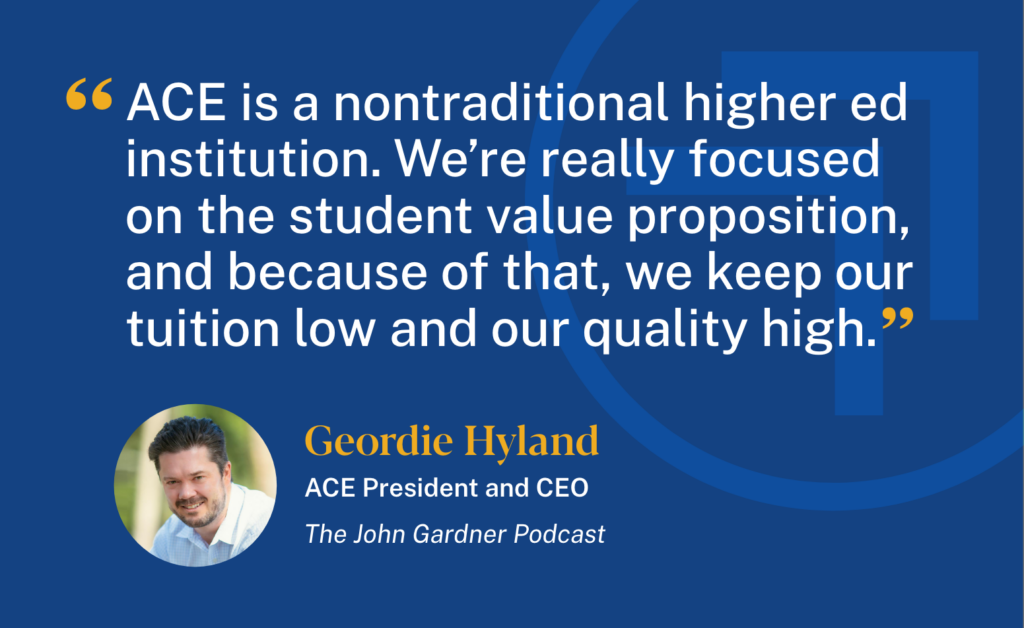
Those questions sit at the center of a recent episode of “Office Hours with John Gardner”, where Gardner spoke with American College of Education (ACE) President and CEO Geordie Hyland about what it means to build a college around a different set of assumptions. Throughout the conversation, Gardner described ACE as “a different way” to approach higher education, particularly for adult learners balancing careers, family responsibilities and professional advancement.
The discussion explores how ACE has built a model focused on affordability, online accessibility, workforce relevance and measurable student outcomes. While the institution’s structure differs from many traditional colleges and universities, the episode makes clear that its approach is not about abandoning accountability or academic quality.
Instead, it raises a larger question for higher education as a whole: What happens when institutions design themselves around the lives and needs of students rather than around longstanding institutional traditions?
Rethinking Value
One of the strongest themes throughout the conversation is the growing pressure on higher education to demonstrate value more clearly and transparently. Gardner and Hyland discuss the ways student debt, tuition costs and questions about return on investment (ROI) have reshaped public conversations about college.
Hyland pointed to broader dissatisfaction with higher education and the scrutiny many institutions face regarding spending priorities, infrastructure expansion and escalating costs. Gardner reflected on how student debt can shape major life decisions long after graduation, affecting everything from homeownership and family planning to career mobility.
Within that environment, ACE positions itself differently. Rather than centering on the traditional campus experience, Hyland describes a model focused more directly on teaching, learning and career advancement.
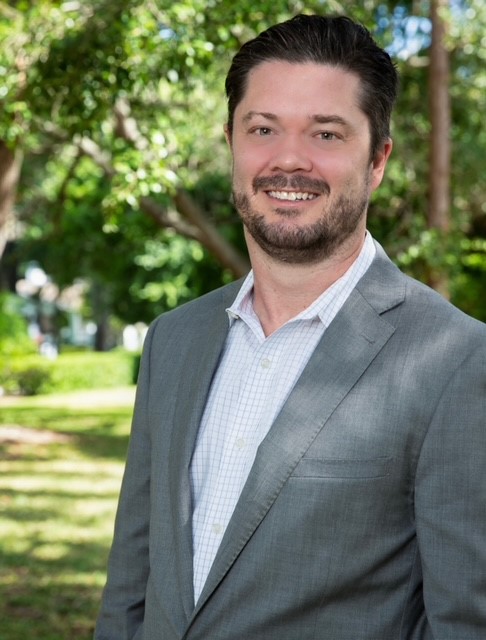
Our graduates are not just getting a degree, but a relevant degree that helps facilitate career progression. They're learning the intricacies of their job. At the master's or doctoral level, they're connecting it to their work, and they're getting a learning experience that helps them get ahead in their career.
Geordie Hyland, ACE President & CEO
Learn More About AI at ACEBecause ACE operates fully online for both students and employees, the institution avoids many of the costs associated with physical campuses, athletics and large-scale infrastructure investments. According to Hyland, that operational structure allows the institution to focus resources more intentionally on academic delivery and student support.
The conversation ultimately frames affordability as more than a pricing strategy. At ACE, it is part of a broader philosophy about student value and accessibility. Through its online structure and emphasis on working adult learners, the institution aims to create pathways that align more closely with the realities many students face today.
For higher education more broadly, the conversation highlights a growing shift in expectations. Students increasingly want institutions to demonstrate not only academic quality, but also affordability, flexibility and clear career relevance.
How ACE Built a Different Model for Adult Learners
Throughout the episode, Hyland repeatedly returned to the idea that ACE was intentionally designed around the needs of adult learners. Founded in 2005, the institution began with the goal of providing a high-quality, largely debt-free college experience for educators, initially centered around a master’s degree priced at approximately $5,000.
That philosophy continues to shape the institution’s operating model today. Hyland noted that most ACE master’s degree programs cost less than $10,000,1 while most doctoral degree programs are priced under $25,000.1 He also highlighted that 87% of ACE students graduate without student debt.2
The conversation frames those outcomes as the result of broader institutional decisions and not as isolated incidents. Hyland explained that ACE does not participate in Title IV federal student aid programs and does not rely on state or federal subsidies. That independence, he suggested, has allowed the institution to build a model less dependent on student borrowing and more focused on controlling operational costs.
The episode also emphasizes that “nontraditional” at ACE extends beyond online delivery. Hyland described a student population made up largely of working adults, many balancing full-time employment, caregiving responsibilities and career advancement goals.
Supporting those students requires flexibility, timely instructional support and coursework designed to connect directly to professional practice. That workforce relevance appears throughout the institution’s academic approach.
ACE employs practitioner faculty across many programs, allowing students to learn from professionals actively working in their fields. Assignments are often designed to connect directly to workplace applications, particularly in areas such as education, healthcare, nursing and business.
Employer partnerships also play a significant role in the model. Hyland discussed collaborations with thousands of school districts, hospital systems and other organizations that help inform curriculum relevance while also creating scholarship opportunities, referral pathways and workforce development initiatives.
Taken together, the episode presents ACE’s nontraditional model as a broader operational philosophy rather than simply an online format. Funding structures, pricing strategies, curriculum design, faculty expertise and student support systems all work together to give learners an education that fits within already complex professional and personal lives.
Accountability, Transparency & Outcomes – As Important as Ever
While much of the conversation focuses on innovation and institutional flexibility, Gardner and Hyland repeatedly returned to the importance of accountability and measurable outcomes.
ACE is accredited by the Higher Learning Commission, and Hyland discussed the institution’s recent 10-year reaccreditation process as an opportunity for reflection, peer review and institutional improvement. Rather than positioning innovation as an alternative to accountability, the conversation suggests that new educational models still require rigorous evaluation and continuous assessment.
Gardner also connected the discussion to the broader idea of institutional responsibility for student learning. In the episode, both speakers emphasized that student success is not solely the responsibility of individual students. Institutions themselves play a role in creating the conditions that support persistence, engagement and completion.
Transparency emerged as another major theme throughout the discussion. Hyland explained that ACE aims to provide students with clear information about tuition, program costs and student outcomes, contrasting that approach with experiences where prospective students may struggle to determine the true cost of a degree program.
I see us as largely in a category of our own, again with being nontraditional, whether it be for profit or nonprofit. Most higher ed institutions that are at a scale to participate in the Title IV program have been having tuition inflation and graduates who come out with significant levels of debt. We are a for profit, but we don't participate in Title IV, and most of our students come out with no debt.
Geordie Hyland, ACE President & CEO
Learn More About ACE and Our MissionHyland cites an 84% graduation rate3 and a Lightcast study ROI calculation showing that every $1 invested in ACE tuition leads to $19.20 in future career earnings.
Hyland mentioned that ACE publishes detailed outcome information through its Student Right to Know, which includes program-level data, survey feedback and graduation rates.
Hyland also cited a graduate Net Promoter Score (NPS) of 71. NPS measures how likely students are to recommend an institution to others, making it a useful indicator of student satisfaction and loyalty.
Equally important is how the institution uses feedback internally. Hyland described a continuous improvement process built around student surveys, faculty feedback and employer input.
One moment Gardner particularly responded to is Hyland’s explanation that ACE converts feedback into concrete action plans. Gardner noted that many traditional institutions do not always approach student feedback in such a direct operational way.
Throughout the discussion, continuous improvement is framed less as a compliance requirement and more as an institutional habit: collect information, identify opportunities, implement changes and continue refining the student experience.
Innovation as an Institutional Culture
The conversation also explored innovation as an ongoing institutional mindset and not simply as a strategy. Hyland described ACE as an institution intentionally designed to remain nimble and adaptive, both operationally and academically. That philosophy appears in everything from strategic planning to curriculum development and internal idea generation.
One example discussed in the episode is ACE’s centralized curriculum model. Rather than individual faculty independently designing separate versions of courses, instructional designers partner with faculty to create shared course structures and learning experiences.
Faculty members then bring their own practitioner expertise and student support into those courses. According to Hyland, that model helps create greater consistency while still preserving instructor engagement and professional insight.
The institution’s online environment also allows faculty and staff to monitor student engagement and academic progress more closely. Hyland explains that this visibility enables more responsive support interventions tailored to individual student needs.
Innovation at ACE is also embedded into broader institutional planning processes. Hyland discussed five-year strategic planning, annual stretch goals and an internal idea bank where employees can submit new concepts and improvements.
Innovation, he explained, is even incorporated into employee incentive structures, reinforcing the idea that adaptation and continuous evolution are part of the institution’s culture rather than isolated initiatives.
The conversation highlights several examples of how that mindset translates into new programs and workforce-responsive pathways. Hyland referenced professional development offerings designed specifically for travel nurses, as well as pathways that help paraprofessionals and teaching assistants combine prior learning, degree completion and teacher certification in more affordable and streamlined ways.
Taken together, these examples position innovation at ACE not as disruption for its own sake but as an effort to remain responsive to changing workforce demands and student realities.
Workforce Relevance, Technology & Community Impact
As the conversation turned toward the future of higher education, workforce relevance became an increasingly central theme.
Hyland discussed the importance of preparing students for a labor market shaped by technological change, particularly in fields such as education, healthcare and nursing. Artificial intelligence and emerging technologies, he noted, are already reshaping how professionals work and how institutions prepare students for those environments.
At the same time, Hyland made clear that ACE does not see itself primarily as a technology company. Rather than developing technology products, the institution focuses on partnering with school districts, hospitals, community colleges and employers to provide education and workforce development solutions.
Those partnerships connect directly to broader workforce shortages affecting communities across the country. The episode repeatedly references teacher shortages and nursing shortages, framing them not simply as employment gaps but as challenges that affect learning outcomes, healthcare access and long-term community wellbeing.
In that sense, the conversation positions ACE’s model as something larger than an alternative higher education structure. It is presented as part of a broader workforce and human capital strategy aimed at helping organizations attract, retain and upskill employees while creating more accessible educational pathways for working adults.
That mission-oriented focus ties back to the institution’s founding purpose. Hyland described ACE’s mission as providing high-quality, affordable and accessible online education while emphasizing service, community impact and career advancement.
Across the episode’s many themes, that mission serves as a consistent throughline connecting affordability, workforce relevance, flexibility and student success.
A Promising Model for Higher Education’s Future
By the end of the conversation, one idea becomes especially clear: ACE is not described as nontraditional simply because it operates online or uses a different financial structure. Rather, the college is presented as a model built around affordability, flexibility, transparency, workforce alignment and measurable student outcomes.
As students increasingly seek education that fits their professional goals, financial realities and personal responsibilities, the episode suggests that higher education may be entering a period where institutions are judged less by tradition and more by how effectively they serve the people they were designed to support.
American College of Education proudly offers programs designed for working professionals to pursue career advancement.
1This is an estimated value of the cost for tuition and fees. Amounts may vary depending on number of transfer credits applied to the selected program hours, the pace and satisfactory completion of the selected program, receipt of institutional scholarship and/or grant amounts, or adjustments to tuition or fees as described in the Catalog Right to Modify Tuition section. State sales and use tax will apply where required by law.
2Internal research completed in November 2025
3Student Right to Know. Accessed June 1, 2026.