

As a healthcare professional, you may be considering taking your career to the next level, where you can play a more influential role in strategic organizational conversations where you work through advanced challenges.
What drives a hospital’s strategy?
How are financial decisions made?
Why do healthcare organizations operate the way they do?
A master’s degree can help you answer these questions and more while preparing you for leadership roles. It can also equip you to lead in various positions, from clinical and administrative leadership to business, population health, and education.
There are different master’s degrees in healthcare, and choosing which to pursue starts with your end goal. The role you want to pursue and the knowledge you’ll need to succeed can help determine which pathway makes the most sense.
Why Consider a Master’s Degree in Healthcare?
Organizations need healthcare professionals who can think beyond day-to-day responsibilities and understand how strategy, finances, operations and other decisions affect the organization as a whole.
That’s often where a master’s degree comes into the picture. It gives working professionals an opportunity to build on what they already know while looking at healthcare through a different lens.
Graduate education can also create opportunities to take on greater responsibility, move into management or leadership, and apply existing professional experience in new ways across the healthcare industry.
Common Types of Master’s Degrees in Healthcare
Master of Healthcare Administration
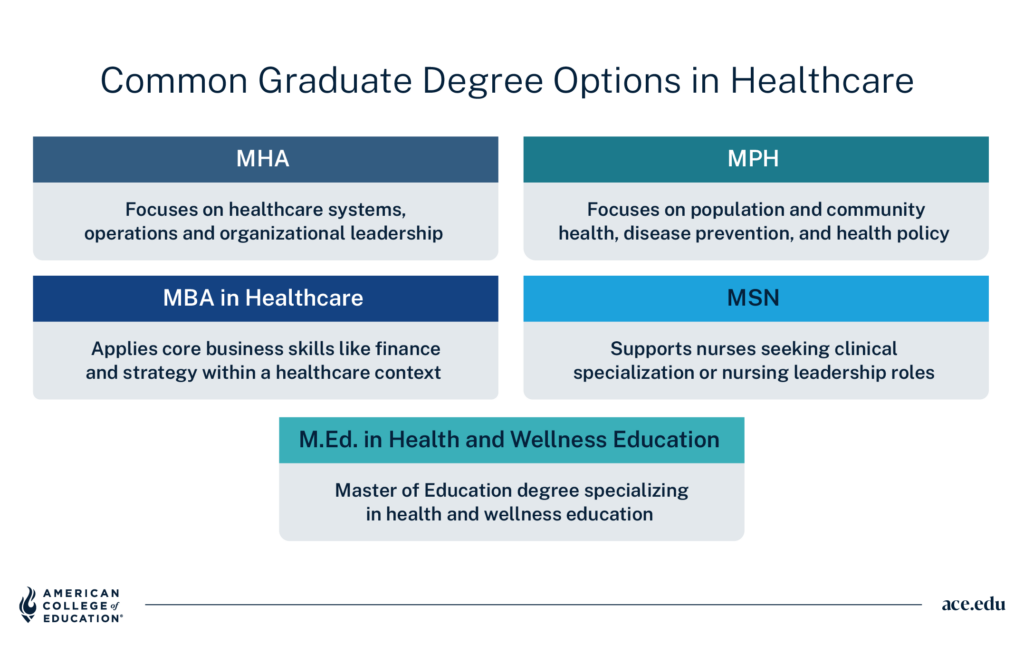
A Master of Healthcare Administration (MHA) is designed for professionals who want to move into leadership within healthcare. Career paths can include hospital administrator, healthcare operations manager and other health system leadership roles, with opportunities to progress into department or executive leadership.
What sets an MHA apart is its healthcare focus. Students learn about areas like finance, strategy and operations through the context of the healthcare industry and how a health system works.
Completing a healthcare management master’s program can prepare healthcare administration professionals to take on greater responsibility across healthcare organizations, from managing departments and practices to contributing to broader organizational decisions.
Master of Public Health
A Master of Public Health (MPH) centers on the health of communities and populations. Study might include epidemiology, disease prevention and health policy, along with environmental factors that influence the health of a community.
Career possibilities include epidemiology, health education and community health program management. An MPH may also appeal to professionals interested in health departments, policy or understanding what drives health outcomes across a population.
Depending on the institution, an MPH may be offered through a school of public health or another academic department.
MBA With a Healthcare Concentration
A Master of Business Administration (MBA) with a healthcare concentration applies broader business preparation to the healthcare industry. Coursework typically covers areas like finance, strategy, economics, marketing and human resources.
The key distinction from an MHA is specialization. An MHA is built around the unique environment of healthcare, while an MBA develops business knowledge that can apply across industries.
That flexibility may appeal to professionals who want to pursue business leadership within healthcare without limiting their career options to healthcare organizations.
Master of Science in Nursing
For nurses who want to stay closer to clinical practice or move into nursing leadership, a Master of Science in Nursing (MSN) offers a more specialized path.
Some nurses pursue an MSN with leadership roles such as chief nursing officer in mind. Others use graduate nursing education to prepare for advanced clinical roles, depending on the program and specialization.
The foundation is what distinguishes this degree from broader administrative, business or public health options. An MSN builds specifically on a nursing background.
Master of Education in Health and Wellness Education
Health education offers another way to influence individual and community well-being. A Master of Education in Health and Wellness Education prepares professionals to develop and lead programs that engage people around health and wellness.
Graduates may apply that knowledge in community health education, corporate wellness programs or nonprofit health initiatives. Rather than focusing on clinical care or healthcare operations, this path emphasizes education and programs that support healthier communities.
MHA vs. MBA vs. MPH: Which Healthcare Master’s Degree Is Right for You?
If you’re choosing between an MHA, MBA or MPH, a great way to start is to lay the programs out side by side. Look at the curriculum, identify what interests you and think about where you want to be five years from now.
Each degree approaches healthcare differently:
- MHA: Best suited to professionals pursuing a healthcare leadership role, whether that means leading healthcare organizations, managing operations or becoming a health administrator
- MBA: Develops broader business skills and strategy that can support leadership within healthcare or in other industries
- MPH: Centers on population health, community needs and health policy for professionals interested in improving outcomes across communities and populations
Skills You’ll Gain From a Healthcare Master’s Degree
A healthcare master’s degree can change the way professionals think about the work happening around them. Instead of only asking why a decision was made, you learn to ask better questions about what’s driving that decision and what could be done differently.
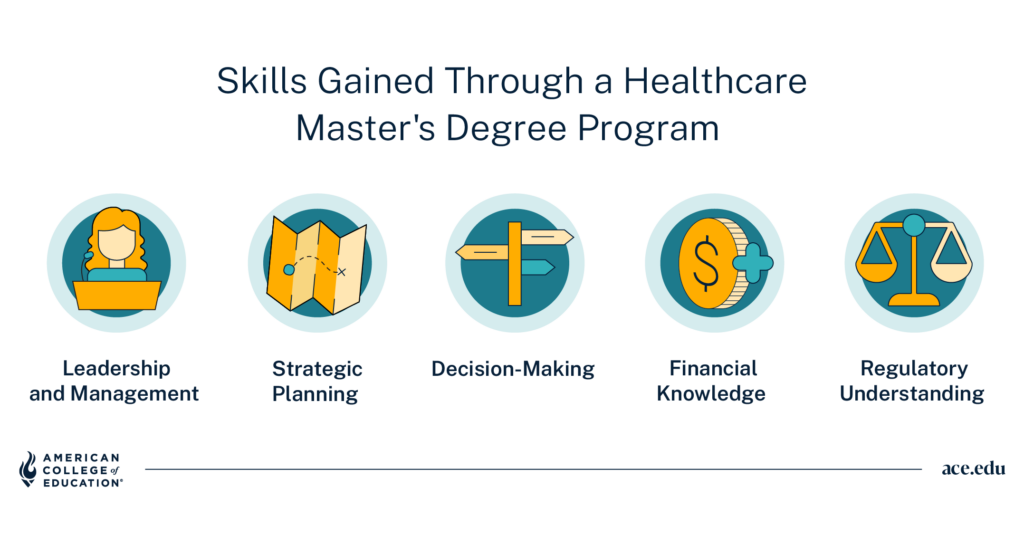
While the exact skills depend on the program, common areas include:
- Leadership and management
- Strategic planning
- Evidence-based decision-making
- Financial and budgeting practices
- Legal, ethical and regulatory considerations in healthcare
Together, these capabilities can help professionals better understand the decisions that shape healthcare organizations and ultimately affect patient care.
Career Paths for Graduate Healthcare Program Graduates
Healthcare graduate programs can prepare professionals for leadership and administrative roles such as hospital administrator, healthcare manager, director of patient experience or chief operations officer. These individuals may oversee a department, practice or broader organizational operations depending on their role and experience.
Population health and policy offer another direction. Career paths can include health policy analyst, program evaluator and community health director, with opportunities to work on programs and policies that affect communities and populations.
What to Look for in an Online Master’s Program for Healthcare Administration
When comparing online master’s programs for healthcare administration, make sure to look beyond the program title. A few factors can help determine whether a program fits your goals and your schedule:
- Accreditation: Check the institution’s accreditation, then research the accrediting organization and the standards the institution has met.
- Curriculum: Look at the actual courses you’ll take. Do they cover what you want to learn and provide preparation that aligns with your career goals?
- Faculty experience: Find out who will be teaching you. In a practice-oriented field like healthcare, instructors with industry experience can bring real-world context to what happens in the classroom.
- Flexibility and format: Consider whether the program offers fully online coursework, accelerated terms and scheduling that fits your existing responsibilities. Check for a practicum, internship or applied project requirement as well, since completion can affect your schedule and program duration.
How Long Does It Take to Complete a Master’s in Healthcare?
A healthcare master’s degree can take roughly 1.5 to three years to complete, with 18 months to two years being common. The timeline depends on the program and how quickly a student chooses to move through it.
Course load, scheduling, prior coursework and transfer credits can all affect completion time. Accelerated terms or taking multiple courses at once may shorten the timeline, while other students may choose a pace they can realistically manage.
The goal shouldn’t be to finish as fast as possible. Give yourself enough time to absorb what you’re learning and gain meaningful insights from the program.
Healthcare Master’s Programs at ACE
At American College of Education (ACE), healthcare professionals can choose among graduate programs based on where they want to make an impact. These programs include fully online courses, with some requiring a local practicum.
For those interested in the operations and leadership side of healthcare, the MHA program helps students build knowledge in management, strategic planning, organizational development and financial decision-making. That preparation can be applied in roles ranging from hospital administration and patient experience to executive leadership.
Population and community health are at the center of ACE’s MPH program. Students explore areas such as epidemiology, health policy and program evaluation, building a foundation for work in public health programs, community health and policy.
The M.Ed. in Health and Wellness Education offers a different route. Designed around education and wellness, the program prepares professionals to develop and lead initiatives that help people make informed decisions about their health. Career applications can include health education, wellness programming and community-based work.
Each path develops a different perspective, but leadership, evidence-based decision-making and the ability to apply what’s learned in real-world settings run throughout ACE’s healthcare graduate offerings.
Choosing the Right Healthcare Master’s Degree for Your Career
There isn’t one “best” choice. Leadership takes different forms across the healthcare industry, from running healthcare operations and shaping business strategy to improving population health, advancing nursing practice or educating communities.
What kind of problems do you want to solve? Consider where your strengths are most useful, what holds your interest and where you could make a meaningful contribution.
Having different graduate pathways makes personalized choices possible. Rather than following a single route into healthcare leadership, professionals can pursue the education that best fits the contribution they want to make.
FAQs
Do I need a clinical background to pursue a non-clinical healthcare master’s degree?
Not necessarily. Many non-clinical healthcare master’s degree programs don’t require clinical experience, although admission requirements vary. Check the prerequisites for individual programs before applying.
Can I transition into healthcare administration from a different industry with an MHA or MBA?
Yes, depending on the position and employer requirements. Experience in fields such as banking or business can provide transferable skills and a different perspective on organizational challenges. An MHA or MBA with a healthcare concentration can then help build the healthcare-specific knowledge needed to work in the industry.
Is a doctoral degree required for executive-level healthcare leadership roles, or is a master’s enough?
It depends on the role. A master’s degree can meet the education requirements for many executive healthcare positions, while some large health systems, academic settings or specialized clinical roles may prefer or require a doctorate. Before pursuing another degree, look at the requirements for the roles and organizations you want to work in.
How do I know if a healthcare master’s program is properly accredited?
Start with the institution’s accreditation information, then research the accrediting organization. Not all accreditation is the same, so look at the standards the institution or program had to meet and what the accreditation represents. A little due diligence can help you understand the quality standards behind the program before enrolling.
American College of Education is here to help you reach your healthcare career goals. From affordable program cost to accessible coursework, we design our healthcare and nursing programs with working professionals seeking career advancement at the forefront.