
A public health degree is a versatile credential that opens doors to a wide array of careers dedicated to improving community and population health. This field is dynamic, with the Public Health 3.0 era calling for professionals who can act as what they call “chief health strategists” and lead cross-sector collaborations that address social determinants of health. This evolution has expanded job opportunities for graduates across government, nonprofits, healthcare and private industries, with each offering distinct roles, strong growth potential and competitive salary ranges.
For those exploring this impactful field, understanding the diverse careers in public health, required skills and earning potential is the first step toward a meaningful career.
What Is Public Health?
At its core, the field of public health focuses on protecting and improving the health of people and their communities. Achieving this includes promoting healthy lifestyles, researching disease prevention and treatment, and implementing effective health policies. Note: Public health and clinical health overlap in some capacity, but they’re not the same.
Why Public Health Matters?
The work of public health professionals is largely preventative and impacts millions daily. Key achievements include controlling infectious disease outbreaks, promoting wellness initiatives and addressing systemic health disparities. These efforts are fundamental to a functioning society, saving lives and reducing long-term health care costs.

Key Areas of Public Health
The discipline is broad, encompassing several critical specializations:
- Epidemiology: The study of disease patterns and causes within populations
- Environmental health: Focused on identifying and mitigating external factors that affect human health
- Health policy and management: The art of shaping health policies and managing healthcare administration systems
- Global health: Addressing health issues that transcend national borders, often in partnership with bodies like the World Health Organization (WHO)
Understanding a Public Health Degree
A degree in this field provides the foundational knowledge and practical skills to tackle complex health issues.
What a Public Health Degree Covers
Curricula are comprehensive with a blend of science, policy and social theory. Core courses often include biostatistics, epidemiology, health communication and environmental health. Most programs emphasize applied learning through internships, capstone projects and community-based research.
Levels of Public Health Degrees
Educational pathways are tiered to suit different career goals.
- Bachelor of Science (B.S.): Provides entry into the field for roles like community health worker or health educator
- Master of Public Health (MPH): The most common professional degree for leadership roles
- Education specialist degrees: Includes doctoral-level coursework without a dissertation requirement
- Doctoral degrees (Ph.D., DrPH, Ed.D.): For those pursuing high-level research, academia or executive leadership
- Micro-credentials: For skill-specific advancement
Core Skills You Gain
Graduates emerge with a powerful and marketable skill set.
- Analytical skills: Proficiency in data analysis, statistics and research methods to investigate health issues
- Communication and collaboration: The ability to work with diverse communities, present findings and engage in interdisciplinary teamwork
- Program planning and management: Expertise in designing, implementing and evaluating health promotion and disease prevention initiatives
- Critical thinking: The capacity for problem-solving and addressing complex population health challenges
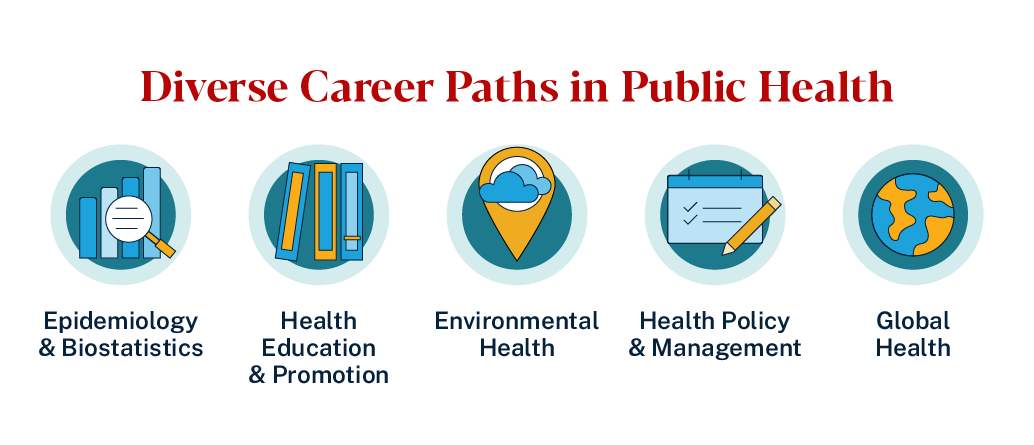
Diverse Career Paths in Public Health
The breadth of the field translates into a wide spectrum of rewarding careers in public health.
- Epidemiology and biostatistics: These data-driven professionals investigate disease patterns and use statistics to inform public health decisions. They are crucial to agencies like the Centers for Disease Control (CDC).
- Job titles: Epidemiologist, biostatistician, clinical research coordinator
- Key responsibilities: Conducting studies, analyzing health data and reporting findings to guide policy
- Health education and promotion: These professionals are on the front lines of health promotion to create programs and improve outcomes directly within communities.
- Job titles: Health educator, community health worker, wellness coordinator
- Key responsibilities: Developing educational materials, running workshops and advocating for healthy behaviors
- Environmental health: This path involves identifying and mitigating environmental factors — from air quality to workplace safety — that affect human health.
- Job titles: Environmental health specialist, occupational health and safety officer, food safety inspector
- Key responsibilities: Conducting inspections, enforcing regulations and assessing environmental risks
- Health policy and management: This sector operates at the systems level, which shapes policies and manages the organizations that deliver care.
- Job titles: Public health administrator, health policy analyst, healthcare manager (a key role in healthcare administration)
- Key responsibilities: Analyzing policy impacts, advocating for change and overseeing healthcare operations
- Global health: For those looking to address health issues internationally, this path focuses on challenges that transcend borders, often through work with non-governmental organizations (NGOs) or the WHO.
- Job titles: Global health specialist, humanitarian aid worker, public health consultant
- Key responsibilities: Working on international development projects, disease surveillance and disaster response
Salary and Job Outlook for Public Health Careers
The job outlook for public health graduates is strong. Demand has surged post-COVID-19, driven by an intensified focus on pandemic preparedness, data-driven public health research and achieving health equity.
However, a comprehensive analysis of federal data from 2021-2022 confirms significant salary disparities across the public health workforce. Median salaries vary dramatically by industry and role.
- Government: Roles at agencies like the CDC are foundational but often offer lower median salaries compared to the private sector.
- Nonprofits and NGOs: Mission-driven work in organizations addressing health disparities is rewarding but is also often among the lower-paid in the sector.
- Healthcare and private sector: Hospitals, pharmaceutical companies and consulting firms frequently offer the highest salary potential for specialized roles like biostatisticians or epidemiologists.
This data underscores the importance of education and specialization. An MPH is frequently required for these higher-paying, advanced technical and leadership positions.
Conclusion
A public health degree prepares graduates for meaningful, impactful careers in public health. Whether your passion lies in data-driven research, direct community engagement or shaping health policy, there is a path for you. While financial rewards and day-to-day work vary between a government agency, a global nonprofit and a private research laboratory, the common thread is the opportunity to make a lasting impact on the well-being of populations.
FAQs
What industries hire public health graduates?
Government agencies (e.g., state health departments, CDC), nonprofits and NGOs, hospital and healthcare systems, private research institutes, and corporations (e.g., pharmaceuticals, insurance) all hire public health graduates.
What jobs can I get with a public health degree?
Common roles include epidemiologist, health educator, community health worker, health policy analyst, environmental health specialist and public health administrator. With an advanced degree, opportunities expand to leadership and specialized research positions.
Do you need a master’s in public health for higher-paying jobs?
Yes. While a bachelor’s degree provides entry into the field, an MPH is typically required for advanced, higher-paying positions in leadership, research, consulting and specialized technical fields like epidemiology.
American College of Education offers a fully online, affordable and relevant MPH program that will equip you for an advanced role in public health.