

Teaching has never been an easy job, but in 2026, its challenges and its pull are colliding in new ways. Many current teachers describe long hours, thin pay and mounting non-teaching duties, yet plenty still show up every day out of real love for the work. American College of Education surveyed 694 U.S. teachers, including current classroom teachers and people studying or preparing to enter the field, to find out what keeps people teaching and what pushes them toward the door.
The results show a profession torn between exhaustion and purpose, with artificial intelligence (AI) emerging as one of its biggest open questions. Teachers’ answers cover respect, burnout, retention and where AI fits into the classroom of the future.
Key Takeaways
- 75% of current teachers believe teaching is a fulfilling long-term career
- 76% of aspiring teachers say making a meaningful impact on students’ lives is what draws them most to teaching
- Current teachers spend an average of 7.7 hours a week working outside contract hours on grading, planning and communication
- Over half of current teachers (54%) have received no formal training on how to use or manage AI tools in the classroom
- 22% of teachers say AI will make teachers more valuable, not less
What Draws People to the Classroom
Despite the demands of the job, teaching is a profession that’s appealing and rewarding to both current and aspiring educators in a variety of ways.
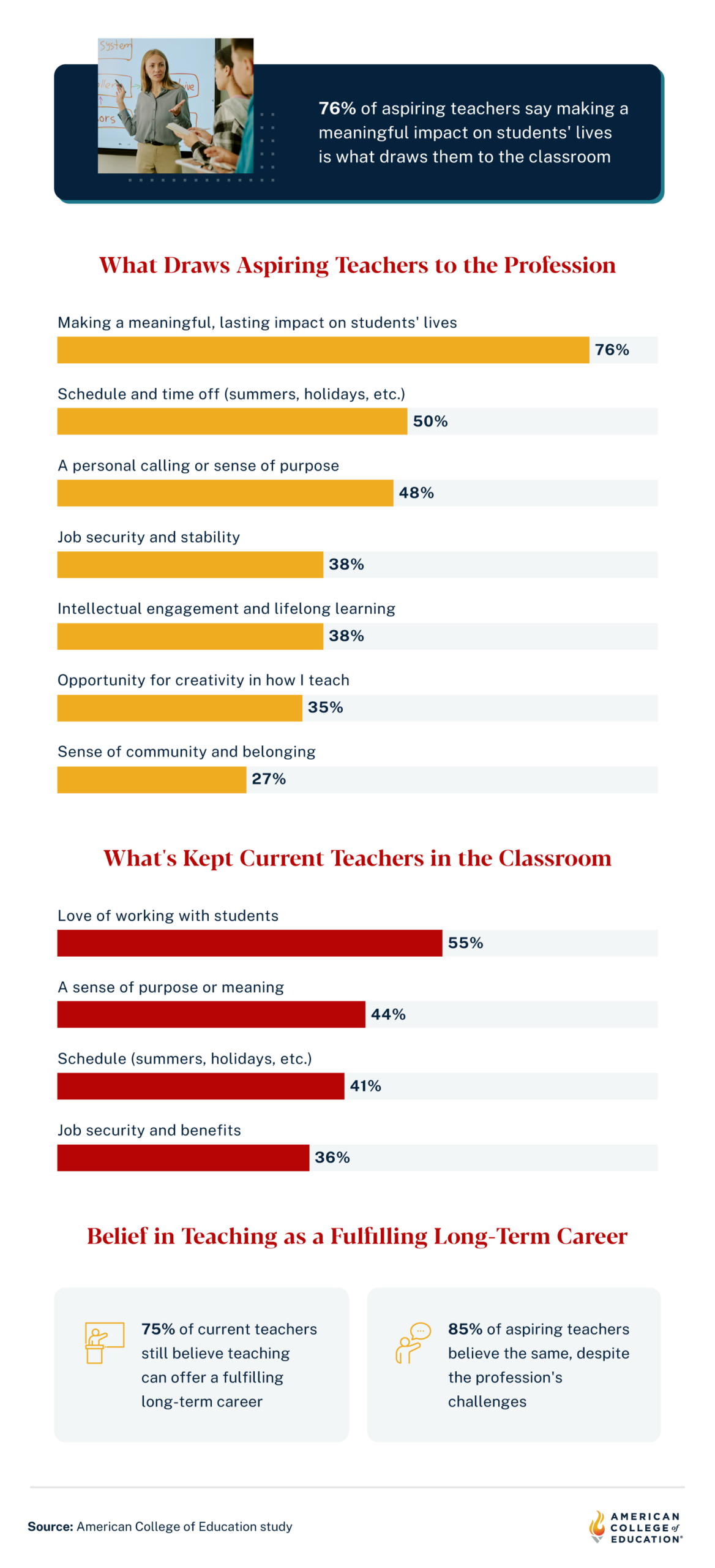
Making a meaningful impact was the biggest draw for aspiring teachers, with 76% citing it as their top motivation for taking on the job. This was followed by schedule and time off (50%) and a personal calling to the profession (48%). That pull toward impacting students’ lives is strongest among younger recruits: 88% of Gen Z aspiring teachers named it as a top draw, compared with 60% of millennials.
Current teachers who’ve stayed in the classroom point to similar reasons. Most cited their love of working with students (55%), a sense of purpose (44%), schedule (41%), and job security and benefits (36%) as the factors that have kept them there.
The Reality of Teaching Today
The pressures piling up on today’s teachers help explain why respect feels in short supply. But the same data points to where things could get easier, especially as new tools start to take some of that weight off.
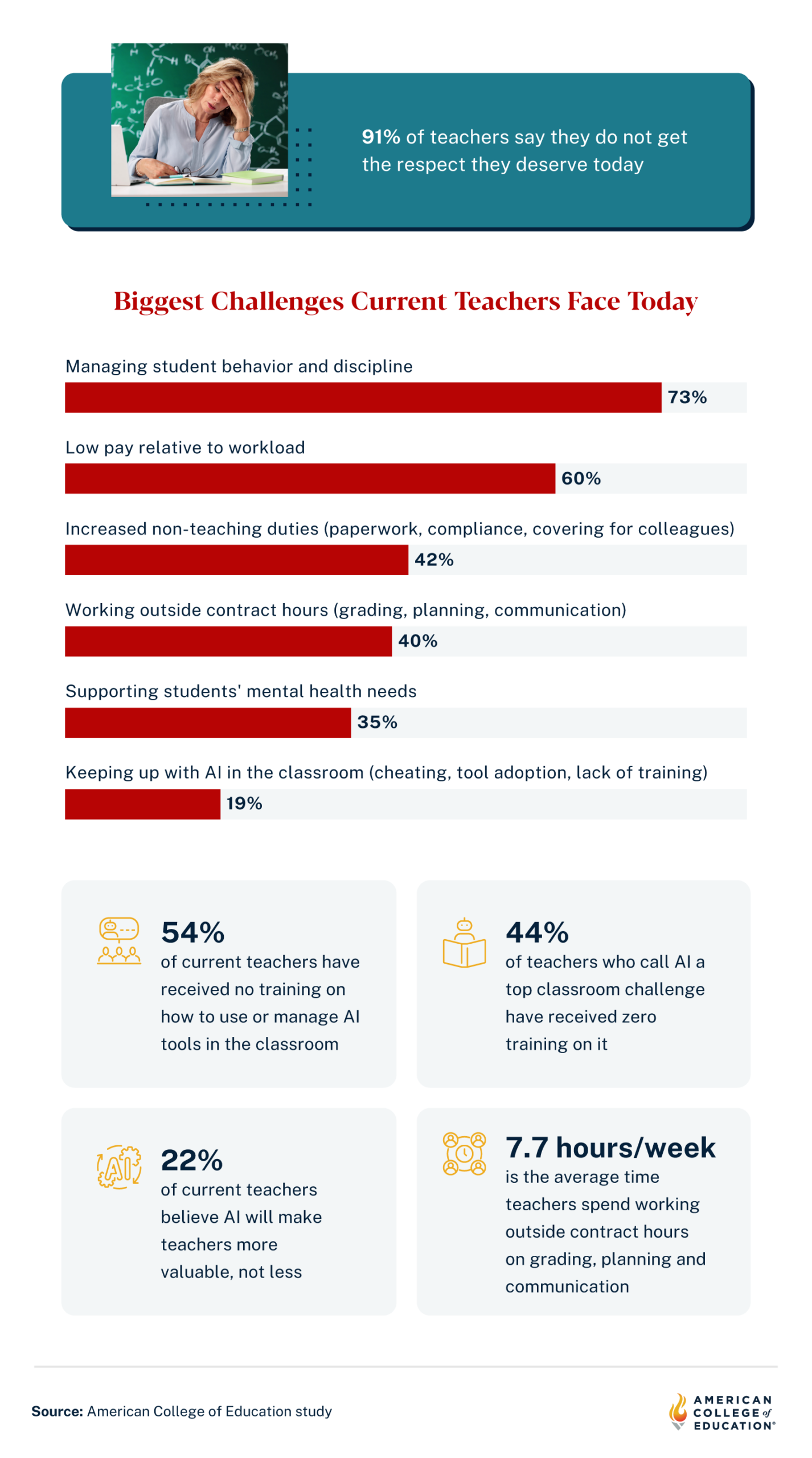
The majority of current teachers (91%) said teachers don’t get the respect they deserve today. Much of that frustration traces back to what’s landing on their plates, with managing student behavior (73%), low pay relative to their workload (60%) and non-teaching duties (42%) topping the list of daily challenges.
That workload doesn’t end when the school day does. Current teachers spend an average of 7.7 hours a week grading, planning and communicating outside contract hours.
Top Ways Teachers Expect the Profession to Change in the Next 5 to 10 Years
- Continued teacher shortages and larger class sizes: 69%
- More teachers leaving for education-adjacent roles outside the classroom: 53%
- More AI-assisted grading, lesson planning and administrative work: 49%
- Greater reliance on AI tutoring tools inside the classroom: 43%
- More non-teaching responsibilities added to the job: 34%
More than half of current teachers (54%) have had no training on how to use AI in the classroom, despite it being a tool that could take some of the workload off their plates.
The AI gap is something aspiring teachers can take note of as they study to prepare for the profession. Those who grow comfortable with these tools while still in their programs can start their first teaching job with a skill many current teachers lack. Options include seeking out a program that builds AI into the coursework or exploring the free tools available online.
What Would Keep Teachers in the Classroom
For a profession full of people who still want to make it work, teachers are clear about what would help.
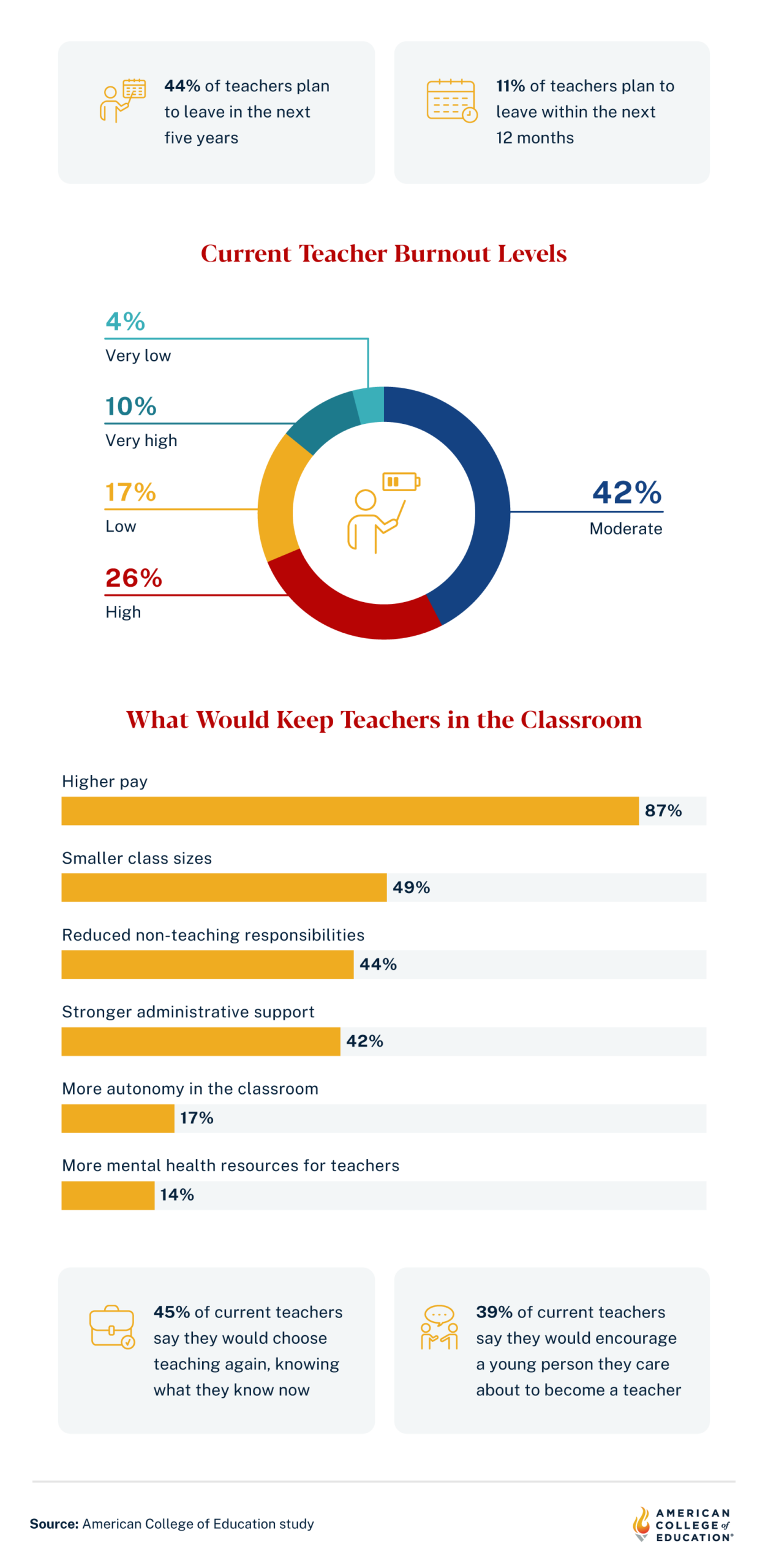
A significant share of current teachers are already eyeing the exit, with 44% saying they plan to leave the profession within the next five years and 11% considering leaving within the next year. That urgency lines up with how burned out many of them feel. More than a third of current teachers (36%) rate their burnout as high or very high.
Even so, many haven’t soured on the job itself. Close to half (45%) would choose teaching again if given the choice, and 39% would encourage a young person to enter the field.
When asked what would most improve retention, teachers pointed to higher pay first at 87%, followed by smaller class sizes (49%), reduced non-teaching responsibilities (44%) and stronger administrative support (42%). And for anyone weighing the profession, 22% of current teachers said the most important thing to know going in is that the pay doesn’t always match the workload.
The Opportunity Hiding in Teaching’s AI Gap
Teaching in 2026 is a job of real strain paired with real staying power. Teachers are asking for higher pay, smaller class sizes and more support, and those changes would clearly help with the burnout and attrition many are feeling. But the data also points to an opening for anyone willing to prepare differently.
More than half of current teachers reported no formal AI training, even as non-teaching duties and administrative work rank among their heaviest daily burdens. That gap points to a clear opportunity.
Aspiring teachers who build AI fluency early, during their coursework, certification or student teaching, can enter the profession ready to use these tools where they help most, easing the grading, planning and administrative load that pulls teachers away from students.
Methodology
This survey was conducted online by Fractl on behalf of American College of Education in August 2026 among 694 teachers across the United States. Respondents included current K-12 teachers (82%) and aspiring teachers studying for, pursuing certification for or otherwise planning to enter the profession (18%). Age was collected and grouped into generations (Gen Z, millennials, Gen X and baby boomers) for analysis.
All survey questions were text-entry or multiple-choice. Where noted, respondents could select more than one answer, so those percentages may sum to more than 100%. Respondents were recruited through an online research panel. Results have a margin of error of approximately ±3 percentage points.
About American College of Education
American College of Education is an accredited, fully online college specializing in high-quality, affordable programs in education, business, leadership, healthcare and nursing. Headquartered in Indianapolis, we offer more than 60 innovative and engaging programs for adult students to pursue a doctorate, specialist, master’s or bachelor’s degree, along with graduate-level certificate programs.
Fair Use Statement
This information is provided for noncommercial reuse with attribution to American College of Education and a link back to this page.


