

Artificial intelligence (AI) is everywhere. From smartphones that predict what we’ll type next to streaming platforms that recommend what to watch, AI has steadily become a major player in our routines. In healthcare, its influence is even more profound. AI technologies are transforming how medical professionals deliver care, interpret data, and manage workloads.
For nurses, this evolution brings powerful tools designed to enhance the human touch that defines the profession. AI in nursing is already supporting nurses in clinical decision-making, documentation, patient monitoring and education. The result is a smarter, more efficient, and more compassionate healthcare environment that benefits both providers and patients.
Read on to explore how artificial intelligence in nursing is reshaping the profession today and preparing nurses for a technology-driven future.
The Growing Importance of AI in Nursing
AI in nursing refers to the use of artificial intelligence technologies – such as machine learning, predictive analytics and natural language processing – to improve nursing care, reduce administrative burdens and enhance patient outcomes. These tools help nurses process large amounts of patient data quickly, identify potential risks, and make more informed decisions.
Across healthcare settings, AI is driving a quiet revolution. Hospitals now use AI systems to track patient vitals in real time, analyze medical images for early signs of disease and predict which patients may need additional support after discharge. According to a trend report by the Assistant Secretary for Technology Policy/Office of the National Coordinator for Health IT, 86% of health system-affiliated hospitals in the United States used predictive AI technology in the last year.
For patients, the benefits of AI use in healthcare include earlier detection of health issues, fewer medical errors and more personalized care. For nurses, AI provides valuable support, including the ability to automate repetitive tasks, which offers real-time insights and reduces the mental load that often contributes to burnout.
How AI Can Help Support Nurses in Daily Tasks
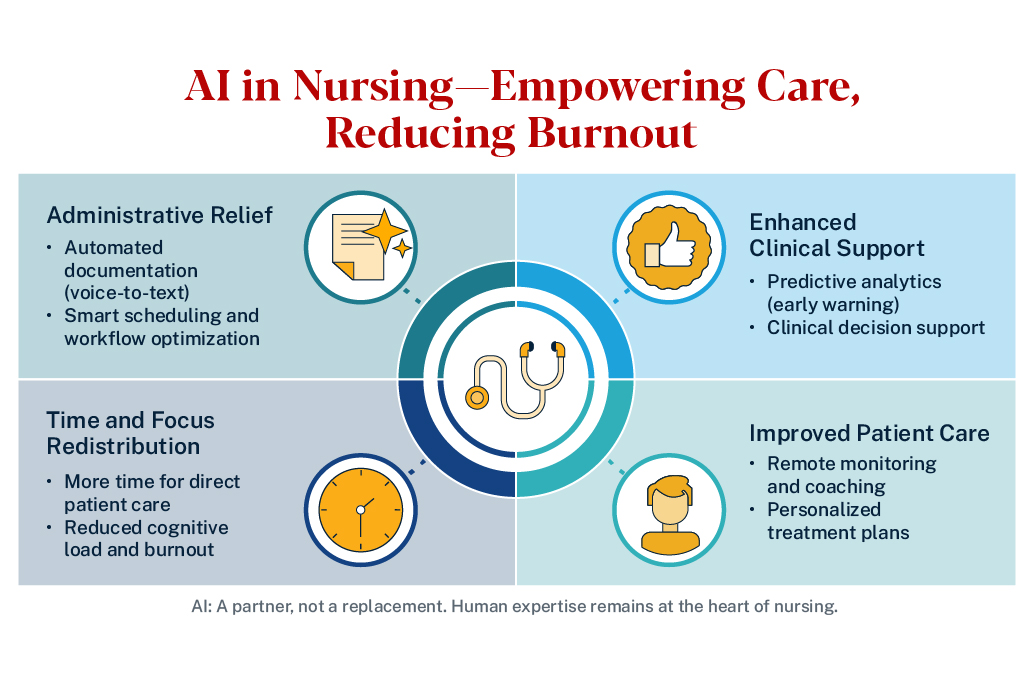
Nurses handle an enormous range of responsibilities every day, from documentation and charting to coordinating care across teams. While these duties are essential, they often take time away from direct patient interaction. AI-based tools help shift that balance by automating and simplifying routine tasks.
AI nursing tools can assist with scheduling, documentation and charting, ensuring that nurses spend less time clicking through electronic health records (EHRs) and more time connecting with patients. For example, AI-driven scheduling software can predict patient demand and staffing needs, while natural language processing tools can automatically transcribe and organize clinical notes from voice recordings.
By taking time-consuming administrative work, AI gives nurses the chance to focus on what matters most: compassionate, hands-on care that improves patient experiences and outcomes.
AI and Nursing: Enhancing Patient Care
As AI takes over more routine tasks, nurses gain valuable time to focus on patients. Beyond improving workflows, the true impact of AI in nursing lies in how it enhances patient care. By combining human empathy with data-driven precision, nurses can deliver safer, more personalized treatment. Additionally, through machine learning in healthcare, AI helps identify early warning signs, predict potential complications and support nurses in making timely, informed interventions.
Here are a few ways AI supports nurses in improving patient care:
- Early disease detection: AI systems analyze medical images and lab data to detect patterns that may signal disease before symptoms appear. This early detection leads to faster treatment and better outcomes.
- Real-time monitoring and alerts: Patient monitoring with AI-powered sensors tracks patient vitals around the clock, alerting nurses to sudden changes that require attention.
- Predictive analytics for better outcomes: Predictive models help nurses identify patients at higher risk for complications, allowing preventive care and personalized treatment plans.
It’s important to remember that AI tools are not here to replace clinical intuition but to strengthen it. With immediate access to actionable insights, nurses can make informed decisions and deliver more efficient, effective and compassionate care.
Improving Clinical Decision-Making With AI
Nurses constantly make high-stakes decisions under pressure. From assessing symptoms to determining medication dosages, their expertise guides every step of patient care. Artificial intelligence in nursing offers decision-support tools that help validate those choices and improve confidence in complex clinical environments.
For instance, some AI models analyze patient data to recommend appropriate medication dosages, taking into account allergies, comorbidities and drug interactions. Other systems help interpret diagnostic results, flag inconsistencies and suggest possible next steps for treatment.
By providing real-time guidance, these AI systems help reduce human error and relieve cognitive strain, which just happen to be two key contributors to nurse burnout. When nurses can rely on technology to handle data-heavy analysis, they can direct their energy toward empathy, communication and critical thinking, three key human elements of care that no algorithm can replicate.
Case Studies: How AI Supports Nurses Today
AI in nursing isn’t a distant concept. In fact, the healthcare industry is already seeing the benefits of AI in medicine in hospitals and clinics. At Mayo Clinic, AI-based algorithms help process cancer screening results much faster than with traditional methods. As per Bradley J. Erickson, director of Mayo Clinic’s Radiology Informatics Lab, this approach frees up radiology professionals – an approach that he admits “can help us a lot.”
Similarly, Cedars-Sinai Medical Center has introduced AI nurse assistant systems designed to make nursing more efficient and less stressful. One recent initiative, the Aiva Nurse Assistant app, allows patients to communicate requests through voice commands, automatically routing those needs to the appropriate staff member.
Speaking on the adoption of AI tools at Cedars-Senai Medical Center, Executive Director of Nursing, Peachy Hain, commends the technology’s effects. “We turned saved minutes into meaningful moments with patients,” she asserted. “It’s a win for our nurses, a win for our patients and a win for our organization.”
Ethical Considerations of AI in Nursing
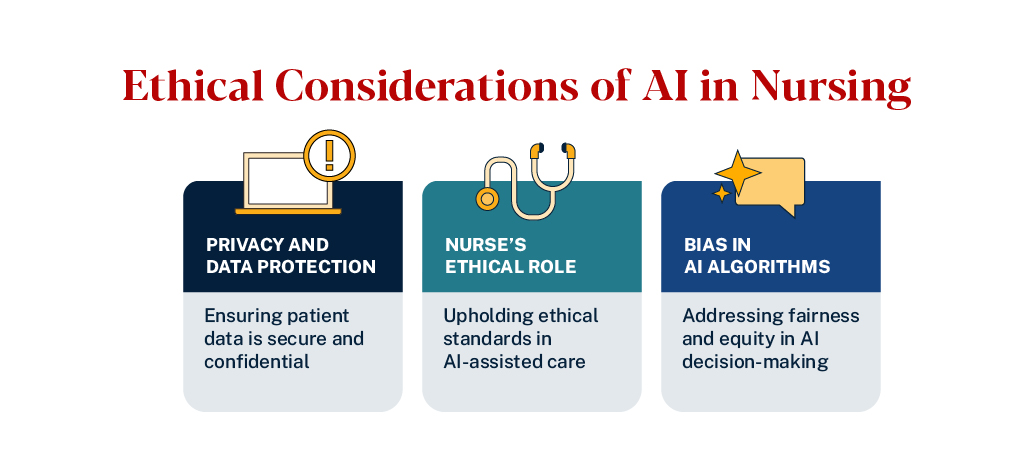
While the benefits of AI in healthcare are impressive, nurses must also navigate important ethical and legal concerns. AI systems rely on vast amounts of patient information, raising questions about privacy, data protection and compliance with HIPAA regulations. Nurses play a crucial role in safeguarding this information and ensuring that AI tools are used responsibly.
Another challenge involves bias in AI algorithms. Because these systems learn from historical data, they can unintentionally replicate existing inequities in healthcare. Nurses, with their commitment to equitable care, are often the first to notice when something doesn’t align with ethical standards.
Ultimately, the nurse’s role extends beyond using AI. It includes advocating fairness, transparency and patient trust as technology becomes more integrated into care.
Training Nurses for an AI-Driven Future
As AI technologies continue to advance, nurses must be prepared to adapt. Tech literacy is quickly becoming an essential part of nursing education, equipping professionals with the confidence to use digital health technologies effectively.
Nursing schools across the country are introducing courses in AI applications, data analytics and informatics. These programs help future nurses understand how to interpret data, evaluate AI-generated recommendations and make evidence-based decisions.
At American College of Education (ACE), innovation and accessibility are at the heart of nursing education. Programs such as the RN to BSN and BSN to MSN emphasize critical thinking, leadership and the responsible use of technology in healthcare.
For nurses already in the field, continuous learning is key. Professional development courses and graduate programs like ACE’s RN to MSN prepare nurses to integrate technology into practice and lead digital transformation initiatives.
AI will continue to shape the future of nursing but with proper training, nurses can ensure that technology enhances their care, not defines it.
The Future of AI and Nursing Collaboration
The relationship between AI and nursing will only deepen over the next decade. Experts predict that by 2035, AI will become a standard part of nearly every healthcare setting, assisting with diagnostics, workflow management and personalized medicine. However, this evolution doesn’t mean nurses will be replaced. Instead, the future of AI in nursing lies in collaboration between human compassion and machine intelligence:
- AI as a collaborative tool: AI systems will likely continue to handle data-heavy tasks such as trend analysis and early detection, while nurses provide emotional intelligence and ethical judgment that machines can’t replicate.
- Hybrid nursing care: Care models will blend human expertise and AI technology, allowing for greater efficiency, fewer errors and improved patient satisfaction.
- Enhanced nursing leadership: As AI becomes more prevalent, nurse leaders will play a vital role in training staff, shaping policies and ensuring equitable access to technology-driven care.
FAQs
What is AI in nursing?
AI in nursing involves using artificial intelligence technologies, such as machine learning and predictive analytics, to improve patient care, streamline workflows and enhance decision-making in healthcare.
How does AI support nurses in patient care?
AI assists nurses by automating documentation, analyzing patient data for early detection and offering real-time alerts for potential risks. These tools free nurses to spend more time providing direct, compassionate care.
What are examples of AI used in nursing?
Examples include AI-powered scheduling systems, predictive analytics for disease prevention and real-time monitoring devices that alert nurses to changes in patient conditions.
What challenges do nurses face with AI?
Common challenges include data privacy concerns, algorithmic bias, and the need for proper training to ensure nurses can use AI responsibly and effectively.
Advancing Your Nursing Career in the Age of AI
Just as AI is integrating into other industries, the integration of AI into nursing is the next chapter of healthcare innovation. As the technology evolves, nurses will remain the heart of the profession, using AI-based systems to deliver safer, smarter and more compassionate care.
If you’re ready to embrace this future, start by strengthening your skills and advancing your education. Whether you’re moving from RN to BSN or pursuing a master’s in nursing, ACE offers affordable, flexible online programs that prepare nurses to lead in an AI-driven world.