
American College of Education (ACE) is incredibly proud of our graduates and how their impactful research contributes to various fields. Ed.D. in Public Health Education graduate Dr. Melissa Dueck researched the outcomes of high school students experiencing homelessness in Oregon and the relationship between access to school-based health centers, chronic absenteeism and dropout rates. Below is a summary of the study, and we invite readers to explore the full version.
Students experiencing homelessness often face challenges that extend beyond the classroom, affecting attendance, academic success and overall well-being. While school-based health centers (SBHCs) have expanded access to healthcare for many students, less is known about how these services may influence educational outcomes for students experiencing homelessness.
Dr. Melissa Dueck analyzed enrollment data from approximately 180,000 Oregon high school students to examine the relationship between access to SBHCs and educational outcomes for students experiencing homelessness. The research explored two questions:
- Research Question 1: Is there a statistically significant relationship between access to SBHCs and chronic absenteeism rates among high school students who are homeless compared to non-homeless?
- Research Question 2: Is there a statistically significant relationship between access to SBHCs and dropout rates among high school students who are homeless compared to non-homeless?
Addressing Homelessness as a Public Health and Education Challenge
Students experiencing homelessness often face barriers that extend well beyond the classroom. Housing instability can affect attendance, academic achievement, physical health and future opportunities, making youth homelessness a concern for both educators and public health professionals.
During the 2022-2023 school year, roughly 21,500 students in Oregon experienced homelessness, accounting for about 4% of statewide enrollment. Although policies have been enacted that help students access educational services and remain enrolled, many continue to experience higher rates of chronic absenteeism and dropout than housed peers.
School-based health centers have become an important part of that conversation because they expand access to healthcare and other services within schools. While research has linked SBHCs to improved health and educational outcomes, less is known about how these services may affect students experiencing homelessness.
What Previous Research Reveals About Student Homelessness
Before conducting the study, Dueck reviewed current research examining youth homelessness, educational outcomes and school-based interventions. Collectively, these studies provided insight into the challenges students experiencing homelessness face while highlighting opportunities to better support academic success and overall well-being.
How Homelessness Affects Educational Outcomes
Students experiencing homelessness face greater educational challenges than housed peers. Housing instability can disrupt learning, lead to frequent school changes and make it more difficult to attend school consistently.
Chronic absenteeism is closely linked to poor academic performance and can increase the risk of dropping out. Students experiencing homelessness are more likely to miss school because of barriers such as transportation, illness and unstable living situations. Over time, missed instructional time can increase the risk of dropping out and make it harder to stay on track academically.
The effects can extend beyond high school. Lower educational attainment is associated with poorer health, fewer employment opportunities and greater economic instability, reinforcing the importance of helping students stay engaged in school.
Barriers Beyond the Classroom
Students experiencing homelessness often face challenges that extend beyond the classroom. Limited access to healthcare, nutritious food, transportation, stable housing and mental health services can all affect a student’s ability to attend school consistently and succeed academically.
Housing instability can also take an emotional toll. Stress, anxiety, depression and the stigma surrounding homelessness may discourage students from seeking help, creating additional barriers to learning and academic success.
Because these challenges often overlap, supporting students experiencing homelessness requires more than addressing academic needs alone. Access to healthcare, basic resources and a supportive school environment can all play a role in helping students stay engaged in school.
Existing Support Systems and the Role of School-Based Health Centers
The McKinney-Vento Homeless Assistance Act established important protections that help students remain enrolled in school and access educational services, but supporting students experiencing homelessness takes more than one solution.
District homeless liaisons, teachers, counselors and community organizations also help connect students with resources and support. Together, these individuals and organizations can help students navigate the challenges associated with housing instability.
School-based health centers add another layer of support by making healthcare more accessible. Located on or near school campuses, many SBHCs provide primary care, behavioral health services, preventive care and referrals to community resources, making healthcare more accessible to students who may otherwise struggle to receive these services.
Research has linked SBHCs to improved attendance and graduation outcomes among students overall. However, relatively little research has examined how these services affect students experiencing homelessness.
Exploring Student Data in Oregon
Dueck analyzed existing statewide data from the Oregon Department of Education and the Oregon Health Authority rather than collecting new information through surveys or interviews.
Dueck examined chronic absenteeism among more than 124,000 students and school dropout rates among more than 102,000 students. The data included students experiencing homelessness and housed students, making it possible to compare outcomes for students with and without access to SBHCs.
The study examined the relationship between access to SBHCs, chronic absenteeism and school dropout among Oregon high school students.
Conducting Statistical Analysis and Examining Relationships
After the data was reviewed and prepared, each research question was analyzed separately to examine the relationship between access to school-based health centers and student outcomes.
Statistical analyses measured whether differences in chronic absenteeism and school dropout between student groups were significant and evaluated the strength of those relationships.
Using statewide data and statistical analysis helped identify meaningful patterns that can inform future education and public health efforts to support students experiencing homelessness.
What the Findings Mean for Supporting Students Experiencing Homelessness
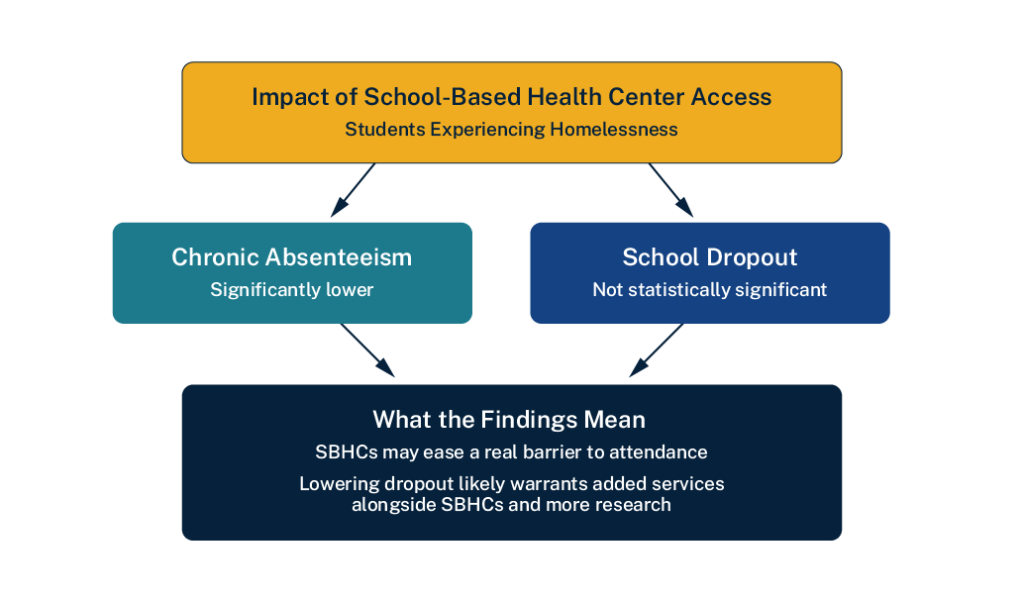
The study found a statistically significant relationship between access to school-based health centers and lower rates of chronic absenteeism among high school students experiencing homelessness. The findings suggest that expanding access to healthcare and supportive services within schools may help reduce one of the barriers that keeps students out of the classroom.
The findings were different for school dropout. Although students with access to SBHCs had lower dropout rates overall, the relationship was not statistically significant for students experiencing homelessness.
The results suggest that reducing dropout rates may require additional services and interventions alongside SBHCs. Additional research is needed to better understand which approaches are most effective for improving graduation outcomes among students experiencing homelessness.
Study Limitations and Future Research
The study included several limitations. Because the research focused on Oregon public schools, the findings may not apply to states with different student populations or school-based health center systems. The study also relied on existing state data, limiting the analysis to information already collected by state agencies.
Dueck suggested that future research could build on these findings by:
- Examining additional interventions that complement SBHCs
- Exploring outcomes in other states and school settings
- Evaluating broader partnerships among schools, public health organizations and community organizations that support students experiencing homelessness
- Informing education policy and decisions about expanding school-based health services
American College of Education offers affordable education and healthcare degree programs designed to equip adult learners to impact student success and wellbeing.