
Marketing Skills
Explore the career you could build with this skill.
What Are Marketing Skills?
Every organization is vying for attention in a crowded marketplace. Whether they’re launching a new product or growing a small business, successful organizations rely on marketing to connect with the right audience at the right time. As consumer behavior continues to evolve, marketing has become an essential driver of business growth.
Marketing skills help professionals understand customer needs, develop effective messaging and create strategies that support organizational goals. These skills may include market research, branding, content creation, digital marketing, social media marketing, campaign planning and performance analysis. As businesses increasingly rely on data and technology to guide their decisions, professionals with marketing skills are well equipped to help organizations strengthen their brand, engage customers and measure the impact of their marketing efforts.


Recent Trends in Marketing
Digital channels and data-driven decision-making are two of the biggest reasons for change in today’s marketing landscape. Businesses increasingly use analytics, artificial intelligence and automation to better understand customer behavior, personalize marketing efforts and measure campaign performance. As a result, professionals who can combine creativity with analytical thinking are becoming increasingly valuable across industries.
Social media, search engines, email marketing and other digital platforms also continue to shape how organizations communicate with their audiences. Marketing professionals who understand changing consumer preferences, emerging technologies and integrated marketing strategies are well positioned to support business growth in today’s competitive marketplace.
Marketing Courses
American College of Education (ACE) offers standalone courses that can help you develop your skills in this area.
Marketing Careers
Learn more about the career paths you can pursue with this skill on your resume.
Course Stackability
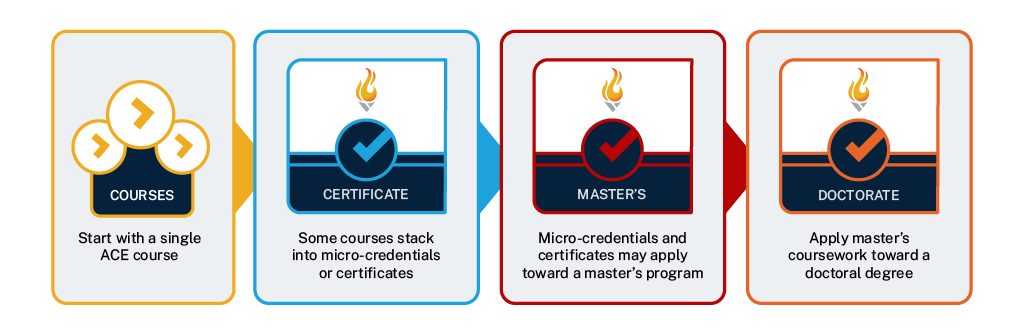
We want our students to get the most out of their hard work. That’s why we design our courses and programs with stackability in mind. Some courses can be applied toward a micro-credential or certificate, which can in turn be applied toward a master’s degree, subject to program requirements. That master’s degree coursework could then be applied toward a doctorate. Even by taking a single course at ACE, you're taking a smart step toward a larger educational future.
Related Degrees
The courses you take in this skill area can earn you academic credit that you can apply to these ACE degrees.
Course Admissions
For students taking single courses without enrolling in a program, admission requirements will depend on the level of the course. Students must meet ACE’s general admission requirements and be admitted to the college before signing up for a stand-alone class.
Bachelor’s Level
- At least 30 semester credits
- Minimum GPA of 1.75
Master’s Level
- A bachelor’s or highest post-baccalaureate degree
- Minimum GPA of 2.5*
Doctoral Level
- A master’s or doctoral degree
- Minimum GPA of 3.0
*Applicants whose overall GPA is between 2.0-2.49 may be considered for admission if their degree was conferred more than 10 years from the start date at ACE or the applicant has five or more years of experience in the field appropriate for intended courses.
Marketing FAQs
What are the benefits of taking marketing courses online?
Marketing courses online allow you to build valuable marketing knowledge while learning on a schedule that fits your personal and professional commitments. Depending on the course, you may strengthen your understanding of consumer behavior, branding, digital marketing, market research and campaign planning while developing practical skills that can be applied across a variety of industries.
How do digital marketing courses help professionals stay competitive?
Digital marketing courses help professionals keep pace with the evolving ways organizations connect with customers online. You may learn how digital channels, data analytics, search engines, email marketing and social media support business growth, while developing skills that help you adapt to changing technologies and marketing trends.
What is covered in marketing strategy courses?
Marketing strategy courses typically explore how organizations develop and execute plans to reach their target audiences and achieve business goals. Depending on the course, you may study market research, customer segmentation, branding, competitive analysis, campaign planning, performance measurement and strategic decision-making. The specific topics covered will vary by course.
Are online marketing courses useful for small business owners?
Yes. Online marketing courses can help small business owners better understand how to promote their products or services, connect with customers, and build brand awareness. Marketing knowledge can also support business growth by helping owners make informed decisions about advertising, digital marketing, customer engagement and long-term marketing strategies.
What skills can I gain from studying digital and social media marketing?
Studying digital marketing and social media marketing can help you develop skills in content creation, audience engagement, campaign planning, digital advertising, analytics and performance measurement. You may also strengthen your understanding of branding, marketing strategy and how organizations use digital platforms to build relationships with customers and achieve business objectives.