
Career Guide: Market Research Analyst
Here’s what you need to know.
Toggle Navigation
Our Enrollment Counselors are here to answer your questions and walk you through the enrollment process.
Market Research Analyst Career Overview
The economy moves fast. Trends shift, consumer preferences change and what worked yesterday may not work tomorrow. In today’s data-driven landscape, businesses must rely on measurable insights to stay competitive.
This is where market research analysts make an impact. They ask the right questions, dig into data and uncover findings that shape real decisions. From launching new products to refining marketing strategies, their work helps organizations move with purpose instead of guesswork.
If you enjoy solving problems, spotting patterns and understanding what drives people to make decisions, this is a career where your curiosity becomes your greatest strength. Learn more about what a market research analyst does, how to become one and what to expect from this growing career field.
What Is a Market Research Analyst?
A market research analyst helps organizations make smarter business decisions by studying data about consumers, competitors and overall market conditions. They are the connection between what people do and how businesses respond. By analyzing consumer behavior, identifying target markets and tracking market trends, these professionals help companies adjust their strategies in real time.
What Does a Market Research Analyst Do?
At first glance, the role might seem like it is all about data. In reality, it is about understanding people and helping businesses respond to what they learn.
Core Duties and Responsibilities
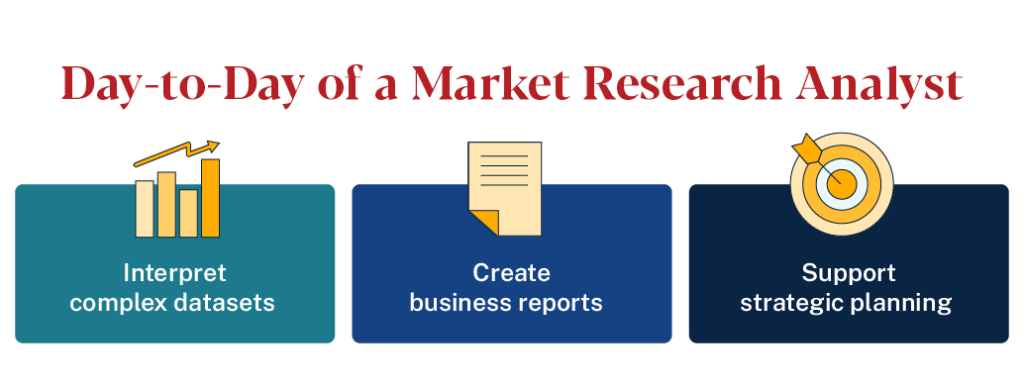
On any given day, a market research analyst is connecting the dots between information and action. That might look like:
- Collecting and organizing data to understand how consumers behave and how markets are shifting
- Analyzing sales trends and patterns to uncover what is working and what needs to change
- Designing surveys and focus groups that reveal how people think, choose and respond
- Interpreting findings so teams can clearly see what the data is saying
- Presenting insights in a way that helps decision-makers move forward with confidence
- Monitoring market conditions to spot opportunities before competitors do
The work is not just about finding answers. It is about asking better questions and leveraging information for stronger business and consumer relationships.
Work Environment Variations
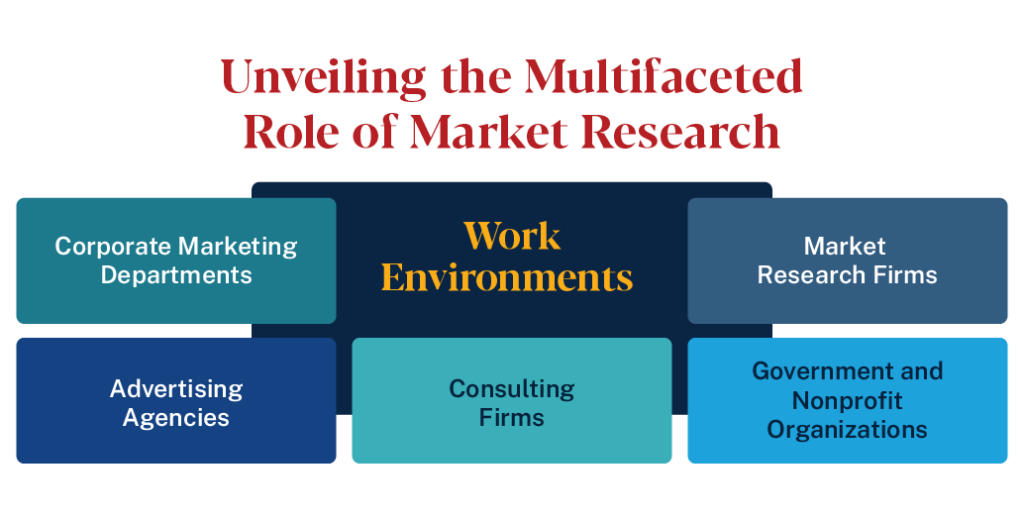
Market research analysts work in a variety of industries, including business, marketing, consulting and corporate settings. Their ability to connect data to real-world decisions makes them highly valuable in today’s economy. Common work settings include:
- Corporate marketing departments focused on brand growth
- Market research firms that support multiple clients
- Advertising agencies that rely on audience insights
- Consulting firms that guide business strategy
- Government or nonprofit organizations analyzing public trends
Skills & Traits That Make a Successful Market Research Analyst
To succeed as a market research analyst, you need more than technical knowledge. The role sits at the intersection of data and decision-making, which means you must understand the numbers and explain what they mean in a way others can act on.
Essential Soft Skills
Data can seem overwhelming to individuals who aren’t familiar with how to interpret and understand it. That’s where marketing research analysts leverage soft skills to ensure metrics translate into action items. These skills include:
- Clear communication: Presenting findings in a way that is easy for stakeholders to understand and use
- Critical thinking: Evaluating complex information and determining how it can support decision-making
- Attention to detail: Prioritizing close proofreading when working with large datasets where small errors can lead to misleading conclusions
- Curiosity: Exploring consumer behavior to drive better questions and more effective research
- Data translation: Transforming metrics into insights that connect numbers to real-world business decisions
Important Technical Skills
Technical knowledge allows analysts to collect, interpret and present data with confidence. For example:
- Proficiency in data analysis tools and statistical software to identify patterns and trends within large datasets
- Understanding of research methods and survey design to ensure the data being collected is accurate and useful
- Familiarity with marketing strategies and analytics tools so insights align with business goals and campaigns
- Ability to create reports and data visualizations that make complex information clear and actionable
How These Skills Apply on the Job
In this role, your skills are constantly in motion. One moment, you are exploring data to understand consumer preferences. Next, you are explaining what those insights mean for a campaign or product launch. Your work helps teams move forward with clarity instead of guesswork, which makes this role both challenging and rewarding.
Market Research Analyst Education Requirements
If you are thinking about becoming a market research analyst, your education should help you answer one core question: How do you turn data into decisions?
Most professionals start with a degree that builds both business knowledge and analytical thinking. You do not need to have everything figured out right away, but you do need a foundation that helps you understand how markets work and how consumers make decisions.
Minimum Education Requirements
Most entry-level roles expect:
- A bachelor’s degree in marketing, business or a related field that introduces you to how organizations operate
- Coursework in statistics, research methods or social sciences so you can work confidently with data and interpret results
Preferred Education Pathways
As you grow in your career, additional education can help you move into more specialized or leadership roles:
- Degrees in marketing, business analytics or economics that deepen your understanding of market behavior
- Advanced degree that strengthens your ability to lead projects and guide strategy
How to Become a Market Research Analyst
While there is no single path into the market research field, many careers follow a similar progression. This step-by-step process can look like this:
- Earn a Relevant Degree
Start with a degree that helps you understand both business strategy and data. This is where everything begins to connect.
- Gain Experience
Build experience in entry-level roles where you’re actively participating in supporting marketing teams with research and reporting, and assisting with surveys, focus groups or campaign analysis.
- Build Technical Skills
As you gain experience, your toolkit becomes more important as you:
Learn statistical software and research tools
Practice turning data into clear and useful insights - Apply for Market Research Analyst Roles
Look for opportunities in corporate teams, agencies or consulting environments where data plays a central role.
- Optional: Advance With a Graduate Degree
If you want to move into leadership or more strategic roles, a graduate degree can help:
Master of Business Administration
M.S. in Organizational Leadership
Day-in-the-Life & Real-World Scenarios
Take a closer look at what the market research analyst career can look like as the role comes alive.
A Typical Workday
You might start your day digging into campaign data, looking for patterns in how consumers are responding. By mid-morning, you could be refining a survey or preparing questions for a focus group. Later in the day, you may meet with a team to explain what the data reveals and what actions make the most sense moving forward.
Real-World Examples
Much of a market research analyst’s work starts with a simple question that a business needs answered. It could come from a marketing team preparing for a campaign, a company launching a new product or leadership trying to understand a shift in performance.
From there, the analyst steps in to investigate, using data to uncover what is really happening and why. In practice, that often means answering questions like:
- Who is most likely to buy this product and why?
- What is driving changes in consumer behavior?
- How can a company better connect with its target market?
What Success Looks Like in the Role
Success in this role is about impact. Keep in mind that you’re doing much more than analyzing data. Ultimately, you’re helping organizations make smarter decisions because of it.
Strong market research analysts deliver accurate market insights that reflect what consumers actually want and how markets are shifting. Those insights help teams refine their approach, leading to more effective and focused marketing strategies.
Over time, your work becomes part of how an organization operates. Instead of relying on assumptions, teams begin to make data-driven decisions with confidence. That shift is where the real value of the role shows up.
Available Degree Programs
Whether you are just starting out or looking to take the next step, the right program can support your market research analyst career. American College of Education (ACE) offers flexible, affordable pathways to a strong education in business.
- Bachelor of Science in Business Administration & Leadership
- Master of Business Administration
- Master of Science in Organizational Leadership
Career Outlook and Growth
As the value of data continues to rise in today’s digital economy, the demand for market research analysts continues to grow.


According to the United States Bureau of Labor Statistics, these professionals earned a median annual wage of $76,950 as of May 2024.* This annual salary is based on experience, industry and location.
Employment is projected to grow by 7%, reflecting a much faster than average growth for market research analysts over the next decade. This growth represents roughly 87,200 job openings projected each year from 2024 to 2034.*
FAQs
Do market research analysts need strong math skills?
Yes. A solid understanding of statistics and data analysis helps ensure your insights are accurate.
What tools and software do market research analysts use?
They use statistical software, survey platforms and reporting tools to analyze and present data.
What industries hire market research analysts?
These professionals regularly work across business, marketing, consulting, healthcare and government sectors.
How do market research analysts gather consumer data?
Data collection can come in a variety of ways. Market research analysts use surveys, interviews and focus groups along with existing datasets.
What is the difference between a market research analyst and a data analyst?
Market research analysts focus on consumer behavior and market insights, while data analysts may work across broader datasets.
Turn Insight Into Career Opportunity With ACE
Every business wants to understand its consumers, but they don’t always know how. That is where market research analysts make a difference.
If you are ready to build skills in data analysis, consumer insight and strategic thinking, ACE offers programs designed for working professionals to succeed. Take the next step toward a career where your work helps shape real decisions and real outcomes.