

Leadership
Explore the career you could build with this skill.
What Is Leadership?
Leadership inspires individuals and teams to work toward shared goals while fostering collaboration, accountability and growth. Across a wide range of industries, effective leaders build trust, communicate clearly and make thoughtful decisions that help organizations navigate change and achieve long-term success.
Developing leadership skills strengthens your ability to solve problems, manage people and guide strategic initiatives across a variety of industries. These skills support professionals at every career stage, from emerging leaders to experienced managers and executives.


Recent Trends in Leadership
Organizations value leaders who promote collaboration, adaptability and inclusive decision-making in today’s evolving workplace. They also seek professionals who can lead hybrid teams, embrace new technologies and respond effectively to changing business needs.
Leadership increasingly emphasizes emotional intelligence, continuous learning and data-informed decision-making. Professionals who develop these skills help build resilient teams, strengthen organizational culture and drive meaningful results.
Leadership Courses
American College of Education (ACE) offers standalone courses that can help you develop your skills in this area.
Leadership Careers
Learn more about the career paths you can pursue with this skill on your resume.
Course Stackability
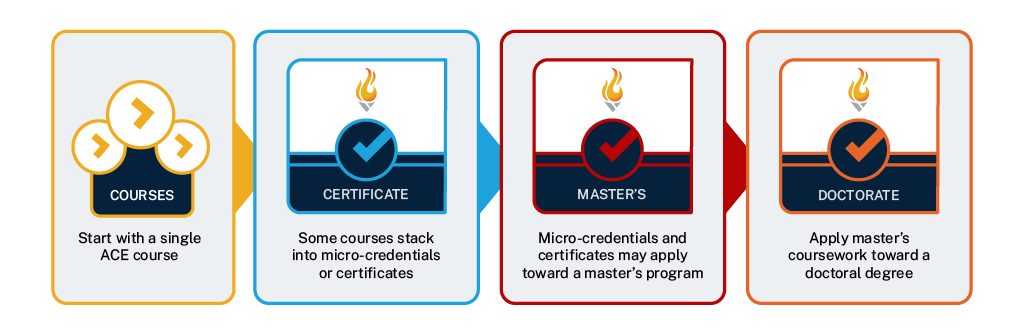
We want our students to get the most out of their hard work. That’s why we design our courses and programs with stackability in mind. Some courses can be applied toward a micro-credential or certificate, which can in turn be applied toward a master’s degree. That master’s degree coursework could then be applied toward a doctorate. Even by taking a single course at ACE, you're taking a smart step toward a larger educational future.
Related Degrees
The courses you take in this skill area can earn you academic credit that you can apply to these ACE degrees.
Course Admissions
For students taking single courses without enrolling in a program, admission requirements will depend on the level of the course. Students must meet ACE’s general admission requirements and be admitted to the college before signing up for a stand-alone class.
Bachelor’s Level
- At least 30 semester credits
- Minimum GPA of 1.75
Master’s Level
- A bachelor’s or highest post-baccalaureate degree
- Minimum GPA of 2.5*
Doctoral Level
- A master’s or doctoral degree
- Minimum GPA of 3.0
*Applicants whose overall GPA is between 2.0-2.49 may be considered for admission if their degree was conferred more than 10 years from the start date at ACE or the applicant has five or more years of experience in the field appropriate for intended courses.
Leadership Management FAQs
What are leadership skills?
Leadership skills are the abilities that help you guide, motivate, and support individuals or teams toward a common goal. They include communication, decision-making, problem-solving, emotional intelligence, collaboration and strategic thinking that apply across many professional settings.
What do leadership courses typically teach?
Leadership courses help you develop practical skills for leading teams and organizations. Depending on the course, you may study communication, conflict resolution, organizational behavior, strategic planning, change management and techniques for motivating others and making effective decisions.
Can I develop leadership skills through online leadership courses?
Yes. Online leadership courses provide flexible opportunities to strengthen your leadership abilities while balancing work and personal commitments. Many courses combine leadership theory with practical strategies that you can apply in professional settings.
Who should take leadership and management courses?
Leadership and management courses benefit current and aspiring leaders, supervisors, educators, healthcare professionals, business professionals, and anyone who wants to strengthen their ability to lead others. They also support individuals preparing for greater responsibility or management roles within their organizations.
Why are leadership skills valuable across industries?
Leadership skills help professionals communicate effectively, build strong teams and navigate change with confidence. Because every industry relies on effective leadership, these skills support career growth and contribute to organizational success in business, education, healthcare, government and nonprofit organizations.