
History
Explore the career you could build with this skill.
What Is History?
History examines the people, events and ideas that have shaped societies over time. By exploring the past, we can better understand how cultures, governments and communities have evolved and how those changes continue to influence the present.
Studying history develops skills in research, critical thinking, analysis and communication that apply across many professions. These skills help professionals evaluate sources, interpret evidence and communicate complex ideas in education, business, government and other fields.


Recent Trends in History
Today’s historians use digital archives, geographic information systems and online collections to expand access to historical records and uncover new perspectives. These tools make historical research more accessible while supporting collaboration across institutions and disciplines.
History also plays a growing role in helping people understand diverse experiences and global events. Professionals use historical research to inform education, public policy, cultural preservation and organizational decision-making.
History Courses
American College of Education (ACE) offers standalone courses that can help you develop your skills in this area.
History Careers
Learn more about the career paths you can pursue with this skill on your resume. Please note that some careers listed may require state licensure, certification or additional qualifications.
Course Stackability
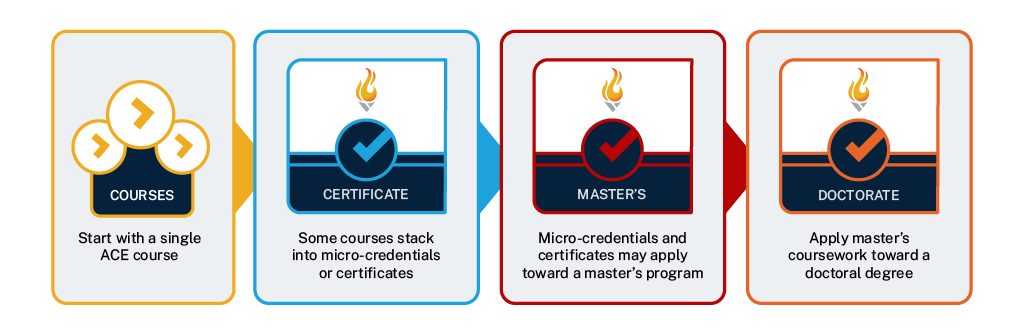
We want our students to get the most out of their hard work. That’s why we design our courses and programs with stackability in mind. Some courses can be applied toward a micro-credential or certificate, which can in turn be applied toward a master’s degree. That master’s degree coursework could then be applied toward a doctorate. Even by taking a single course at ACE, you're taking a smart step toward a larger educational future.
Related Degrees
The courses you take in this skill area can earn you academic credit that you can apply to these ACE degrees.
Course Admissions
For students taking single courses without enrolling in a program, admission requirements will depend on the level of the course. Students must meet ACE’s general admission requirements and be admitted to the college before signing up for a stand-alone class.
Bachelor’s Level
- At least 30 semester credits
- Minimum GPA of 1.75
Master’s Level
- A bachelor’s or highest post-baccalaureate degree
- Minimum GPA of 2.5*
Doctoral Level
- A master’s or doctoral degree
- Minimum GPA of 3.0
*Applicants whose overall GPA is between 2.0-2.49 may be considered for admission if their degree was conferred more than 10 years from the start date at ACE or the applicant has five or more years of experience in the field appropriate for intended courses.
History FAQs
What can you learn in online history courses?
Online history courses explore the people, events and movements that have shaped societies throughout history. Depending on the course, you may examine historical periods, analyze primary and secondary sources, strengthen research skills, and learn how historical events continue to influence the modern world.
Are history courses online as comprehensive as in-person courses?
Yes. History courses online often cover the same core concepts as in-person courses while offering greater flexibility for busy students. Many online courses include discussions, research assignments and source analysis that help you build historical knowledge and critical thinking skills.
Who should take history courses?
History courses benefit students, educators and professionals who want to better understand historical events, cultures and societal change. They also support anyone looking to strengthen research, analytical thinking and communication skills that transfer across a variety of careers.
What skills are important for history teachers?
Skills for history teachers include historical research, source evaluation, critical thinking and effective communication. History teachers also benefit from the ability to engage students, present multiple perspectives and connect historical events to contemporary issues through meaningful instruction.
How can history skills apply outside the classroom?
History skills help professionals analyze information, evaluate evidence and communicate ideas clearly in many workplace settings. Employers across business, government, nonprofit organizations and healthcare value these transferable skills because they support informed decision-making, research and problem-solving.