

Chemistry
Explore the career you could build with this skill.
What Is Chemistry?
Chemistry helps explain the world at its most fundamental level, from the air we breathe to the medicines we take and the materials we use in our everyday lives. This core branch of natural science explores matter, its properties and the reactions that transform one substance into another.
Building chemistry skills can strengthen your ability to observe, analyze data and solve complex problems. These abilities can support work in education, healthcare, research and other science-related fields.


Recent Trends in Chemistry
Chemistry continues to evolve as scientists search for new ways to improve health, develop materials and address environmental challenges. Advances in areas such as nanotechnology, biotechnology and computational chemistry are creating new possibilities for research and innovation.
Sustainability also influences the field, as researchers explore cleaner processes, renewable materials and ways to reduce waste. These developments make chemistry an important part of solving complex scientific and societal challenges.
Chemistry Courses
American College of Education (ACE) offers standalone courses that can help you develop your skills in this area.
Chemistry Careers
Learn more about the career paths you can pursue with this skill on your resume. Please note that some careers listed may require state licensure, certification or additional qualifications.
Course Stackability
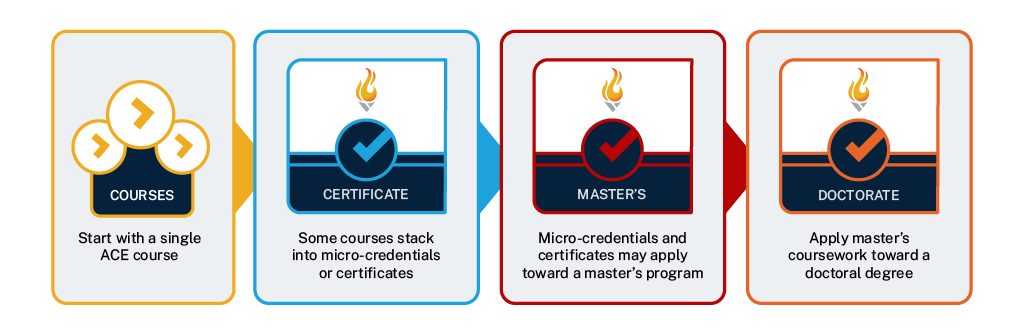
We want our students to get the most out of their hard work. That’s why we design our courses and programs with stackability in mind. Some courses can be applied toward a micro-credential or certificate, which can in turn be applied toward a master’s degree. That master’s degree coursework could then be applied toward a doctorate. Even by taking a single course at ACE, you're taking a smart step toward a larger educational future.
Related Degrees
The courses you take in this skill area can earn you academic credit that you can apply to these ACE degrees.
Course Admissions
For students taking single courses without enrolling in a program, admission requirements will depend on the level of the course. Students must meet ACE’s general admission requirements and be admitted to the college before signing up for a stand-alone class.
Bachelor’s Level
- At least 30 semester credits
- Minimum GPA of 1.75
Master’s Level
- A bachelor’s or highest post-baccalaureate degree
- Minimum GPA of 2.5*
Doctoral Level
- A master’s or doctoral degree
- Minimum GPA of 3.0
*Applicants whose overall GPA is between 2.0-2.49 may be considered for admission if their degree was conferred more than 10 years from the start date at ACE or the applicant has five or more years of experience in the field appropriate for intended courses.
Chemistry FAQs
What do online chemistry courses teach?
Online chemistry courses can cover topics such as atomic structure, chemical reactions, bonding, matter and the periodic table. Specific topics vary depending on the course and its level.
Can beginners take a chemistry course online?
Yes. Introductory chemistry courses are designed to build foundational knowledge before progressing to more complex concepts. Be sure to review individual course descriptions and prerequisites before enrolling.
What are chemistry study skills?
Chemistry study skills are strategies that can help you understand scientific concepts and solve chemistry problems effectively. They can include analyzing data, interpreting formulas, applying mathematical concepts and connecting scientific theories with real-world examples.
Why are chemistry skills important?
Chemistry skills can help you understand how substances interact and how scientific principles apply to the world around you. Studying chemistry also develops transferable abilities such as critical thinking, data analysis, observation and problem-solving.
Who can benefit from online chemistry courses?
Online chemistry courses may benefit educators, science professionals and others looking to strengthen their understanding of chemistry. They can also provide a flexible option for working professionals seeking additional academic credit or subject-area knowledge.