

American College of Education (ACE) is incredibly proud of our graduates and how their impactful research contributes to various fields. Ed.D. in Instructional Technology graduate Dr. April Allen focused her dissertation on understanding how online faculty perceive best practices in distance learning and how those practices may contribute to student success. Below is a summary of Allen’s study, and we invite readers to explore the full version.
Online education has expanded access to higher learning for working adults, parents, military members and other nontraditional learners. However, as online enrollment grows, some colleges and universities continue to face a persistent challenge: Students in online courses often experience lower success rates than their peers in traditional classroom settings.
Dr. April Allen’s dissertation explored this challenge from the perspective of online faculty. The purpose of the basic qualitative study was to understand faculty perceptions of best practices in distance learning and how those practices may contribute to student success.
The study was guided by three research questions:
- Research Question 1: What do online faculty consider best practices for teaching in distance learning courses?
- Research Question 2: How do online faculty believe distance learning courses can be improved based on experiences?
- Research Question 3: What efforts do online faculty perceive as important to the success rates of students?
Understanding the Challenges of Online Student Success
Distance learning has become an increasingly important part of higher education, offering flexibility for students who may not be able to attend classes in person. For working adults, parents and other nontraditional learners, online programs can make earning a degree more accessible while balancing professional and personal responsibilities.
Despite those benefits, student success in online courses remains a concern. Allen noted that colleges and universities continue to report lower success rates among online learners than among students in traditional classroom settings. Adult learners often face competing demands, including work schedules, family obligations and other responsibilities that can make it difficult to stay engaged and on track.
These challenges have prompted educators and researchers to explore ways to improve online learning experiences and outcomes. While many strategies have been proposed, questions remain about which approaches have the greatest impact on student success. Allen’s study sought to contribute to that conversation by examining the perspectives of experienced online faculty.
What Earlier Research Revealed About Online Learning Success
Before conducting her own research, Allen examined existing studies on distance learning, faculty practices and student success. Her review highlighted several themes that researchers have consistently linked to effective online learning experiences.
Interaction and Engagement
One message surfaced repeatedly in the research Allen reviewed: Connection matters. Studies suggested that students who interact regularly with instructors and classmates are more likely to stay engaged throughout an online course.
Researchers highlighted a variety of ways to foster those connections in online courses, including discussion boards, collaborative projects and peer-review activities. These opportunities allow students to exchange ideas, learn from one another and build a sense of community that can be more difficult to establish in virtual learning environments.
Researchers also pointed to the value of opportunities for live interaction. Giving students a chance to ask questions, receive feedback and participate in discussions in real time may help them feel more connected to the course and less isolated.
Another recurring finding involved instructor presence. Previous studies found that students often feel more connected to a course when instructors actively participate in discussions, communicate regularly and remain visible throughout the learning experience. For adult learners in particular, opportunities to share experiences and apply their knowledge through discussion and collaboration may further strengthen engagement.
Communication and Feedback
Across multiple studies, researchers found that timely, meaningful feedback helps students understand expectations, improve their work and stay on track throughout a course.
Researchers emphasized the value of instructor responsiveness. Because online learners may not have the same opportunities for informal conversations that occur before or after an in-person class, prompt communication can play an important role in keeping students engaged and moving forward with their coursework.
Regular communication through announcements, discussion posts and direct messages was another common recommendation. Studies suggested that students are more likely to feel supported when instructors maintain an active presence and clearly communicate expectations throughout a course.
Researchers also found that consistency matters. When students know where to find information, how to ask for help and when to expect feedback, they may be better equipped to navigate the course successfully.
Institutional Support and Course Design
According to research, colleges and universities play an important role in supporting online students through course design, technology resources and student services.
Technical support emerged as one important consideration. When students encounter technology issues, timely assistance can help them stay focused on learning rather than troubleshooting problems that disrupt their progress.
The literature also highlighted the value of preparation and training. Orientation programs, technology training and ongoing professional development can help both students and instructors navigate online learning environments more effectively.
Course design was another recurring topic. Allen reviewed research on quality assurance practices and instructional frameworks designed to create accessible, engaging learning experiences. Together, these approaches focused on making online courses easier to navigate and more effective for diverse groups of students.
Despite the breadth of existing research, Allen identified an important gap in the literature. While researchers had proposed a variety of strategies for improving online learning, there was little consensus about which approaches have the greatest impact on student success. Her study sought to address that gap by gathering insights directly from experienced online faculty and exploring what they believe contributes to success in online learning environments.
Gathering Faculty Perspectives on Online Student Success
Allen used a basic qualitative research design to explore faculty perceptions of student success in online learning.
The study included 15 college professors from a variety of academic disciplines who had experience teaching online courses. Participants were selected through criterion random sampling and took part in one-on-one interviews conducted via Zoom.
Using open-ended interview questions, Allen invited faculty members to share their experiences teaching online, including the practices they believed support student success and the challenges they have observed in virtual learning environments.
Identifying Patterns in Faculty Perspectives
After completing the interviews, Allen analyzed the data using a six-step thematic analysis process.
Because the research site did not permit recording, Allen documented interview responses through detailed note-taking and written transcription. She reviewed the interview responses multiple times, coding recurring ideas and grouping similar responses together to identify patterns across participants.
The analysis focused on themes that appeared consistently throughout the interviews and helped answer the study’s research questions. Allen also incorporated procedures to strengthen the credibility of the findings, including member checking, bracketing and efforts to reach data saturation. These steps helped ensure that the themes reflected participant perspectives rather than the researcher’s assumptions.
What Online Professors Believe Matters Most
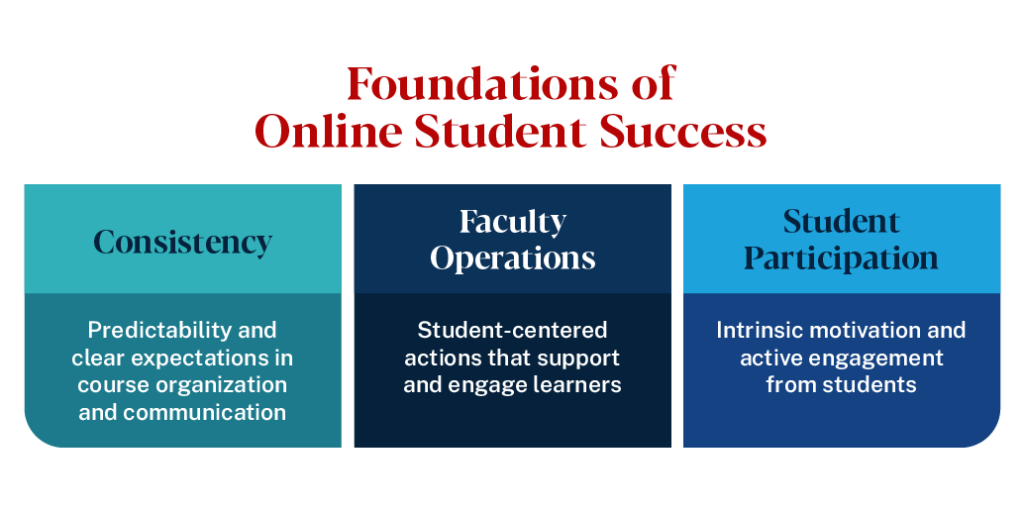
The interviews revealed three themes that helped answer Allen’s research questions and provide insight into what faculty members believe contributes to student success in online learning environments.
Consistency
Faculty members pointed to predictability and clear expectations as important elements of online teaching. Participants discussed consistency in course organization, communication, feedback and policies, describing it as a way to help students navigate online learning environments with greater confidence.
One professor emphasized the importance of providing consistent feedback and organizing course modules so students always know where to find information and what steps to take next. Another noted that maintaining the same routine throughout a course, including consistent learning objectives and lesson summaries, helps students focus on learning rather than figuring out how the course is organized.
Consistency also extended to course policies. One participant explained that expectations related to late work, assignment revisions and other requirements should be clearly communicated at the beginning of the term and applied throughout the course. Another described using a syllabus quiz during the first week of class to ensure students understood those expectations.
Several faculty members also highlighted the importance of regular communication and outreach. Consistent announcements, emails and reminders were viewed as ways to keep students connected to the course, while one participant recommended checking in with students individually to help them stay on track.
Across the interviews, consistency emerged as a way to reduce confusion, clarify expectations and help students stay focused on learning.
Faculty Operations
The second theme focused on the actions instructors take to support students and shape the online learning experience.
Building rapport emerged as an important practice. One professor shared that students seemed more engaged after virtual lectures moved from a formal office setting to a more informal environment. Conducting Zoom sessions from home and allowing students to see pets in the background sparked conversation and helped create a more comfortable atmosphere.
Faculty members also emphasized the importance of making coursework relevant to students’ lives. One participant described connecting math lessons to everyday experiences, such as measuring Amazon packages to calculate circumference. According to the professor, students were often more interested and engaged when they could see how course concepts applied outside the classroom.
Communication and feedback were recurring topics throughout the interviews. Participants stressed the importance of providing meaningful feedback, checking in with students and maintaining a visible presence throughout a course. Several also emphasized clear expectations, including well-defined syllabus policies and course requirements.
Across the interviews, faculty operations reflected a student-centered approach to online teaching. Participants described building relationships, maintaining communication and designing learning experiences that help students stay engaged and supported throughout a course.
Student Participation
While faculty members discussed many ways instructors can support students, they also emphasized the role students play in their own success.
Intrinsic motivation emerged as a recurring theme. One professor explained that college students cannot rely entirely on instructors for encouragement and motivation. Instead, successful students are often driven by personal goals such as career advancement, financial stability or family aspirations. Participants viewed this internal motivation as an important factor in student success.
Faculty members also highlighted the importance of time management and attention to detail. Several noted that successful students take time to complete assignments carefully, follow instructions and review grading rubrics. One participant explained that students who rush through coursework often miss important details and earn lower grades as a result.
Engagement was another common topic. Participants encouraged students to log into their courses regularly, monitor announcements and emails, participate in discussions, and communicate with instructors when questions arise. One professor specifically highlighted class discussions as an opportunity for students to deepen their understanding of course material and learn from their peers.
Ultimately, faculty members viewed student success as a partnership. Instructors can create supportive learning environments, but students must also demonstrate motivation, accountability and active engagement throughout the learning process.
Limitations, Recommendations and Future Research
Allen identified several limitations that may affect how broadly the findings can be applied:
- Participants entered the study with varying levels of online teaching experience, and some had only begun teaching online during the COVID-19 pandemic.
- Faculty members received different types and levels of preparation for online instruction. As a result, the findings may not reflect institutions where instructors receive standardized training for online teaching.
- Some academic disciplines were more heavily represented than others, meaning certain perspectives may have been more prominent in the findings.
Based on the study’s findings, Allen recommended providing online faculty with training focused on building rapport with students, applying consistent teaching practices and understanding how to support adult learners in virtual settings. She also recommended offering students training on how to succeed in online courses, including guidance related to motivation, engagement and self-directed learning.
Allen further recommended additional research from the student perspective. Future studies could explore the experiences of students who have completed both in-person and online courses, examining which instructional practices they believe are most effective in virtual learning environments. Comparing student and faculty perspectives may provide a more complete understanding of the factors that contribute to success in online learning.
Taken together, the findings reinforce the idea that student success in online courses depends on more than a single teaching strategy or technology tool. Faculty members consistently pointed to the importance of clear expectations, meaningful instructor engagement and active student participation. Their experiences offer valuable insights for institutions seeking to strengthen online learning and better support student achievement.
American College of Education (ACE) offers affordable degree programs with online coursework designed for adult learners seeking career growth.