
American College of Education (ACE) is incredibly proud of our graduates and how their impactful research contributes to various fields. Ed.D. in Leadership alumnus, Dr. Samuel S. Beyhan, focused his dissertation on the impact of virtual teacher home visits on student academic achievement during the COVID-19 pandemic, and we invite readers to explore the full version.
As schools rapidly shifted to virtual environments during the pandemic, educators were forced to rethink how they connected with students and families. Teacher home visits were adapted to a virtual format, raising questions about whether the same level of connection could be maintained online. Could virtual home visits strengthen family engagement in meaningful ways, and more importantly, strengthen student academic outcomes?
Beyhan conducted a quasi-experimental quantitative study in a large Texas-based charter school system, analyzing data from more than 24,000 K–10 students. Using NWEA MAP assessment scores in reading and math, his research examined differences in academic achievement and growth between students who participated in virtual home visits and those who did not. Beyhan sought to answer:
- Research Question 1: What significant differences, if any, exist in the academic achievement of K–12 students who received a virtual teacher home visit compared to similar students who did not receive one during the COVID-19 pandemic?
- Research Question 2: What significant differences, if any, exist in the academic growth of K–12 students who received a virtual teacher home visit compared to similar students who did not receive one during the COVID-19 pandemic?
The Shift to Virtual Home Visits in K–12 Education
Parent involvement has long been recognized as a key factor in student success. One way schools have traditionally strengthened that connection is through teacher home visits, which create intentional opportunities for educators to meet with families outside the classroom. The goal is to build trust and improve communication.
Before the COVID-19 pandemic, these visits were typically conducted in person. Teachers met with families in their homes or other informal settings, often outside school hours, to better understand students’ environments and build stronger relationships. These interactions were widely seen as a meaningful way to connect school and home.
The pandemic disrupted that model. As instruction moved online, many engagement strategies shifted to virtual formats, including home visits. Teachers began meeting with families through video calls, maintaining communication while adapting to new constraints.
Even with widespread adoption, little was known about how effective virtual home visits would be. While the goal remained the same, the format introduced new variables. Beyhan’s study set out to better understand whether these virtual interactions translated into measurable academic outcomes.
Previous Studies: Existing Research About Home Visits
Before examining Beyhan’s findings, it’s helpful to understand how existing research has approached teacher home visits and family engagement. His extensive secondary research presents a solid foundation for his study.
The Impact of In-Person Home Visits
Research on teacher home visits has largely focused on in-person models, particularly in elementary settings. These studies consistently highlight positive outcomes. Teachers often report stronger relationships with students and families, improved communication and increased trust.
In addition to these relational benefits, in-person home visits have been linked to improved student outcomes, including higher academic achievement, better attendance and more positive classroom behavior. By gaining insight into students’ home environments, educators are often better equipped to support learning in meaningful ways.
Family Engagement as a Driver of Achievement
The value of home visits is closely tied to the broader impact of family engagement. When families are actively involved in their children’s education, students are more likely to stay motivated, engaged and academically successful.
Home visits support this by creating space for direct communication and partnership. They help establish a shared understanding between educators and families, supporting a more collaborative approach to student success.
The Missing Piece: Virtual Home Visit Research
While in-person home visits are well studied, research on virtual home visits is limited. Beyhan’s review found that much of the existing work relied on small sample sizes, perception data or qualitative insights rather than large-scale quantitative analysis.
This gap became especially important during the pandemic, when virtual engagement strategies were implemented at scale. Without strong data, schools were left to make decisions based on limited evidence. Beyhan’s study helps fill that gap by examining virtual home visits through a large, data-driven lens.
Inside the Study: How the Research Was Designed
To examine the impact of virtual teacher home visits, Beyhan used a quasi-experimental quantitative design. This approach allowed for a comparison between students who participated in virtual home visits and similar students who did not, within a real-world school setting.
Beyhan’s study included:
- 24,075 K–10 students across a Texas-based charter school network
- Two groups: students who received virtual home visits and similar students who did not
- Virtual visits conducted via Zoom, typically lasting 20 to 30 minutes
- Voluntary participation, with teachers receiving a stipend after completion
- NWEA MAP assessments in reading and math
- Data collected from Fall 2020 to Spring 2021
Measuring Impact: How the Data Was Analyzed
To understand whether virtual home visits influenced student outcomes, Beyhan used statistical comparisons between the two groups. Analyses of variance were conducted to examine differences in both reading and math performance.
The study focused on two key outcomes:
- Academic achievement, based on Spring 2021 NWEA MAP scores
- Academic growth, measured by changes from Fall 2020 to Spring 2021
A standard level of statistical significance was used, allowing Beyhan to determine whether observed differences between groups were meaningful or simply due to chance. Given the large sample size, even very small differences between groups could be detected. This makes it especially important to look beyond statistical significance and consider whether those differences are meaningful in practice.
What the Study Found About Virtual Home Visits
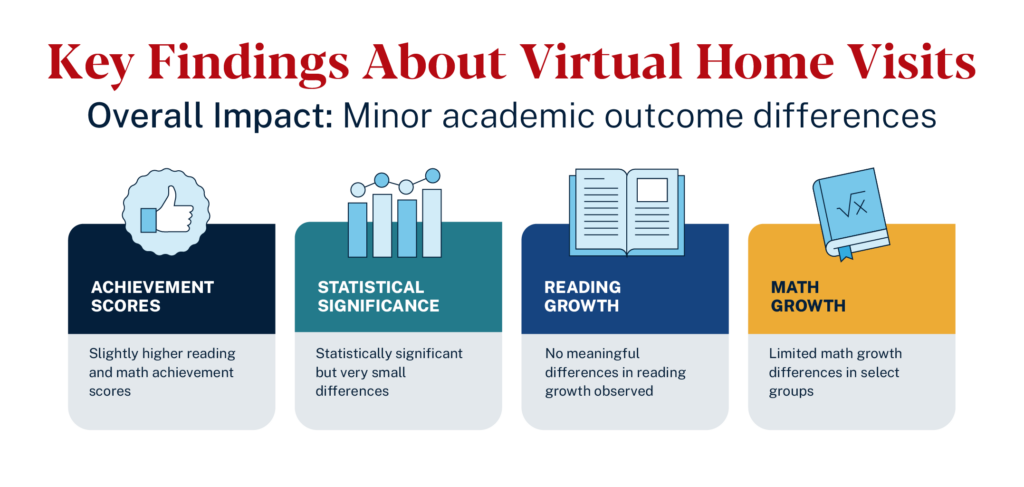
The findings show a nuanced picture instead of a simple yes-or-no answer. For academic achievement, students who received virtual home visits scored slightly higher in both reading and math than those who did not. These differences were statistically significant, meaning they were unlikely to be due to chance.
In practical terms, the impact on achievement was minimal. While the data shows a measurable difference, it does not suggest that virtual home visits led to meaningful improvements in student performance.
For academic growth, the results were even more limited. Across most grade levels and subjects, students who participated in virtual home visits did not demonstrate greater growth than their peers. The only exceptions appeared in specific areas of math, particularly in second grade, fifth grade and among male students, where modest differences were observed. No significant differences in growth were found in reading at any level.
Taken together, the findings suggest that while virtual home visits were associated with slight differences in achievement, they had little overall influence on student academic growth and limited practical impact.
These findings contribute to a growing body of research on family engagement by providing large-scale, quantitative insight into virtual home visits. At a time when many schools adopted virtual strategies out of necessity, the study offers a clearer understanding of what those approaches do and do not impact.
Why Didn’t Virtual Visits Have a Stronger Impact?
Several factors noted in the study may help explain the results. One consideration is the nature of relationship-building in a virtual setting. In-person interactions often allow for deeper connection and more natural communication, which can be harder to replicate through a screen.
The structure of the visits may also play a role. At 20 to 30 minutes, these meetings were relatively brief and focused primarily on communication rather than ongoing academic support. That level of interaction, while valuable, may not be enough to influence measurable academic results.
The broader context of the pandemic also matters. Students, families and educators were navigating significant disruption, from remote learning challenges to uneven access to resources. These conditions may have limited the impact of any single strategy.
Additionally, how the visits were implemented likely varied across teachers and campuses. Differences in approach, consistency and engagement could all influence results in ways the study was not designed to capture.
What This Means for Educators and School Leaders
Beyhan’s findings highlight an important point: Implementing a program is only one part of the equation. Understanding its impact is just as critical.
For school leaders, the results suggest that virtual home visits may not meaningfully influence academic outcomes on their own. While they can support communication and relationship-building, their direct academic impact appears limited in this context. Beyhan suggests future implementations may benefit from more targeted approaches, particularly for students with greater academic or engagement needs.
While the study focuses on academic outcomes, virtual home visits may still support communication and relationship-building in ways not captured by assessment data. However, schools may need to think more intentionally about how these interactions are structured and how they connect to broader academic support systems.
The study also highlights the importance of evaluating programs with real data. Well-intentioned strategies do not always produce the expected results, and having clear evidence helps guide better decisions.
Limitations and Opportunities for Future Research
Beyhan notes several limitations of the study. First, the research was conducted within a single Texas-based charter school network with a predominantly Hispanic and economically disadvantaged population, which may limit how broadly the findings can be applied. Academic performance was measured using NWEA MAP assessments, which capture specific aspects of achievement but do not reflect other outcomes, including behavior or family engagement.
The study also did not compare virtual home visits directly with in-person visits, leaving questions about how format influences effectiveness.
Future research could explore hybrid approaches, incorporate qualitative measures of relationship-building or examine outcomes beyond test scores. Expanding this work across different school settings would help build a clearer understanding of when and how virtual home visits are most effective.
Continuing the Conversation Around Family Engagement
Family engagement remains a critical part of student success, and strategies like home visits continue to play an important role in building connections between schools and communities. Beyhan’s study adds an important perspective to this conversation, particularly as schools continue to navigate changing learning environments.
As education evolves, so too must the ways schools engage with families. This research offers a thoughtful starting point that encourages educators and leaders to look not just at what is implemented, but at what truly makes a difference for students.
American College of Education (ACE) supports educator growth through affordable programs designed to equip you to positively influence student outcomes.