
American College of Education (ACE) is incredibly proud of our graduates and how their impactful research contributes to various fields. Ed.D. in Leadership alumna, Dr. Sahar Hussain, focused her dissertation on how artificial intelligence has affected school leaders, and we invite readers to explore it in full.
Artificial intelligence (AI) is rapidly transforming K–12 education, creating new opportunities and challenges for school leaders. As AI tools become more accessible, leaders are expected to make decisions about implementation, ethics and instructional impact, often without clear guidance.
Dr. Hussain’s study explores how K–12 school leaders in New York perceive the adoption and effectiveness of AI in their school communities. Grounded in transformational leadership theory and diffusion of innovation theory, the study examines how leaders approach AI integration and how they evaluate its role in improving educational practices. The following research questions guided the study:
- Research Question 1: What are the perceptions of K–12 school leaders in New York regarding the utilization of artificial intelligence?
- Research Question 2: How do K–12 school leaders in New York perceive the effectiveness of adopting artificial intelligence?
Background: Artificial Intelligence and Leadership in K–12 Education
Artificial intelligence is transforming how schools operate, influencing both instructional practices and administrative processes. As AI tools become more accessible, school leaders play a central role in determining how these technologies are introduced and used within their organizations.
Despite growing interest in AI, there remains a lack of clear guidance for school leaders, particularly in New York K–12 settings. Leaders must navigate complex challenges related to ethics, data privacy, equity and implementation. These challenges often emerge alongside pressure to innovate and improve efficiency, creating a landscape that requires careful decision-making.
The study highlights a gap in understanding how school leaders perceive and adopt AI in their schools. While research has explored technology integration broadly, fewer studies focus specifically on leadership perspectives related to AI. Addressing this gap can provide valuable insight into how schools can adopt AI in ways that are both effective and responsible.
Previous Studies: Digital Leadership and Artificial Intelligence
Digital Leadership in K-12 Schools
Digital leadership has become an essential component of modern school administration. Leaders are expected to support technology integration while also fostering environments that encourage innovation and adaptability. This often involves moving beyond incremental changes and embracing more transformative approaches to teaching and learning.
Artificial Intelligence in Education
Research on artificial intelligence in education highlights its potential to enhance personalized learning, streamline administrative tasks and support data-driven decision-making. While teachers are increasingly engaging with AI tools, the role of school leaders in guiding adoption remains less explored.
Barriers and Opportunities in AI Adoption
Existing studies identify several barriers to AI adoption, including limited technical expertise, lack of infrastructure and uncertainty about ethical implications. At the same time, AI presents opportunities to improve efficiency, reduce administrative workload and support more tailored learning experiences.
Theoretical Framework
Hussain’s study is grounded in transformational leadership theory and diffusion of innovation theory. Transformational leadership emphasizes the role of leaders in inspiring change and fostering innovation, while diffusion of innovation explains how new ideas and technologies are adopted over time. Together, these frameworks provide a lens for understanding how school leaders approach AI adoption within their organizations.
Research Gap
Although research on technology integration is well established, there is limited focus on how K–12 school leaders in New York perceive and implement artificial intelligence. This study contributes to the field by examining leadership perspectives in a specific and evolving context.
Methodology: Exploring Leader Perspectives on AI
Hussain employed a basic qualitative research design to explore how school leaders perceive the adoption and effectiveness of artificial intelligence. This approach allowed for an in-depth understanding of participants’ experiences and perspectives.
The study included 15 K–12 school leaders in New York, selected through purposive sampling. Participants represented a range of leadership roles within their respective schools.
Data collection was conducted through semi-structured interviews, allowing participants to share their experiences with AI adoption in their own words. This method provided flexibility while ensuring that key topics related to the research questions were addressed.
To analyze the data, Hussain used inductive thematic analysis. Interview responses were coded and organized using Dedoose software, allowing patterns and themes to emerge from the data.
Data Analysis: Key Themes in AI Adoption
Through the analysis process, several themes emerged that reflect how school leaders are navigating artificial intelligence in their schools. One key theme is the perception of AI as a tool for enhancement rather than replacement. Many participants viewed AI as a way to support existing practices rather than replace educators or traditional methods.
Implementation varied across schools. Leaders reported differing levels of AI integration across schools, often influenced by access to resources, infrastructure and individual readiness.
The need for professional development also emerged as a consistent theme. Participants indicated that both leaders and educators require ongoing training to effectively use AI tools. In addition, the lack of clear policies and guidance was identified as a challenge. Leaders expressed uncertainty about best practices, particularly in areas related to ethics and data privacy.
Finally, infrastructure limitations were noted as a barrier to adoption. Access to reliable technology and support systems played a significant role in determining how AI could be implemented.
Findings: School Leader Perceptions of AI Adoption
Research Question 1: Perceptions of AI Utilization
The first research question focused on how school leaders perceive the utilization of artificial intelligence. Participants described a range of perspectives, with many viewing AI as a valuable tool that can enhance efficiency and support both instructional and administrative tasks.
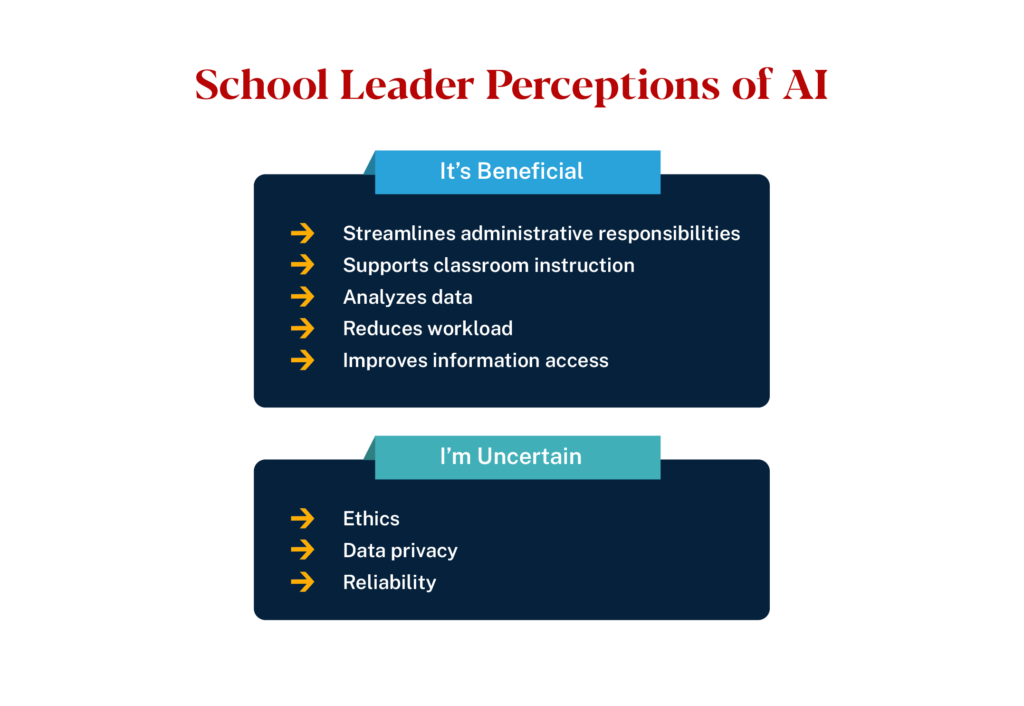
Leaders reported using AI for a variety of purposes, including streamlining administrative responsibilities, supporting classroom instruction and analyzing data. These uses were generally seen as beneficial, particularly when they reduced workload and improved access to information.
At the same time, some leaders expressed uncertainty about AI adoption. Concerns related to ethics, data privacy and reliability influenced how comfortable participants felt integrating AI into their schools. These perceptions often influenced how widely AI was used within their organizations.
Research Question 2: Perceived Effectiveness of AI Adoption
The second research question examined how school leaders perceive the effectiveness of adopting artificial intelligence. Participants offered mixed perspectives, reflecting both the potential benefits and the challenges associated with AI integration.
Many leaders identified positive outcomes, such as increased efficiency, improved access to information and enhanced support for instructional practices. These benefits were often linked to specific use cases where AI tools were implemented effectively.
However, participants also emphasized that effectiveness depends on several factors. Lack of training, limited infrastructure and the absence of clear policies were identified as barriers that can reduce the impact of AI adoption. Leaders noted that without proper support, AI may not be used to its full potential.
Overall, the findings suggest that while AI holds promise for improving school operations and learning environments, its effectiveness is closely tied to how it is implemented and supported within each school context.
Implications for Educational Leadership
Hussain’s study highlights the important role school leaders play in guiding the adoption of artificial intelligence. Effective implementation requires thoughtful planning, clear communication and ongoing support for educators.
One key implication is the need for structured professional development. School leaders must ensure that both they and their staff are equipped with the knowledge and skills necessary to use AI responsibly and effectively. The study also emphasizes the importance of developing clear policies and guidelines, particularly in areas related to ethics, data privacy and equitable access.
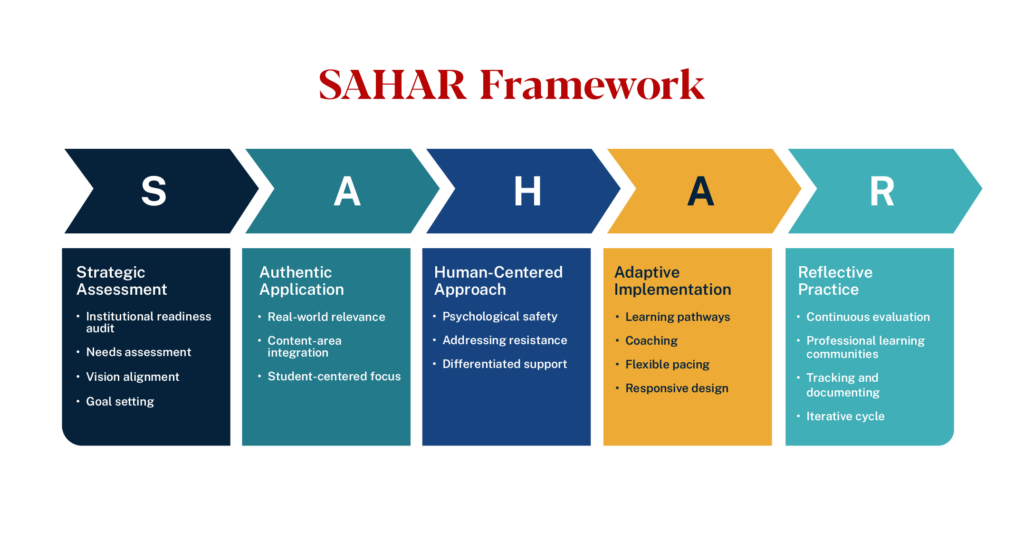
In addition, Hussain introduces the SAHAR framework as a tool to support AI adoption in educational settings. This framework encourages leaders to assess readiness, apply AI tools thoughtfully, implement strategies effectively and reflect on outcomes.
While the study provides valuable insight, it is limited by its focus on a specific group of participants within New York K–12 schools. Future research may expand on these findings by exploring AI adoption in other regions and educational contexts. As artificial intelligence continues to evolve, school leaders will play a critical role in shaping how these technologies are used in education, balancing innovation with a focus on equity, ethics and student success.
American College of Education (ACE) supports educators and leaders through programs designed to develop effective leadership practices grounded in research. Explore our full catalog of online doctorates in education.