More and more, working adults are looking for ways to connect what they study with what they actually do. That’s where experiential learning stands out. Instead of focusing solely on theory, this approach emphasizes learning through doing, reflecting and applying skills in the real world.
Understanding how experiential learning works and why it matters can help you make more informed decisions about your education and career path.
Key Takeaways:
- Experiential learning is a hands-on approach to education. Students learn through real-world experiences, reflection, and active participation.
- This learning model strengthens practical skills. Problem-solving, communication, collaboration, and critical thinking are commonly developed through experience-based activities.
- Experiential learning increases engagement and retention. Applying knowledge in real situations helps students better understand and remember concepts.
- Examples include internships, simulations, service learning, and fieldwork. These opportunities connect classroom learning to real-world applications.
- Experiential learning supports career readiness. Students gain confidence and transferable skills that prepare them for professional environments.
What Is Experiential Learning?
Experiential learning is a method of learning through direct experience. Instead of relying on traditional instruction, students actively engage in hands-on learning, then reflect on what they’ve done to deepen their understanding.
This approach is used in a wide range of career paths, including:
- Teaching: Future educators practice classroom management and apply pedagogy in real time
- Nursing: Students develop skills in both simulated and real-world care settings
- Business: Students work through challenges that mirror real workplace scenarios
In fields like these, student learning moves beyond theory, and students begin to apply knowledge in meaningful, practical ways.
Experiential Learning Theory Explained
The theory of experiential learning was first explained by educational theorist David Kolb, who introduced a model explaining how people process and retain knowledge. It’s one of several learning theories that focus on how people learn through experience.
Kolb’s model has four stages:
- Concrete experience: Engaging in a new experience or activity
- Reflective observation: Thinking critically about what happened
- Abstract conceptualization: Connecting the experience to existing ideas
- Active experimentation: Applying what was learned to new situations
Reflection is key to the whole model. Without taking time to evaluate an experience, it’s much harder to turn action into insight. Reflecting transforms hands-on experience into lasting knowledge. This emphasis on reflection is also what makes experiential learning measurable — students don’t just participate in activities, they demonstrate what they’ve learned through analysis, application and evidence of growth. This demonstrated learning is also core to the concept of credit for prior learning (CPL), which we will explore later.
What Is the Purpose of Experiential Learning?
Experiential learning is meant to bridge the gap between theory and practice. It helps students move from memorizing facts into applying what they’ve learned.
Key outcomes include:
- Applying theory to real-world situations: Students gain the ability to use knowledge in practical settings
- Strengthening critical thinking: Experiential learning often requires students to analyze situations and solve problems
- Building confidence: Repeated exposure to real-world experiences helps students feel more prepared in professional environments
- Improving knowledge retention: People remember what they’ve actively experienced more clearly than what they’ve only read or heard
The experiential learning process is designed to make education more relevant, engaging and effective.
Examples of Experiential Learning
Experiential education can take many forms, depending on the setting and goals.
- Internships: Gaining hands-on experience in a professional environment
- Service learning: Learning skills while contributing to community initiatives
- Job shadowing: Observing professionals to understand day-to-day responsibilities
- Simulations and labs: Practicing skills in controlled, real-world scenarios
- Project-based learning: Completing assignments that mirror workplace challenges
- Study abroad or fieldwork: Engaging with new environments and perspectives
Each of these methods gives students the opportunity to develop practical skills while reinforcing academic concepts.

Benefits of Experiential Learning for Career Development
Experiential learning helps prepare students for the workforce by moving theory into application. Instead of understanding concepts, students develop practical workplace skills through hands-on experience. This greatly benefits students who favor hands-on learning styles.
It also strengthens communication and collaboration. Many experiential learning activities are built around teamwork, asking students to exchange ideas, respond to feedback and navigate group dynamics. These experiences also give students the chance to explore different roles and career paths before committing.
Over time, this combination of skill-building and exploration leads to stronger employability. Hiring managers often look for candidates who can demonstrate not only knowledge, but the ability to apply it in real situations. By gaining hands-on experience and developing problem-solving skills, students build confidence and can enter the workforce feeling more prepared.
How Experiential Learning Supports Adult Learners
Experiential learning can be especially valuable for adult learners, many of whom bring years of professional and life experience to the table.
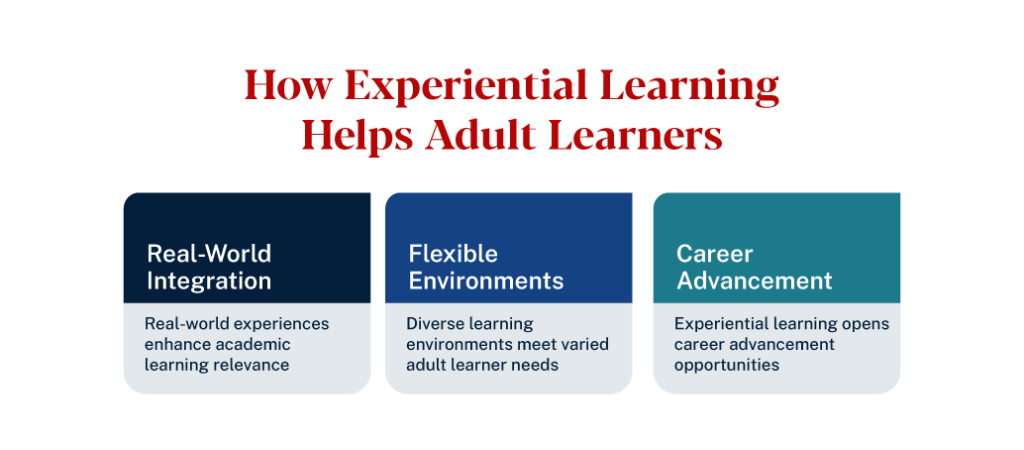
This approach supports adult education pathways by offering flexible learning environments while connecting demonstrated learning from prior work experience to academic outcomes. By emphasizing applied skill development, experiential learning creates clear opportunities for career advancement and helps adult learners make their education immediately relevant to their professional goals.
In many cases, adult learners don’t just benefit from experiential learning. They actively contribute to it through the perspectives and knowledge they already have.
Applications in Higher Education
Colleges and universities are increasingly integrating experiential learning into their programs to better prepare students for modern careers. This can include:
- Applied coursework and project-based assignments
- Internships or field experiences
- Simulations and industry-relevant labs
Many institutions recognize that learning happens beyond the classroom, offering options like CPL to help students turn demonstrated learning from real-world experience into academic progress. The Council for Adult and Experiential Learning (CAEL) provides standards for colleges and universities to follow when it comes to establishing CPL programs and criteria, and it has also created a CPL Provider Network to help students search for institutions that recognize and offer CPL.
This is a core part of our model at American College of Education (ACE). A dedicated CPL team, in tandem with our Academics team, evaluates evidence of college-level learning that students have acquired through work experience, certifications and professional development. Consistent with CAEL standards, credit is awarded for demonstrated learning, not just for experience or time spent. This gives students the potential to receive academic credit for demonstrated learning gained through experience or previous work when that learning aligns with our program’s academic outcomes, making it easier and more affordable to earn their next career-focused degree.
How to Get Started With Experiential Learning
If you’re looking to build real-world skills alongside your education, there are several ways to start incorporating experiential learning in your development.
- Seek out internships or volunteer opportunities in your field
- Participate in workplace-based learning programs or training initiatives
- Look for degree programs that emphasize hands-on learning and real-world application
- Explore opportunities to earn credit for prior learning by demonstrating college-level knowledge gained through your experience
Taking even one of these steps can help you start building practical skills that align with your long-term goals.
FAQs
What is the purpose of experiential learning?
It helps students apply knowledge in real-world situations, strengthen critical thinking and improve long-term retention.
Why is experiential learning important?
It makes education more relevant by connecting theory to practice, helping students build practical skills and confidence.
How does experiential learning help career development?
It provides hands-on experience, improves problem-solving abilities and helps students explore career paths before entering the workforce.
How is experiential learning used in higher education?
Colleges incorporate it through internships, simulations and project-based learning. Many institutions also offer CPL, which allows students to earn academic credit by demonstrating college-level knowledge gained through professional experience, certifications or other learning outside the classroom.
Is experiential learning effective for adult learners?
Yes. It allows adult learners to connect existing experience with new knowledge, making education more efficient, relevant and career-focused.