

Digital technology has become inextricably intertwined with our lives, and just as it has changed how we do almost everything, it’s also changed how we learn in pretty substantial ways.
Connectivism learning theory is one of the newest theories of learning that has been developed to reflect this change. It acknowledges the role of technology in learning in our digital age, explores how it affects knowledge acquisition and provides educators with a helpful framework for designing effective instruction for students growing up as digital natives.
What Is the Connectivism Learning Theory?
The definition of connectivism learning theory is simply that it explains how people learn in the digital age. It suggests that knowledge is gained through technology, the internet and online networks rather than just being stored only in a person’s memory.
According to this theory, learning means creating and using connections between people, information and digital tools. Instead of just memorizing facts, students focus on finding trustworthy information, learning from others and using technology to solve problems and keep their knowledge up to date.
Who Developed Connectivism?
The theory of connectivism in education was developed by George Siemens and Stephen Downes in the early 2000s. They created the theory to explain how people learn in a world where technology and the internet play a major role in day-to-day life.
Siemens first introduced the theory through his 2005 article, “Connectivism: A Learning Theory for the Digital Age,” where he points out that older learning theories were not developed during a time when learning was impacted by technology and therefore did not fully explain how learning occurs in a digital world. Siemens believed that the need to find, judge and connect information is more important to learning than just simply memorizing facts.
Downes developed the theory further by studying online learning, digital networks and open education. He explained that knowledge is shared through networks of people and technology, and that learning happens by taking part in these networks.
Traditional learning theories, such as behaviorism, cognitivism and constructivism, focus on how individuals learn. They explain learning through experiences, thinking and interactions with the environment. In these theories, learning mainly happens inside an individual.
Connectivism is different because it states that learning happens by nurturing and maintaining connections and networks. People learn by connecting with others, using digital resources and joining online communities. Simply using technology is not enough. Knowledge is shared across networks instead of just held by one person.
Why Connectivism Emerged
Connectivism emerged in response to the rise of technology and its incorporation into society and our day-to-day lives. The growth of the internet, in particular, gave people access to more information than ever before, faster than ever before. It also allowed people to connect in unprecedented ways across vast distances.
From there, technology has only evolved even faster. Nowadays, we access and acquire information digitally from a staggering amount of sources, places and mediums. It follows that learning now takes place beyond the bounds of traditional classrooms, especially with the rise of online education that has made virtual and blended classroom experiences possible.
Core Principles of Connectivism
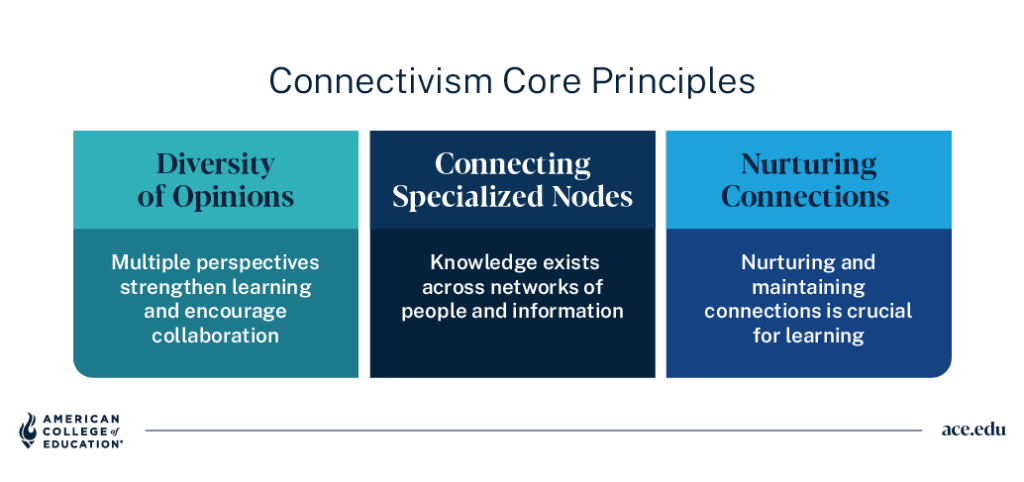
There are a few key principles of connectivism. First is that learning happens through a diversity of opinions. Other principles emphasize connected sources of knowledge and building connections. It also acknowledges that learning is a lifelong activity and that making good decisions about how we learn is part of it. Knowing the sources that are reliable, accurate, useful and trustworthy are all important parts of learning.
Learning and Knowledge Rest in Diversity of Opinions
One of the core components of the theory of connectivism is that learning and knowledge rest in a diversity of opinion. Simply put, learning is stronger when people hear different opinions, use multiple sources of information instead of just one and examine different viewpoints. Doing this helps you compare ideas, question your thinking and gain a better understanding of any given topic. It also encourages collaboration and discussion, which helps many people retain new information more effectively.
Learning Is a Process of Connecting Specialized Nodes
Today, knowledge comes from a wide variety of sources – people, websites, books, databases and even communities. Connectivism states that learning happens through connections between sources, otherwise called “nodes” in the terminology of the original theory.
In his article, Siemens also wrote about how information sources naturally compete with each other within interconnected networks like the digital ones we have today. Some nodes will specialize and gain more recognition, and as they do, their connections to other nodes will grow as well, which allows their information to spread to other learning communities. Connected specialized nodes can offer valuable learning opportunities as people exchange information across networks and communities.
Nurturing and Maintaining Connections
According to connectivism, connections help people find updated information when they need it. Instead of learning alone, people learn by staying connected with teachers, classmates, experts, online communities, trusted websites and other sources. These connections allow people to share ideas, receive feedback and keep up with the latest information.
This is why building them is crucial – connections facilitate continual learning. After all, learning doesn’t stop after school or college. People continue to grow their knowledge as adults and professionals, and it often happens through the connections they make throughout their lives to professional networks, mentors, peers and other digital communities. It’s how we stay informed and aware of new ideas and changes.
How Connectivism Differs From Other Learning Theories
Previously established educational theories tend to focus on the learning process as happening within the individual. Not only does connectivism focus more on how learning happens through connections, it also explicitly examines how technology plays a part in the process.
Connectivism vs. Behaviorism
Behavioral learning theory posits that learning occurs when behaviors are reinforced or discouraged by external forces. Positive reinforcement encourages desired actions, while negative reinforcement or consequences discourage unwanted ones. Over time, consistent responses to these behaviors creates habits and strengthens skills. Behaviorism is what underpins many educators’ classroom management systems, where there are rewards or consequences to motivate students to follow routines or rules.
Connectivism, on the other hand, is more about learning through connections and knowledge networks rather than external stimuli.
Connectivism vs. Cognitivism
Cognitive learning theory focuses on learning as internal mental processing. It states that your cognition plays an active role in knowledge acquisition. Learning happens when you think through and organize new information in your brain, truly understanding the “why” behind a concept or idea.
Cognitivism emphasizes that learning happens within an individual. In contrast, connectivism highlights distributed knowledge and learning that occurs through external connections with others.
Connectivism vs. Constructivism
Constructivist learning theory states that learning occurs when you actively engage with ideas and concepts. Instead of passively receiving information, meaning is developed through experience, reflection and interaction. Constructivism is often seen in classrooms through hands-on projects or collaborative activities, where students interact with what they are learning and then reflect on what they took away from the experience.
While constructivism focuses on how an individual makes meaning from their experiences, connectivism focuses on how groups and networks build knowledge together through connections between fields and ideas.
Examples of Connectivism Learning Theory
Let’s explore some connectivism learning theory examples to see how it plays out in real educational settings.
Online Learning Communities
Online education is on the rise, and it’s also a great example of connectivism in action. In many online programs, students learn through many of the traditional avenues you’d expect in school – readings, assignments, quizzes and lessons. However, through online platforms like learning management systems (LMS), students also learn through discussion boards and peer collaboration, gaining insights through the knowledge they share with fellow classmates and instructors alike.
Professional learning networks are another way many professionals continue to learn about developments and best practices within their field. These are often online spaces where people can connect, sharing or receiving updates, news and other information pertinent to their work.
Learning Through Digital Resources
We now have access to and learn through more digital resources than ever before. Educational videos, online articles, podcasts, digital libraries and textbooks, online databases, virtual labs – the options are staggering. This is why discernment also plays a role in connectivism. Having digital literacy is crucial, as it’s important to assess the credibility, accuracy, bias and trustworthiness of the sources you’re learning from.
Social Learning Networks
There’s nowhere knowledge spreads faster than through social networks. Social media has become a place where people go to get and share information. It’s also facilitated the creation of all sorts of communities, from industry professionals on LinkedIn to niche hobbyists on Instagram. Social networks are the strongest example of connectivism in action, where learning happens digitally through the connections and communities that people make.
Connectivism in Today’s Learning Environments
With the increase in educational technology tools and online learning platforms, it should be no surprise that learning in today’s classrooms includes more technology than ever before.
Technology-Enhanced Learning
Using LMS is just one way that technology is enhancing modern education. There are a plethora of digital tools educators can use to augment everything about their instruction, from assessments to lesson planning. Artificial intelligence (AI) is also being used to support or enhance learning tools and experiences.
Collaborative Learning
Collaborative learning has been and always will be part of the learning experience, and it’s where connectivism’s principles around learning through connection can also be found. Through collaboration, students learn by sharing knowledge with each other and solving problems as a group. Collaboration also often promotes cross-disciplinary learning, where different fields, ideas and concepts come together to create new knowledge opportunities.
Lifelong Learning
Connectivism emphasizes that learning doesn’t stop just because your formal schooling is over. We’re all lifelong learners, developing new skills and acquiring new knowledge every day through the digital resources and networks we have at our fingertips.
Benefits of Connectivism
Many of connectivism’s principles resonate with today’s educators and provide the basis for modern instructional strategies.
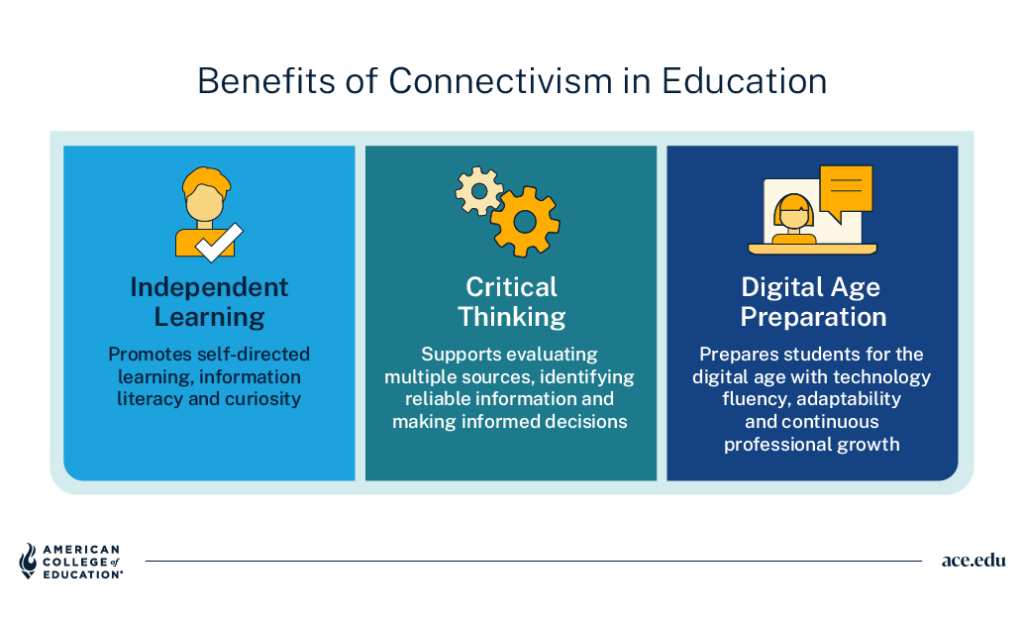
Encourages Independent Learning
Connectivism helps students become more independent. Instead of relying on only teachers or textbooks, students learn how to find, evaluate and use information from different reliable sources. This kind of self-directed learning encourages both information literacy and natural curiosity.
Supports Critical Thinking
Students need to know how to sort through all the available sources and evaluate them for reliability and credibility. This promotes critical thinking and helps students learn how to make better-informed decisions.
Prepares Students for the Digital Age
Technology is only going to become further ingrained across all industries. As part of preparing students for future success, educators can help students develop technology fluency and adaptability when they apply existing skills to new tools and platforms. This also helps build within students a lifelong-learning mindset.
Challenges and Criticisms of Connectivism
Although this theory is important to modern education, it does have some limitations. Some educational researchers also debate whether connectivism is a standalone learning theory, with some believing that it’s more of a pedagogical view or framework for using technology rather than a model for learning.
Information Overload
Without digital literacy and strong research skills, students can easily become overloaded with information or fail to avoid misinformation. With the rise of AI-generated content, this has only become more relevant.
Dependence on Technology
This theory hinges on technology, digital and internet access. As such, there are natural barriers to it for those who don’t have adequate access to that technology. There’s also a level of digital literacy that’s required to truly engage with connectivism’s principles.
Ongoing Academic Debate
For some academics, connectivism is not a standalone model of learning. Critics point out that it’s built on older learning theories, such as constructivism. Some feel that it lacks the proof needed to be a true theory, and others feel that it’s more of an explanation for how digital tools help us learn.
On the flip side, some feel that it’s the only learning theory that addresses the role technology and online networks play in today’s educational landscape. Similarly, it sheds light on new ways of learning that didn’t exist before the capabilities of the internet and other digital tools.
How Educators Can Apply Connectivism
So how can educators apply the principles of connectivism to enhance their instruction? Here are some practical strategies.
Encourage Student Collaboration
Group projects, discussion, online forums and digital tools allow students to share ideas, learn from others, see different viewpoints and improve their communication skills. Collaborative activities provide opportunities to solve problems in a group, which promotes learning through peers.
Integrate Technology Purposefully
Educators can use technology in meaningful ways to promote learning. Online databases, videos and interactive learning platforms can help connect ideas together and promote student engagement.
Teach Information Literacy
Educators can play a significant role in helping students learn to evaluate information. Show students how to evaluate sources, find trustworthy ones, recognize bias and compare differences. Encourage them to use evidence to support the ideas they find. Responsible technology use and critical thinking about the information they see may be among the most important, longest-lasting lessons educators can provide their students.
FAQs
Why is connectivism considered a modern learning theory?
Not only was connectivism developed more recently in the early 2000s, but it’s also the only learning theory that discusses the role that technology and online networks play in learning.
Is connectivism used outside of formal education?
Yes. In fact, it’s used in everyday life. Most people today access online communities, social media, podcasts and a whole host of other online sources for information. We have a multitude of resources at our fingertips to develop hobbies, learn new skills, study languages, and keep up with both personal and professional updates. Many people create their own individual learning networks by connecting with experts and coworkers on all sorts of topics.
Can connectivism support workplace training and professional development?
Yes, it can be very important in the workplace. Today, there are a lot of new jobs where technology and information play a core part. Additionally, with technology and information changing so quickly, online training and professional development are crucial for staying up to date.
What role does digital literacy play in connectivism?
Digital literacy plays a significant role in connectivism. In fact, without it, students may not be able to participate in this type of learning. Connectivism requires you to have an understanding of how to use and access online networks, as well as how to parse through all the information available through these channels.
Is connectivism relevant for students of all ages?
Yes, but the way it’s used depends on the age, experience and skills of the student. High school and college students, as well as adults, are better equipped to access and evaluate information and typically use technology more efficiently. Younger students will need more guidance from educators to use educational apps, online learning and digital resources safely and responsibly. Educators should evaluate their lesson plans to ensure the content is practical and relevant to the age and technology experience of their students.
How might emerging technologies continue to shape connectivism?
As technology evolves and new technologies emerge, learning will likely become more personal and interactive, along with being more available anytime and anywhere. Technology like AI will place a bigger emphasis on source evaluation and critical thinking, but it may also herald a shift away from connected networks as a source for learning as people turn toward AI chat to gain and research new information.
American College of Education provides a modern, dynamic online educational experience where students learn from faculty working in their fields and peers from all over the world. Explore ACE’s programs to find the one that aligns with your career goals.