

A master’s degree in education can help teachers build new skills, deepen their expertise, increase their earning potential and take the next step in their careers. With many types of education master’s degrees available, choosing the right one starts with knowing what you want to accomplish.
Some programs prepare aspiring educators to enter the classroom and pursue initial licensure. Others help experienced educators strengthen their teaching, specialize in a subject area or prepare for leadership. There are also options for professionals who want to work in education beyond the traditional classroom.
Knowing how these types of education degrees differ can help you choose a path that aligns with where you are now and where you want to go next.
Why Consider a Master’s Degree in Education?
Education master’s programs can help current teachers prepare for new opportunities while building skills that support their work in the classroom. Depending on the school district and position, earning a master’s degree may:
- Support career advancement or continued licensure
- Increase earning potential in districts that provide additional compensation for advanced degrees
- Prepare educators for specialized teaching positions
- Build skills for leadership roles in education
A teacher’s master’s degree can be their practical next step if they’re looking to grow within their current role or prepare for new responsibilities.
MAT vs. M.Ed.: Understanding the Two Main Degree Types
The Master of Arts in Teaching (MAT) and Master of Education (M.Ed.) are two common types of degrees in education, but they’re meant for educators at different points in their careers.
What Is a Master of Arts in Teaching?
MATs are commonly designed for aspiring teachers seeking a pathway toward initial teacher licensure. The degree focuses on hands-on, practical teaching skills and instructional techniques that prepare future educators for the day-to-day realities of the classroom.
The coursework is grounded in the daily responsibility of teaching, with a focus on student development, differentiated instruction, assessment and teaching methods. At American College of Education (ACE), MAT students complete fully online courses and local student teaching, giving them the opportunity to apply what they learn in a classroom setting.
What Is a Master of Education?
An M.Ed. is designed for experienced educators who want to build on their classroom experience and take their careers in a new direction. Depending on their goals, educators may choose to deepen their expertise in a specific content area or prepare for opportunities in leadership and other roles beyond the classroom.
Compared with an MAT, M.Ed. educational degrees offer a wider range of specializations, giving educators more flexibility to choose a program that aligns with where they want to go next.
Types of MAT Programs
ACE offers two MAT pathways for aspiring teachers: the M.A. in Elementary Teaching and M.A. in Secondary Teaching.
The M.A. in Elementary Teaching prepares aspiring educators to teach core subjects to students in grades K-6. It’s a strong fit for those who want to build foundational skills across multiple subject areas in elementary and middle school and support younger students as they grow.
The M.A. in Secondary Teaching prepares aspiring educators to teach students in grades 5-12, with a greater focus on subject-specific instruction. This path is designed for those who want to bring their knowledge of a particular subject into the middle school or high school classroom.
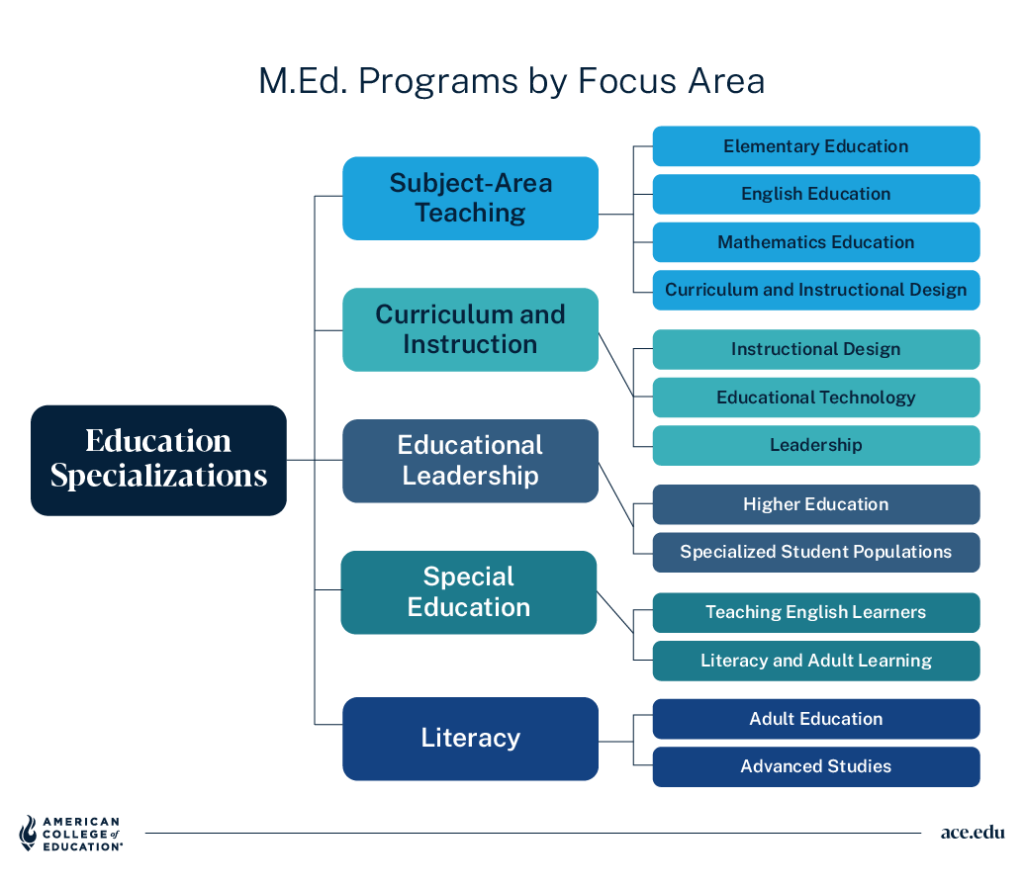
Types of M.Ed. Programs by Focus Area
ACE offers options across subject-area teaching, curriculum and instruction, leadership, and specialized areas of education, making it easier to find a path that fits specific career goals.
Subject-Area Teaching Specializations
For educators who want to grow in the classroom, a subject-area specialization offers the opportunity to build deeper expertise in what they teach and how they teach it.
ACE offers M.Ed. programs in English Education, History Education, Biology Education, Chemistry Education, Mathematics Education, STEM Education and Sociology Education. These programs allow educators to focus their graduate studies on a specific content area while strengthening the knowledge and skills they can bring back to their students.
Curriculum and Instructional Design Specializations
Educators interested in developing stronger learning experiences have several M.Ed. paths to consider:
- Curriculum and instruction: Focuses on curriculum development and design, helping educators strengthen how learning is planned and delivered
- Instructional design and educational technology: Focuses on integrating educational technology into curriculum design to create engaging learning experiences
- Instructional coaching and teacher leadership: Prepares educators to support other teachers, strengthen instruction and take on greater leadership responsibilities
Leadership Specializations
Educators interested in leadership roles can choose an M.Ed. path based on the setting where they want to make an impact:
- Educational leadership: Focuses on preparing educators for leadership within K-12 schools and can support growth toward educational leadership positions such as school administration
- Higher education: Focuses on leadership within colleges and universities, preparing educators to apply their skills in postsecondary settings
Specialized Student Population Specializations
Educators who want to strengthen how they support specific groups of students can choose a specialization that aligns with the populations they serve.
- Special education: Helps educators build the knowledge and strategies to support students with diverse learning needs and abilities
- Early childhood education: Focuses on how young children learn and develop, helping educators create meaningful learning experiences during these foundational years
- Teaching English learners: Helps educators strengthen instruction for students who are developing English language skills
Literacy and Adult Learning Specializations
Education careers can take many forms, and these advanced specializations give educators options for serving students at different stages:
- Literacy: Helps educators strengthen literacy instruction and support K-12 students as they build essential reading and literacy skills
- Adult education and training: Focuses on the distinct needs of adult learners, preparing educators to support adults in education, workforce development and corporate training
- Advanced studies: Gives experienced educators a broader path to deepen their knowledge across areas that align with their work and career goals
Skills Gained From an Education Master’s Degree
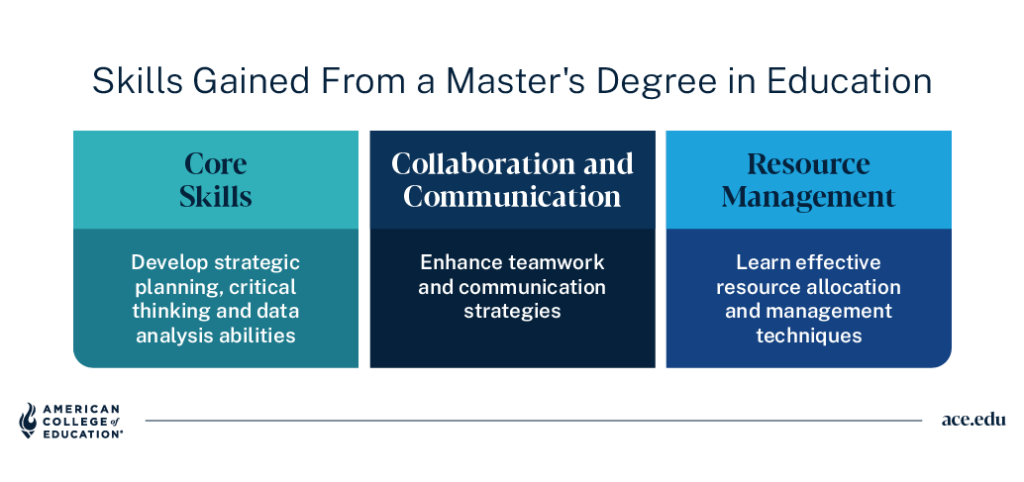
An education master’s degree can help educators build skills they can put to work right away while preparing for what’s next. Depending on the program, that can include:
- Thinking critically and approaching challenges strategically
- Using data and educational research to make informed decisions
- Evaluating research and applying relevant findings in practice
- Making thoughtful decisions about resources and priorities
- Communicating clearly and collaborating with students, colleagues and other stakeholders
Career Opportunities With an Education Master’s Degree
A master’s degree can create opportunities for educators to grow in the classroom or explore a new direction. Education career opportunities will vary based on specialization, experience and any licensure or employer requirements. It’s important to note that some careers may require state licensure, certification or additional qualifications.
Depending on their goals, educators may pursue roles like:
- Elementary or secondary teacher
- Math or science teacher
- Instructional coach
- Curriculum designer
- Academic advisor
- Assistant principal
- Principal
How to Choose the Right Education Master’s Degree for You
Start with one question: What do you want to be able to do after graduation that you can’t do today?
If you’re entering teaching and need an initial licensure pathway, an MAT may be the right fit. If you’re already an educator, think about where you want to grow. Do you want to strengthen your classroom practice, specialize in a subject area, or move into leadership or administration?
From there, consider:
- Career requirements: Research the qualifications, licensure or credentials required for the role you want
- Program focus: Look for a specialization that builds the knowledge and skills that align with your goals
- Flexibility: Consider whether the program allows you to continue teaching and working while earning your degree
- Learning format: Online education programs can offer greater flexibility for working educators
Finding Your Path in Education Graduate Programs
There isn’t one education master’s degree that makes sense for every teacher. The right fit depends on where you are in your career, what you want to accomplish and where you want to go next.
Today’s education graduate programs offer paths for aspiring teachers, experienced classroom educators, subject-area specialists, instructional designers and future leaders. With a wide range of specializations available, educators can find programs that align with their interests, strengths and long-term career goals.
For working teachers, flexibility and affordability can be just as important as specialization. Taking time to compare programs, requirements and outcomes can help you choose a graduate path that supports both your career goals and the realities of your life today.
FAQs
Can I switch specializations after starting an education master’s program?
Yes, but the process for changing specializations will depend on the institution and program. If your goals change after you’ve started your degree, you’ll likely need to connect with an enrollment or academic advisor to explore your options and see how the coursework you’ve already completed may apply to a new path.
Do I need a current teaching license to enroll in an M.Ed. program?
Not always. Teaching license requirements vary by institution and program. Some programs are designed for licensed educators, while others may not require a current teaching license. Check the admission requirements for the specific program you’re considering to ensure it aligns with your background and goals.
How is a Master of Arts in Education different from a Master of Science in Education?
There isn’t a universal difference between a Master of Arts in Education and a Master of Science in Education. Colleges structure and name their degrees differently, so the title alone won’t tell you which program is the better fit. Instead, compare what you’ll study, the specializations available and how each program aligns with your career goals.
Can an education master’s degree help me move into a role outside of a school setting?
Yes, an education master’s degree can build skills that apply well beyond a traditional school setting. Depending on your specialization and career goals, you may find opportunities in instructional design, professional development, adult education, corporate training, higher education or curriculum development.
American College of Education offers both MAT and M.Ed. programs that can help both aspiring and current educators reach their career goals in an affordable, flexible way.