

Education looks different for everyone. Some people thrive under pressure, others plan their study schedules down to the minute, but nearly everyone has a story about how they learn best.
To understand those habits a little better, we surveyed more than 2,300 people across the United States about how seriously they took their studies the last time they were in school. Their answers reveal how study habits vary from state to state and what they say about people’s overall approach to learning.
From which states scored highest for studiousness to how the nation performs on key study habits like attendance, preparation and note-taking, here’s what we found when we put people’s study skills to the test.
Which U.S. States Are the Most Studious?
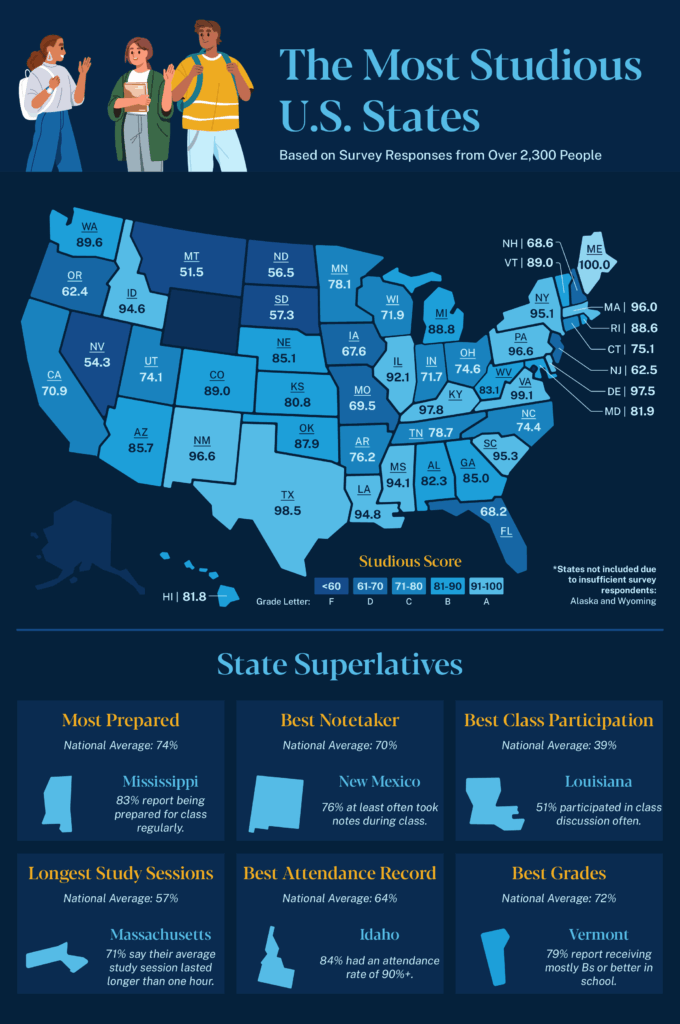
Depending on where you live, study habits may look a little different. Some students thrive in group discussions, others in late-night study sessions, but every state has its share of dedicated students.
To get specifics on how study habits differ, we analyzed survey responses from people in every U.S. state and scored how seriously they took their studies the last time they were in school.
The Most Studious U.S. States
These states stood out in our study for the right reasons. Whether due to how often they completed homework assignments, how often they attended class or how long their study sessions were, their residents reported overall more studious behavior than the rest.
We created an index based on the studying and classroom habits of people in every state. To make our study even more reflective of common grading systems, we decided to apply a curve so the top state received a 100 and each state below was graded on that scale.
Let’s take a closer look at our states that stand out for studiousness.
- Maine – 100
- Grades: 81% of Maine respondents said they almost never earned below a “B.”
- GPA: The state reported the highest average GPA in the study at 3.5.
Maine’s strong performance reflects the state’s emphasis on steady, disciplined learning — the kind that values consistency over cramming.
- Virginia – 99.1
- Class participation: 49% said they often or always engaged in discussions. This may seem low but the national average was just 39%.
- Study session length: 73% reported studying for more than an hour at a time, the second-highest rate overall.
Virginia’s high engagement levels mirror its rich educational history, from some of the country’s oldest universities to a culture that values curiosity and communication.
- Texas – 98.5
- Note-taking: 73% said they always or often took notes in class.
- All-nighters: 63% admitted to pulling an all-nighter at least once for school.
They say everything is bigger in Texas, and their work ethic reflects that. Texans showed that hard work sometimes means burning the midnight oil, which is okay as long as they get plenty of sleep the rest of the time!
- Kentucky – 97.8
- Homework: 84% said they always or often completed their assignments.
- Preparedness: 86% reported showing up ready for class, the second-highest rate in the study.
Kentucky’s results highlight a quiet but determined dedication. A commitment to showing up, doing the work and making steady progress day after day.
- Delaware – 97.5
- Homework: 96% said they always or often completed homework, the highest in the study.
- Attendance: 79% reported attending class at least 90% of the time, the second-highest rate overall.
These strong homework and attendance numbers paint a picture of reliability in Delaware, where the student body understands success starts with simply being present and prepared.
Overall, there’s a clear balance between regions represented in the top five. The mix of New England, Southern and Mid-Atlantic states shows that diligence in education isn’t defined by geography. It’s a shared value across the map.
State Superlatives: States That Stand Out by Subject
While some states stood out overall, others excelled in specific areas of study. These “state superlatives” show how different learning habits take shape across the country.
- Most Prepared – Mississippi: Students from Mississippi reported being the most prepared for class, showing a culture that values readiness and responsibility.
- Best Notetaker – New Mexico: Students here stood out for their detailed note-taking habits, a sign of strong organization and focus.
- Best Class Participation – Louisiana: Known for its vibrant culture and lively conversation, it’s no surprise that Louisiana residents led the nation in classroom participation.
- Longest Study Sessions – Massachusetts: A state home to some of the country’s most prestigious universities produced students who studied the longest on average.
- Best Attendance Record – Idaho: Idaho students showed up — literally. They reported the highest attendance rates in the nation.
- Best Grades – Vermont: Learners in Vermont recorded the best grades on average, reinforcing the state’s reputation for academic excellence and strong public education.
From showing up and staying organized to actively engaging and striving for top marks, lifelong learners across the country show their dedication to learning in different ways.
As we parse through the regional results, a bigger question emerges: What do these study habits reveal about the U.S. as a whole? Next, we’ll take a closer look at national patterns and what they reveal about our collective approach to learning.
How Studious Is the Average Person?
So, how did our survey population stack up as students overall? The state-by-state results show that studiousness is alive and well across the country, but when we zoom out to look at national trends, the picture becomes even clearer. Our collective study habits may not be perfect, but they paint a portrait of students who care about doing well, staying prepared and showing up.
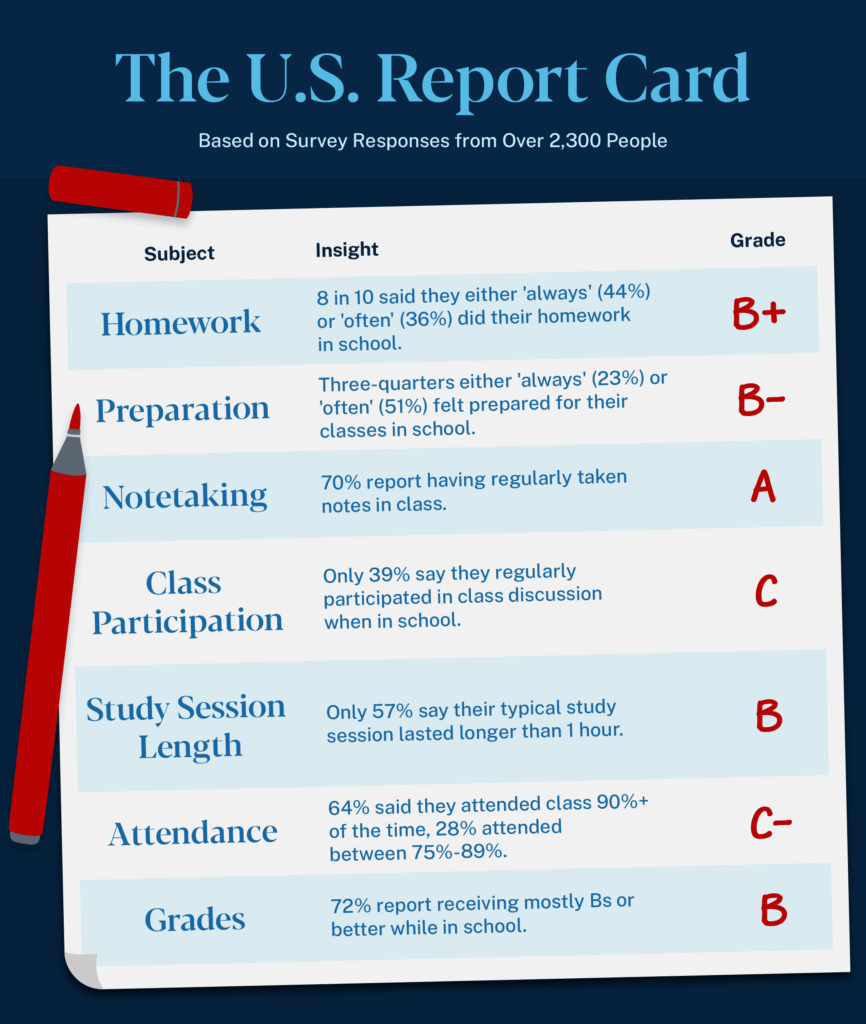
To find out where we’re thriving (and where there’s room for improvement), here’s how respondents scored on key study habits — complete with a letter grade for each.
For consistency, we applied the same curve that we did for the states to the national averages to assign a fair letter grade respondents would receive for each category.
The U.S. Report Card
Homework Completion: B+
- Eight in 10 said they always (44%) or often (36%) did their homework.
- That’s a solid effort, showing that most students were consistent with assignments, even if a small group occasionally let one slip.
Class Preparedness: B-
- Three-quarters said they always (23%) or often (51%) came to class ready with materials in hand and readings complete.
- It’s a good grade but not perfect. Think of it as a student who studies hard but forgets a notebook every now and then.
Note-Taking: A
- About 70% regularly took notes in class.
- It’s a habit that pays off, and this grade suggests that most students took their studies seriously enough to stay engaged and organized.
Class Participation: C
- Only four in 10 said they regularly joined in class discussions.
- Many students seem to prefer listening over speaking. That’s not necessarily a bad thing, but participation is where confidence and curiosity often shine.
Study Session Length: B
- Only 57% say their typical study session lasted longer than one hour, with only 10% spending less than 30 minutes at a time.
- Respondents appear to value quality over quantity when it comes to studying. Hectic student schedules may make it harder to sit down for hours studying, so they fit it in when they can.
Attendance: C-
- Only 64% said they attended class more than 90% of the time, while another 28% attended between 75% and 89%.
- Consistency counts, and most respondents showed up regularly but with only six in 10 being in class 90% of the time there is clear room for improvement.
Grades Earned: B
- 72% received mostly Bs or better while in school. About 20% regularly had a mix of Bs and Cs.
- The results show that many respondents didn’t just try, they succeeded. Even still, 72% regularly receiving above-average marks is only good enough for a passing grade here.
Other Notable Study Habits
Not every aspect of studying fits neatly into a grading scale, but these insights reveal even more about how respondents approach learning.
Study Frequency
Most said they worked on school assignments outside of class four to five days per week (42%), while another 37% studied two to three days a week. That consistency points to a steady rhythm rather than leaving things to the last minute.
All-Nighters
More than half (55%) admitted to pulling an all-nighter at least once. Interestingly, the number jumps from 31% among high school–educated respondents to nearly 60% among college or graduate school graduates — a reminder that the higher the education level, the heavier the workload.
The data shows that while no one’s perfect, the foundation for lifelong learning is fairly strong. We were, admittedly, pretty harsh in our expectations and grading, but it’s clear that people value education, effort and persistence — qualities that continue to shape students long after graduation.
“Be proactive about participating and planning. Create time in your schedule for managing the unexpected and networking with peers and faculty members. Don’t blame yourself if you feel behind. You’re all in progress, and there is always more to learn!”
Lauren Vandermeer, Curriculum Development Manager
Closing Thoughts
From the top-ranked states to the national averages, our study shows that studiousness takes many forms. Whether it’s Maine’s steady discipline, Virginia’s engagement, or the nation’s overall commitment to showing up and doing the work, people take learning seriously, even if there’s still room to raise our collective GPA.
That drive to keep improving is exactly what education is about. At American College of Education (ACE), we believe curiosity doesn’t end when school does. It evolves. Whether you’re advancing your career, finishing a degree or pursuing a new passion, ACE offers flexible, affordable programs designed to help lifelong learners keep moving forward.
No matter where you fall on this report card, there’s always more to learn — and ACE is here to help you take the next step. Explore our fully online programs to find the one that aligns with your career.
Methodology
To determine the most studious states, we surveyed people from 48 states, asking them 10 questions about how seriously they took their studies the last time they were in school. We put responses on a numeric scale where a more studious answer resulted in a higher number. We averaged those figures by state and scaled responses from 0 to 10, so the most studious state for a given question received a 10 and the least received a 0. All questions were equally weighted and totaled so each state was given a final score.
To make our scoring more reflective of what grading looks like for many, we decided to curve the final scores so that the most studious state received a score of 100.
We broke respondents down by education level (high school, college and graduate degrees) and had them answer based on their most recent experience to have consistent answers across states.
The data is based on over 2,300 survey respondents. The survey took place over a two-week period in September 2025. Alaska and Wyoming were excluded from the study due to insufficient survey responses.
Fair Use
You are welcome to use, reference and share non-commercial excerpts of this study with proper attribution. If you cite or cover our findings, please link back to this page so readers can view the full methodology, charts and context.