
For many educators, graduate study is not a theoretical next step. It is a practical decision tied to licensure requirements, classroom effectiveness, career advancement or leadership opportunities. Teachers often return to school while balancing full-time work, family responsibilities and professional obligations.
Against that backdrop, recent updates from the United States Department of Education regarding how certain graduate programs are classified for federal student loan purposes have raised new questions for those considering an education degree or teaching degree.
Understanding what this reclassification involves, and how it affects borrowing rather than professional standing, is an important part of making informed decisions about graduate education. It also provides helpful context for why American College of Education (ACE) continues to prioritize affordability, clarity and quality in educator preparation.
Federal Reclassification of Professional Degrees
The current discussion stems from a federal update that affects how graduate and doctoral programs are categorized for student loan eligibility. The Department of Education uses degree classifications to determine federal student loan limits, including how much students may borrow at the graduate level.
Under this framework, professional degree classification plays a role in setting higher borrowing caps for certain programs. The recent reclassification adjusts which degrees fall under that category. While the change has generated attention, it’s important to note that the update focuses on loan administration rather than academic content or professional legitimacy. The reclassification does not alter accreditation standards, program outcomes or licensure pathways.
What Is a Professional Degree?
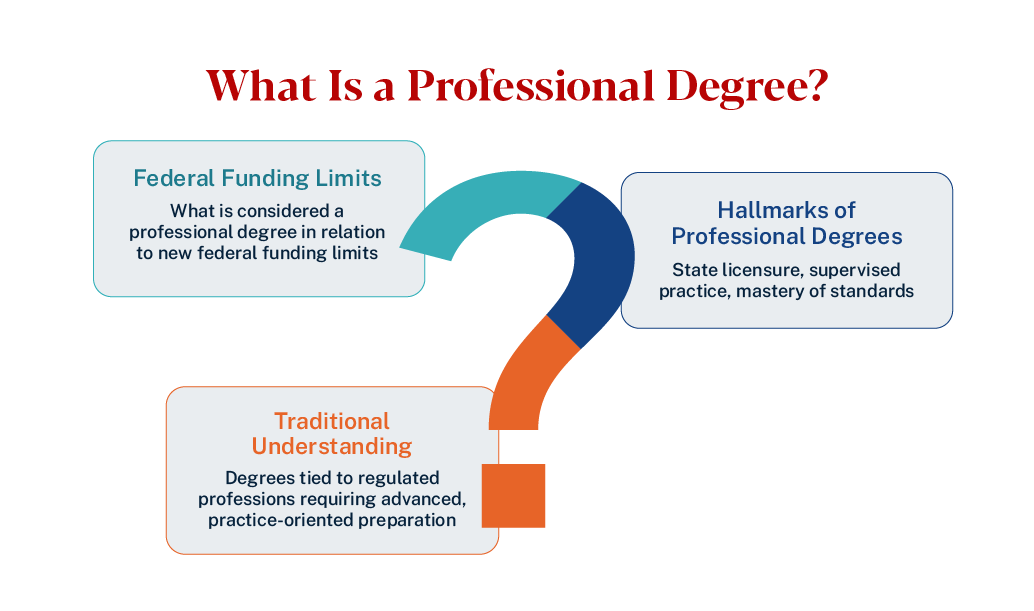
In general terms, professional degrees are associated with fields that require advanced preparation for regulated practice. These programs often include structured training, supervised field experiences, and preparation for licensure or certification. Law and medicine are frequently cited examples.
From a federal aid perspective, however, the professional degree label serves a narrower purpose. It is part of a professional degree classification system used to organize federal student loan limits. While educator licensure programs include supervised practice, mastery of standards and state-level credentialing, they are categorized differently under current federal funding rules. This distinction reflects administrative policy rather than the complexity or importance of the teaching profession.
The New Federal Classification of Education Degrees
Under the updated classification approach, most education degrees are placed within the graduate academic degree category rather than the professional degree category used for higher federal loan limits. This includes many graduate degrees in education, such as master’s degree programs designed for licensed teachers seeking professional growth.
As a result, students enrolled in education graduate programs online may be eligible for lower annual federal student loan limits than students in programs classified as professional degrees. This shift has prompted discussion among preparation providers and educators who are concerned about how financing options affect access to graduate education. Much of that concern centers on affordability and planning rather than changes to program quality or licensure standards.
These concerns come on top of recent changes to graduate-level borrowing limits made by recent federal legislation. Learn more about the Grad PLUS loan program and how it’s been affected.
The Real-World Impact on the Teaching Pipeline
Education leaders and preparation programs have identified several potential implications associated with the teaching degree reclassification. These concerns focus less on academic quality and more on access, affordability and long-term workforce sustainability. Several commonly discussed considerations include:
- Reduced access to federal borrowing: Many education graduate programs cost more than the new annual federal loan limits, which may require students to seek alternative financing or adjust their enrollment plans.
- Pressure on high-need fields: Teaching areas such as special education, bilingual education, early childhood education and elementary education already face shortages. Financial barriers may discourage candidates from entering or advancing within these fields.
- Equity considerations: First-generation college students and candidates from historically underrepresented backgrounds are more likely to rely on federal student loans. Changes to borrowing limits may disproportionately affect these groups.
These concerns exist alongside broader discussions about the long-term effects of student debt. Research has shown that high borrowing levels can influence career decisions and professional development opportunities over time. For additional context, learn more about the student loan debt crisis and how debt can shape professional and career decisions over time.
ACE’s Longstanding Commitment to High-Quality, Accessible Teacher Preparation
While federal policies evolve, ACE has remained consistent in our approach to educator preparation. ACE was founded with the goal of offering affordable, high-quality graduate degrees without participating in federal student loan programs. Of course, one of the benefits of affordable online education degrees is the reduced need for loans, and ACE’s low-cost tuition allows 87% of our students to graduate with no student debt.*
But refusing to accept Title IV federal loans even though we were eligible was a deliberate choice that contributes to how we’re able to keep our program costs low. Now, when fluctuating federal funding structures are causing other programs to become financially unattainable, ACE remains a steady option for educators who want clear, predictable tuition alongside high-quality education.
ACE has a long history of serving practicing teachers through graduate degrees designed to support classroom effectiveness, leadership development and professional growth. We embraced online learning early as a way to expand access while maintaining academic expectations grounded in research and field relevance.
By combining affordability with rigor, ACE helps strengthen the educator pipeline in a sustainable way. Teacher preparation programs are structured to support educators who seek advancement or additional certifications while continuing to serve their students. ACE’s approach to transparent tuition and manageable costs is further explained in our model for affordable tuition and fewer loans.
Affordable Online Graduate Degrees in Education at ACE
ACE offers a range of affordable education degree options designed for working educators. These programs recognize that teachers pursue graduate study for many reasons, including licensure advancement, leadership roles and continued professional development.
Available offerings include education graduate programs online such as M.Ed. online programs, specialist degrees and doctoral pathways, which feature fully online coursework with some programs requiring local student teaching or internships. We prove that you can earn an affordable teaching degree online. Across these options, students benefit from regional accreditation, research-based curricula and coursework aligned with real-world educational practice.
Flexibility is a central feature of ACE’s online teaching degree programs. Educators can balance graduate study with professional and personal responsibilities while maintaining momentum toward their goals. ACE’s tuition model supports this flexibility by providing cost clarity from the outset, which allows students to plan their education without uncertainty. If you’re interested in exploring these options, please visit ACE’s education degree programs page for more information.
ACE’s Ongoing Advocacy for the Profession
Beyond degree offerings, ACE remains committed to supporting educators as professionals. The institution recognizes teaching as a career grounded in expertise, responsibility and continuous learning. While policy discussions around professional degree classification may continue, ACE’s focus remains on honoring the role of educators through accessible, high-quality graduate education that supports long-term career growth.
FAQs
What is a professional degree?
Within federal student loan policy, a professional degree is a classification used to determine borrowing limits. It does not define the value or credibility of a profession.
What does the professional degree federal reclassification mean for educators?
The reclassification affects federal borrowing limits for some graduate degrees in education. It does not change licensure requirements, program standards or the role of teachers.
Why does ACE focus on affordability in education degrees?
ACE was designed to help educators pursue graduate study without excessive debt by offering transparent tuition and affordable education degree options.
Who should consider an ACE graduate degree in education?
ACE programs are well suited for practicing educators who want an affordable teaching degree that supports professional development, leadership or advancement.
A Stable Path to Graduate Education
The reclassification of professional degrees highlights ongoing challenges in how graduate education is financed in the U.S. For educators, understanding how federal loan rules intersect with graduate study is an important part of long-term planning. Throughout these changes, ACE remains focused on providing affordable, high-quality online graduate degrees that respect the traditions of teacher preparation and support educators at every stage of their teaching career.
Explore ACE’s low-cost, high-quality education programs and see how they can help you advance your career in education.
*Internal research completed in November 2025