
Career Guide: Nurse Anesthetist
Here’s what you need to know.
Toggle Navigation
Our Enrollment Counselors are here to answer your questions and walk you through the enrollment process.
Career Overview: Nurse Anesthetist
Nurse anesthesia offers registered nurses (RNs) a path to advanced practice and greater responsibility in patient care. It’s a highly specialized nursing career that requires advanced education, critical care experience and professional certification.
If you’re considering this path, understanding the education requirements, day-to-day responsibilities and skills involved can help you plan your next steps.
What Is a Nurse Anesthetist?
A nurse anesthetist is an advanced practice registered nurse (APRN) who specializes in administering anesthesia and managing pain. Certified Registered Nurse Anesthetists (CRNAs) care for patients by:
- Reviewing medical history
- Planning anesthesia
- Monitoring stability during procedures
- Supporting recovery after procedures
They may work alongside surgeons, anesthesiologists and other healthcare professionals to support each patient’s anesthesia and pain management needs.
What Does a Nurse Anesthetist Do?
CRNAs have responsibilities throughout the full anesthesia process. Day-to-day responsibilities often depend on the patient, procedure and work setting.
Core Duties and Responsibilities
While responsibilities vary by setting and scope of practice, a nurse anesthetist may:
- Review a patient’s medical history and conduct a pre-anesthesia assessment
- Develop an individualized anesthesia care plan based on the patient and procedure
- Administer anesthesia during surgical and other medical procedures
- Monitor vital signs and other indicators before, during and after anesthesia
- Manage pain during procedures and recovery
- Recognize and respond to changes in a patient’s condition
- Collaborate with surgeons, anesthesiologists and other healthcare professionals
- Educate patients about anesthesia, potential effects and recovery expectations
Work Environment Variations
Nurse anesthetists work in a variety of healthcare settings, including:
- Hospitals
- Outpatient surgery centers
- Ambulatory care centers
- Physician offices
- Military healthcare facilities
- Specialty surgical practices
Skills & Traits That Make a Successful Nurse Anesthetist
Nurse anesthetists rely on a mix of clinical expertise and people skills to care for patients. Strong communication, critical thinking and technical skills can all help them navigate the responsibilities of the role.
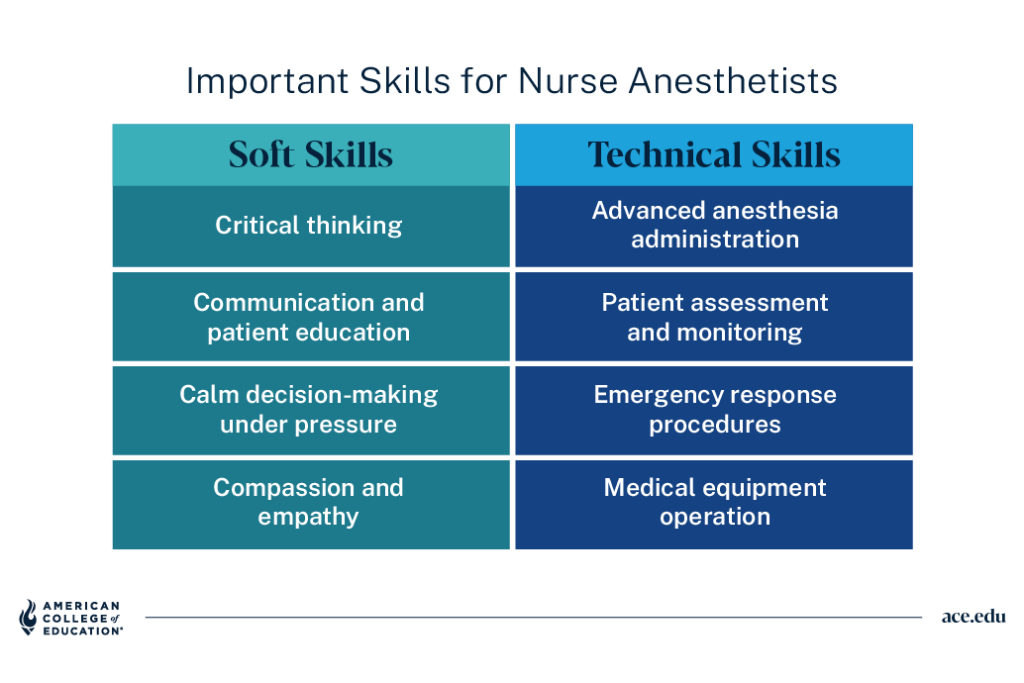
Essential Soft Skills
Strong interpersonal skills are essential for CRNAs and include:
- Critical thinking
- Communication and patient education
- Attention to detail
- Calm decision-making under pressure
- Compassion and empathy
- Leadership and teamwork
Important Technical Skills
Technical expertise is also important, with skills like:
- Advanced anesthesia administration
- Patient assessment and monitoring
- Pain management
- Airway management
- Pharmacology
- Critical care nursing
- Medical equipment operation
- Emergency response procedures
How These Skills Apply on the Job
On the job, these skills help CRNAs administer anesthesia safely, manage complex medical procedures and continuously monitor patients for changes in their condition. Strong clinical skills, communication and quick decision-making all contribute to positive patient outcomes.
Nurse Anesthetist Education Requirements
The path to becoming a nurse anesthetist requires advanced education, nursing experience and specialized training.
Minimum Education Requirements
The first step toward a CRNA career is a nursing school program that results in a Bachelor of Science in Nursing (BSN) or equivalent preparation as well as an active RN license. It’s also required to build experience in critical care nursing prior to applying for a CRNA program.
Advanced Education Pathways
Aspiring CRNAs should also earn an accredited nursing doctorate degree in nurse anesthesia. Most programs offer either a Doctor of Nursing Practice (DNP) or Doctor of Nurse Anesthesia Practice (DNAP) credential. Students deepen their study of anesthesia, pharmacology and physiology along with completing supervised clinical training.
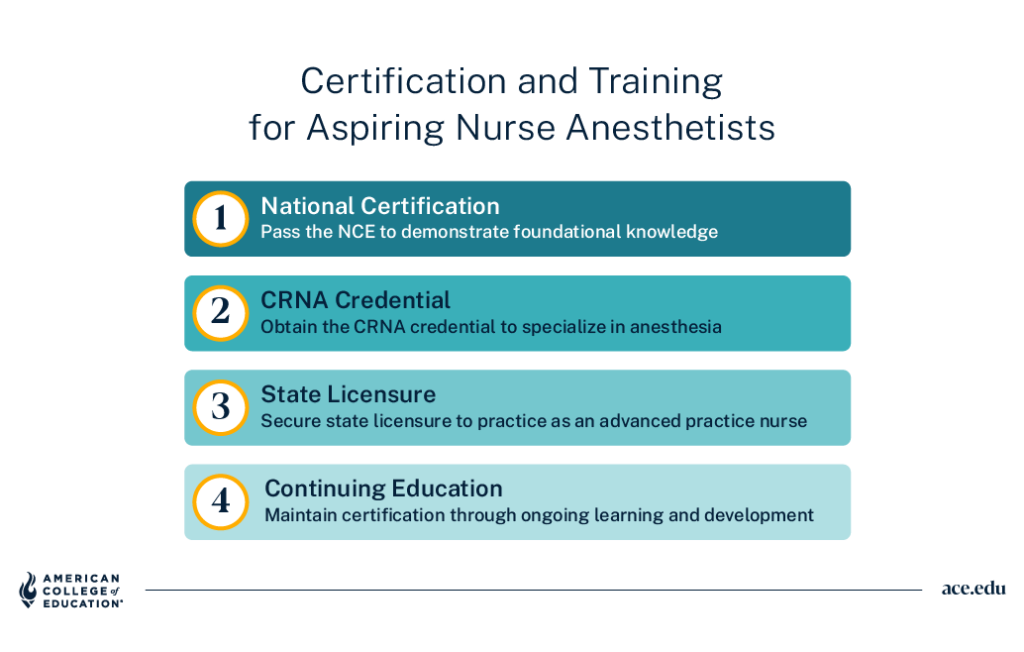
Certifications and Training Options
Passing the National Certification Examination (NCE), administered by the National Board of Certification and Recertification for Nurse Anesthetists (NBCRNA), is required to earn the CRNA credential, as well as meeting state advanced practice licensure requirements wherever employed. Once certified, CRNAs complete continuing education and other requirements to maintain their certification.
How to Become a Nurse Anesthetist
The path to becoming a CRNA builds progressively from general nursing preparation to critical care nursing and specialized doctoral education.
- Earn a Nursing Degree
Start by earning a Bachelor of Science in Nursing or completing an equivalent nursing degree pathway. Your nursing education will help you build foundational knowledge and clinical experience in patient care.
- Become a Registered Nurse
After completing your nursing education, the next step is becoming a licensed registered nurse. You’ll need to pass the NCLEX-RN and meet the licensure requirements established by your state board of nursing.
- Gain Critical Care Nursing Experience
Once you’re an RN, you’ll need experience in a critical care setting. Nurse anesthesia programs require at least one year of full-time critical care RN experience or its part-time equivalent.
This experience gives you the opportunity to care for patients with complex needs while strengthening your assessment, critical thinking and decision-making skills. - Complete a Nurse Anesthesia Educational Program
Next, you’ll complete an accredited doctoral nurse anesthesia program. You’ll build advanced knowledge in areas like anesthesia, pharmacology, physiology and patient assessment while completing supervised clinical training.
- Earn CRNA Certification
After graduating, you’ll need to pass the NCE. You’ll also need to meet your state’s licensure requirements for advanced practice nursing. Requirements can vary by state, so be sure to check with your state board of nursing as you prepare.
- Optional: Advance Through Specialized Practice
As you gain experience as a CRNA, you may choose to grow your career through specialized anesthesia practice, leadership, education or research. These opportunities can help you build on your experience and pursue the areas of nursing practice that interest you most.
Day-in-the-Life & Real-World Scenarios
Daily work can vary based on setting, procedures and patient needs.
A Typical Workday
The day may begin with reviewing medical histories, assessing patients and preparing anesthesia care plans. Once a procedure begins, the CRNA administers anesthesia and closely monitors the patient, making adjustments as needed.
Patient care continues through recovery. Throughout the day, CRNAs also consult with surgeons and other healthcare professionals to coordinate care and respond to patient needs.
Real-World Examples
In an outpatient setting, a CRNA may provide anesthesia for a scheduled surgery and monitor the patient through recovery. During emergency surgery, they may manage anesthesia and pain while responding to changes in the patient’s condition. For a complex medical procedure, the CRNA closely monitors the patient and adjusts anesthesia as needed.
What Success Looks Like in the Role
Success in this role means administering anesthesia safely, managing pain effectively and closely monitoring patients throughout care. It also requires strong collaboration with surgical teams to support positive patient outcomes.
Nurse Anesthetist Salary & Job Outlook
A career as a nurse anesthetist can offer strong earning potential along with opportunities for continued growth in advanced nursing practice. As the need for anesthesia and advanced nursing care continues, CRNAs can find opportunities to use their specialized skills across healthcare settings.


FAQs
What is the difference between a nurse anesthetist and an anesthesiologist?
A CRNA is an APRN who completes doctoral-level nurse anesthesia education, while an anesthesiologist is a physician who completes medical school and residency training in anesthesiology. Both can provide anesthesia care, but their education and professional backgrounds are different.
How much critical care experience is typically needed before applying to a nurse anesthesia program?
You’ll need at least one year of full-time RN experience, or its part-time equivalent, in a critical care setting. Some nurse anesthesia programs may require additional experience, so check the admission requirements for each program you’re considering.
Can nurse anesthetists work independently?
CRNAs can practice independently in some settings, but the level of autonomy varies by state and workplace. If you’re considering this career, check your state’s requirements to understand how CRNAs can practice where you plan to work.
What types of procedures do nurse anesthetists support?
CRNAs can provide anesthesia for procedures ranging from routine outpatient surgeries to more complex operations. Depending on their role and work setting, they may also support emergency procedures and other treatments that require anesthesia or pain management.
Advance Your Nursing Career
The next level of your career is ready when you are. All you have to do is apply now!