
Healthcare Administration Skills
Explore the career you could build with this skill.
What Is Healthcare Administration?
Healthcare is one of the largest and most complex industries in the world. From hospitals and physician practices to long-term care facilities and public health organizations, healthcare systems depend on skilled professionals to coordinate operations, support staff and help organizations deliver quality care. As the industry continues to grow, professionals with strong leadership, management and organizational skills remain in high demand.
Healthcare administration focuses on the leadership, management and coordination of healthcare organizations and services. Healthcare administrators help oversee budgets, manage teams, improve processes and support strategic decision-making while ensuring organizations operate effectively. If you’re interested in developing the skills that help healthcare organizations serve patients and achieve their goals, you’re interested in healthcare administration.


Recent Trends in Healthcare Administration
Healthcare administration continues to adapt as organizations respond to new technologies, changing regulations and growing patient expectations. Digital transformation remains a major focus across the industry, with healthcare organizations increasingly adopting electronic health records, data analytics, telehealth services and artificial intelligence to improve efficiency and support decision-making. At the same time, healthcare leaders must navigate workforce challenges, rising costs and ongoing efforts to improve access to care.
As these changes reshape the healthcare landscape, organizations are seeking professionals who can lead teams, manage resources and support organizational goals in complex environments. Healthcare administration skills can help professionals understand how to evaluate operations, implement improvements and guide strategic initiatives that contribute to both organizational success and positive patient outcomes.
Healthcare Administration Courses
American College of Education (ACE) offers standalone courses that can help you develop your skills in this area.
Healthcare Administration Careers
Learn more about the career paths you can pursue with this skill on your resume.
Course Stackability
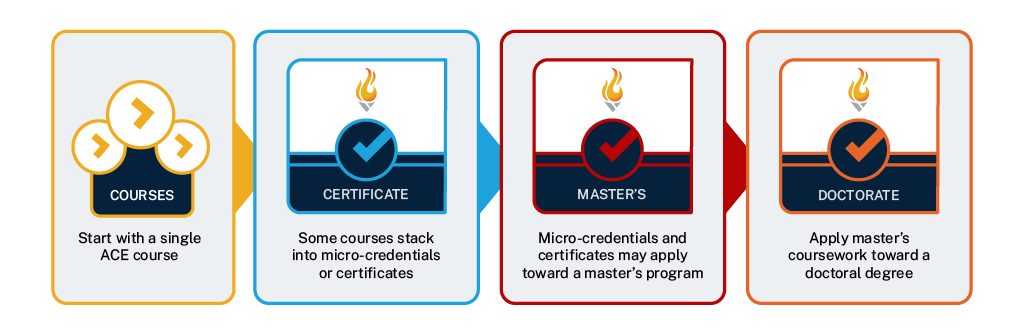
We want our students to get the most out of their hard work. That’s why we design our courses and programs with stackability in mind. Some courses can be applied toward a micro-credential or certificate, which can in turn be applied toward a master’s degree, subject to program requirements. That master’s degree coursework could then be applied toward a doctorate. Even by taking a single course at ACE, you're making a smart investment toward a larger educational future.
Related Degrees
The courses you take in this skill area can earn you academic credit that you can apply to these ACE degrees.
Course Admissions
For students taking single courses without enrolling in a program, admission requirements will depend on the level of the course. Students must meet ACE’s general admission requirements and be admitted to the college before signing up for a stand-alone class.
Bachelor’s Level
- At least 30 semester credits
- Minimum GPA of 1.75
Master’s Level
- A bachelor’s or highest post-baccalaureate degree
- Minimum GPA of 2.5*
Doctoral Level
- A master’s or doctoral degree
- Minimum GPA of 3.0
*Applicants whose overall GPA is between 2.0-2.49 may be considered for admission if their degree was conferred more than 10 years from the start date at ACE or the applicant has five or more years of experience in the field appropriate for intended courses.
Healthcare Administration FAQs
What can I learn from healthcare administration courses online?
Healthcare administration courses online can help you develop a stronger understanding of how healthcare organizations operate. Depending on the course, you may explore topics such as healthcare leadership, organizational management, healthcare policy, finance, quality improvement and strategic planning. These skills can help you better understand the challenges and opportunities facing today's healthcare organizations.
How do health administration courses prepare professionals for leadership roles?
Health administration courses can help you build leadership skills that are valuable in healthcare settings. Through coursework focused on communication, decision-making, organizational strategy and team management, you can learn how to guide initiatives, support employees and contribute to organizational success. These skills can be especially useful as healthcare organizations continue to navigate change and growth.
What is the difference between healthcare management courses online and healthcare administration programs?
Healthcare management courses online often focus on specific leadership, operational or organizational topics that can help you develop targeted skills. Healthcare administration programs typically provide a broader educational experience that explores multiple areas of healthcare leadership, operations, finance, policy and management. Individual courses may help you build expertise in a particular area, while a full program can provide a more comprehensive foundation.
Can I advance my career through an online healthcare leadership course?
An online healthcare leadership course can help you strengthen skills that employers often value in healthcare environments, including communication, strategic thinking, problem-solving and team leadership. By developing these competencies, you may be better prepared to pursue additional responsibilities, leadership opportunities or professional growth within your organization.
What career opportunities are available with healthcare administration training?
Healthcare administration training can support a variety of career paths across healthcare organizations. Depending on your education, experience and professional goals, you may pursue opportunities related to healthcare operations, practice management, healthcare leadership, quality improvement, healthcare consulting or organizational administration. These skills are relevant in settings such as hospitals, clinics, physician practices, long-term care facilities and other healthcare organizations.