

Finance Skills
Explore the career you could build with this skill.
What Are Finance Skills?
Finance skills are the knowledge and abilities used to manage money, evaluate financial information and support sound business decisions. These skills help professionals understand how organizations earn, spend and invest resources while planning for long-term financial success.
Finance skills are valuable across nearly every industry. Whether you work in business, healthcare, education, government or nonprofit organizations, understanding financial concepts can help you interpret budgets, analyze performance, allocate resources and contribute to organizational goals. As organizations increasingly rely on data-driven decision-making, professionals with finance knowledge are well positioned to support strategic planning and financial sustainability.


Recent Trends in Finance
As is the case in many fields, technology continues to reshape the finance profession. Automation, artificial intelligence and advanced analytics are changing how organizations collect, analyze and report financial information, allowing professionals to focus more on strategic planning and decision-making. This means employers currently value professionals who can combine financial knowledge with data literacy and strong communication skills.
Finance professionals are also expected to understand broader business issues such as risk management, regulatory compliance and organizational performance. As industries evolve, finance skills continue to play an important role in helping organizations adapt to changing economic conditions and make informed financial decisions.
Finance Courses
American College of Education (ACE) offers standalone courses that can help you develop your skills in this area.
Finance Careers
Learn more about the career paths you can pursue with this skill on your resume.
Course Stackability
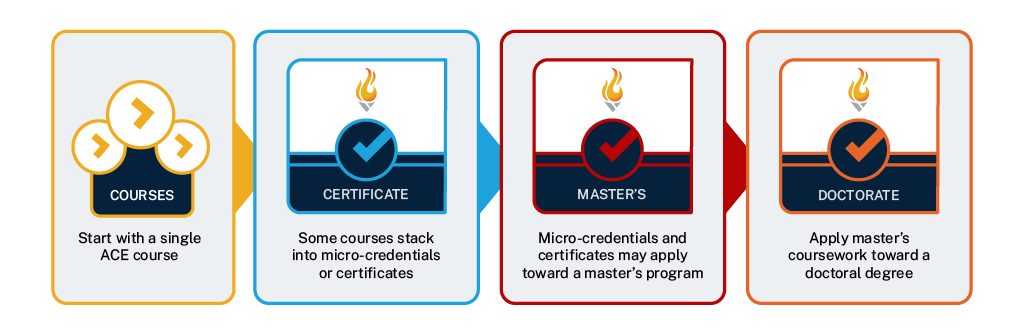
We want our students to get the most out of their hard work. That’s why we design our courses and programs with stackability in mind. Some courses can be applied toward a micro-credential or certificate, which can in turn be applied toward a master’s degree, subject to program requirements. That master’s degree coursework could then be applied toward a doctorate. Even by taking a single course at ACE, you're taking a smart step toward a larger educational future.
Related Degrees
The courses you take in this skill area can earn you academic credit that you can apply to these ACE degrees.
Course Admissions
For students taking single courses without enrolling in a program, admission requirements will depend on the level of the course. Students must meet ACE’s general admission requirements and be admitted to the college before signing up for a stand-alone class.
Bachelor’s Level
- At least 30 semester credits
- Minimum GPA of 1.75
Master’s Level
- A bachelor’s or highest post-baccalaureate degree
- Minimum GPA of 2.5*
Doctoral Level
- A master’s or doctoral degree
- Minimum GPA of 3.0
*Applicants whose overall GPA is between 2.0-2.49 may be considered for admission if their degree was conferred more than 10 years from the start date at ACE or the applicant has five or more years of experience in the field appropriate for intended courses.
Finance FAQs
What can I learn from finance courses online?
Online finance courses can help you build a strong understanding of financial principles used in business, nonprofit organizations and other industries. Depending on the course, you may learn topics such as financial analysis, budgeting, forecasting, financial reporting, investment fundamentals and risk management. You'll also develop skills that can help you interpret financial data, evaluate business performance and make informed financial decisions.
How do financial management courses support career growth in finance?
Financial management courses can strengthen the knowledge and practical skills employers value in finance and business professionals. As you learn how to manage budgets, analyze financial performance and support organizational planning, you may become better prepared for leadership responsibilities or new career opportunities. These courses can also help you build confidence when making financial recommendations and communicating with stakeholders.
What skills are taught in business finance courses?
Business finance courses often focus on developing the knowledge and skills needed to support strategic decision-making and organizational success. Depending on the course, you may learn how to analyze financial data, prepare and manage budgets, interpret financial reports, and forecast future financial performance. You may also explore concepts such as cash flow management, risk assessment and financial modeling while learning how to use financial information to make informed business decisions and contribute to strategic planning. The specific skills you gain will depend on the course content and your learning goals.
Are corporate finance courses online suitable for working professionals?
Yes. Many online corporate finance courses are designed with working professionals in mind. Flexible online formats allow you to complete coursework on a schedule that fits your personal and professional commitments. This makes it easier to build new finance skills while continuing to work and gain real-world experience.
How can finance courses help with business decision-making?
Finance courses teach you how to evaluate financial information and apply it to real business situations. By understanding concepts such as budgeting, forecasting, profitability and financial performance, you can make more informed decisions about allocating resources, managing costs and supporting organizational goals. These skills are valuable for professionals in finance as well as leaders across many industries.
What career opportunities can finance education prepare you for?
Finance education can help prepare you for careers that involve managing financial resources, analyzing business performance and supporting organizational strategy. Depending on your education, experience and career goals, opportunities may include financial analyst, financial manager, budget analyst, accountant, controller, finance director or business consultant. Finance skills are also valuable in management, operations and executive leadership roles across a wide range of industries.