

Autocratic leadership style is a leadership power structure that asserts complete control. It applies authoritarian control to a centralized leadership model. Most individuals from democratic societies view autocratic leadership as an undesirable approach to leading society.
However, it’s a leadership style that has its place in certain scenarios. Military, emergency personnel and other high-stakes careers often rely on autocratic leadership to manage high-risk situations.
In general, people don’t like being told what to do with no ability to share input. Autocratic leaders use a polarizing command-and-control system with a centralized decision-making process. With this leadership style, subordinates are often not invited or allowed to offer input, even if they have greater expertise and experience. Even with the proven value of collaborative and inclusive leadership styles, autocratic leadership remains prevalent in many corporate and organizational settings.
Autocratic leadership is found throughout history. During the industrial revolution and the rise of factory work, autocratic leadership was considered a necessity for running large numbers of employees working in production fields. Productivity and efficiency were more important than employee satisfaction.
Now the question is, is there still a need for autocratic leadership? The dot-com revolution ushered in a wave of collaborative leadership practices and workplace tools. In an increasingly inclusive world, the need for autocratic leadership seems to shrink.
As work environments evolve, some organizations might shift to shared decision-making and collaborative leadership structures to compete for talent that may turn away from traditional hierarchies. When leadership styles don’t align with employee expectations, organizations may face retention or recruitment challenges.
However, wiping autocratic leadership out completely isn’t the answer. It’s important to understand that organizational leadership drives a company’s culture, and in some industries, an autocratic-focused organizational leader is needed to create a safe, secure and successful work environment.
What Is Autocratic Leadership?
The core principles of autocratic leadership are centralized decision-making, absolute authority and little to no employee input. This style uses a top-down approach to managing organizations, and that’s the essential word: managing. Autocratic leaders generally don’t lead their subordinates, they manage them.
Autocratic leaders typically make decisions independently, which can increase efficiency but also heighten the risk of bias if safeguards are not in place. The effectiveness of their approach often depends on transparency, accountability and situational appropriateness.
Dictatorship is autocratic governance. An autocratic leadership style is found in corporations and some nations with centralized decision-making processes that may involve a small group of leaders. A dictatorship is an autocratic form of governance where one leader has totalitarian control over public and private life.
Key Characteristics of Autocratic Leaders
A key characteristic of autocratic leaders is that they follow a top-down approach to decision-making. However, some might argue that the characteristics ensure practical application, successful production, employee safety and timely outputs. When the stakes are high, with little to no room for error, autocratic leadership creates the environment needed to ensure success.
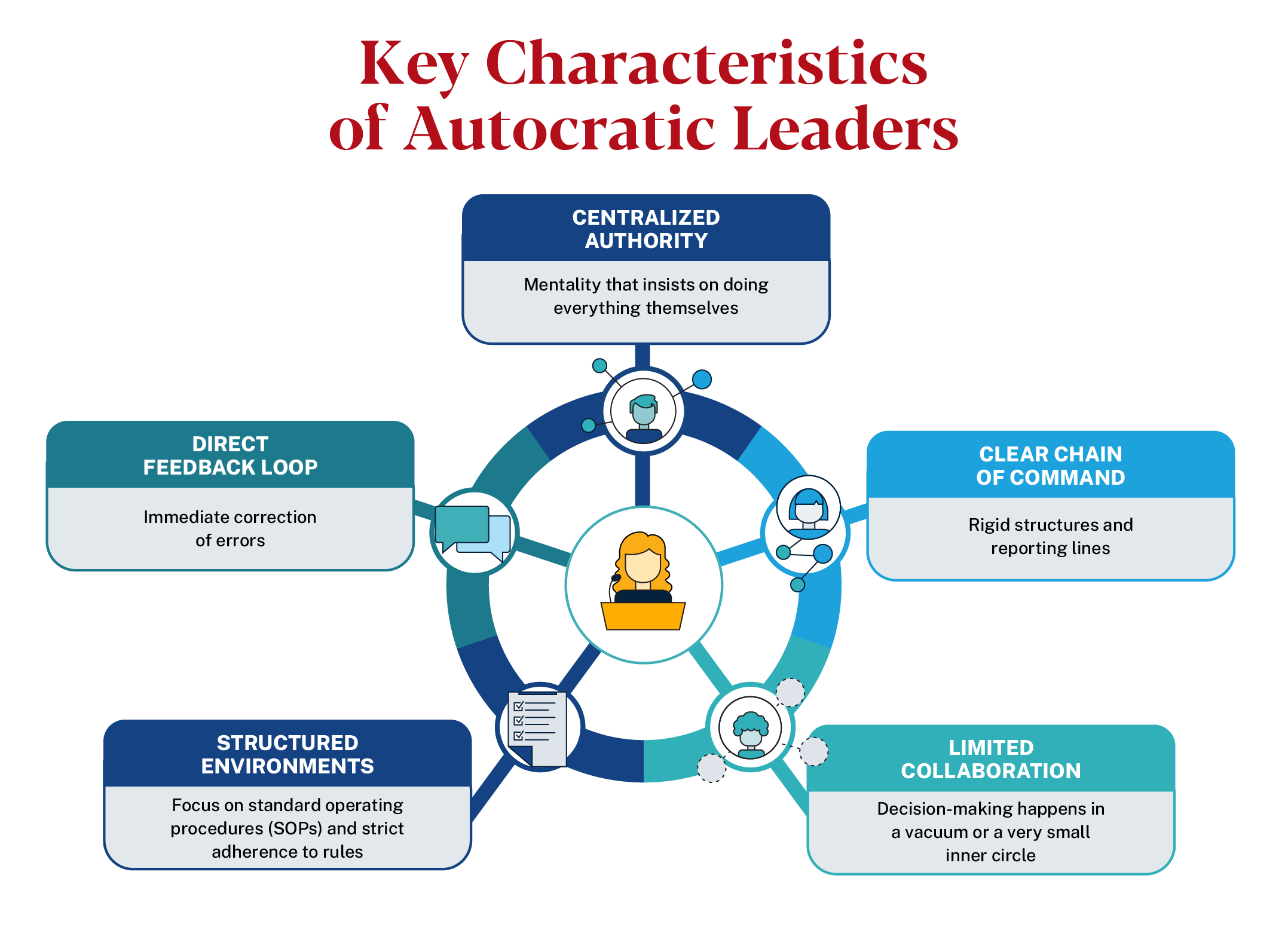
Other key characteristics of autocratic leadership include:
- Centralized authority: Mentality that insists on doing everything themselves
- Clear chain of command: Rigid structures and reporting lines
- Limited collaboration: Decision-making happens in a vacuum or a very small inner circle
- Structured environments: Focus on standard operating procedures (SOPs) and strict adherence to rules
- Direct feedback loop: Immediate correction of errors
Types of Autocratic Leadership Styles
There are nuances to the autocratic leadership style. Specifically, there are three types:
- Direct autocratic leadership: Leader controls everything
- Permissive autocratic leadership: Limited delegation, leader still has final say
- Paternalistic autocratic leadership: Leader acts “in employees’ best interest”
The latter of the three might sound appealing. However, this is likely impossible in a diverse work environment. For paternalistic autocratic leadership to work, it must incorporate ethical leadership, inclusivity and high emotional intelligence. Paternalistic autocratic leaders need to care about their employees and actively listen to their needs and wants.
The Advantages of Autocratic Leadership
Some career sectors demand autocratic leadership. Too many decision-makers can create chaos. When there is a centralized decision-maker, communication is clear and effective – a necessity in emergency situations.
Imagine a fire truck rushing to a house fire. Now, imagine the fire truck driver receiving multiple directives from colleagues about which route to take. That wouldn’t be very helpful, as driving a fire truck to a fire is not a logical place for collaboration. The driver needs immediate information that is clear, direct and concise – and from one person.
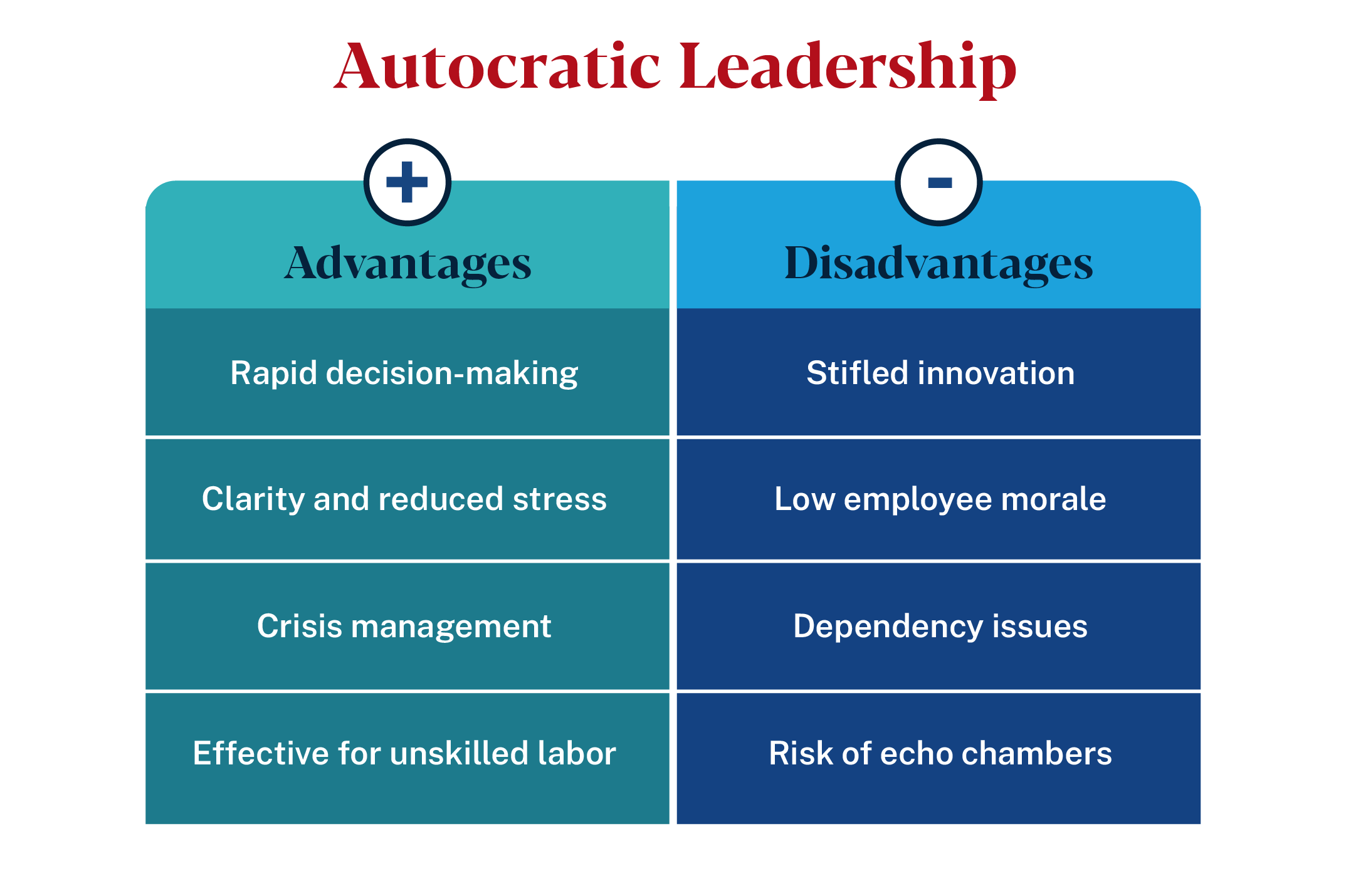
Here are the advantages of autocratic leadership:
- Rapid decision-making: Eliminating “analysis paralysis” and long meetings
- Clarity and reduced stress: Clearly defined roles that allow employees to know exactly what is expected
- Crisis management: Essential in emergency rooms, military operations and corporate turnarounds
- Effective for unskilled labor: Provides a safety net for inexperienced teams who need direct guidance
Disadvantages of Autocratic Leadership Style
Individuals who work in creative fields, or those who thrive when given autonomy and independence usually dislike working for autocratic leaders and prefer working for those who support their freedom, encourage their input and trust their judgement, traits not associated with autocratic leadership style.
Reasons why people turn away from autocratic leadership style include:
- Stifled innovation: Lack of input kills creative problem-solving
- Low employee morale: Correlation between autocratic styles and high turnover/burnout
- Dependency issues: What happens to an organization when the “one leader” is absent?
- Risk of echo chambers: Danger of a leader receiving no “pushback” on bad ideas
When Is Autocratic Leadership Most Effective?
Autocratic leadership is an effective leadership style in high-risk situations. People want an autocratic leader during wildfire evacuations and other crisis management scenarios.
It is also beneficial when there are tight deadlines. The commanding style of the autocratic leader can help move projects along and ensure production timelines are met. Additionally, it’s valuable in compliance-heavy industries where there is no room for errors.
New employees and entry-level teams often require autocratic leadership simply because they lack experience and knowledge. In these situations, employees often appreciate this approach, as otherwise they would be unsure of the next steps and processes.
Real World Examples of Autocratic Leadership
Some autocratic leaders are famous and even revered. Famous and real-world examples of autocratic leaders include:
- Steve Jobs (Apple): “Perfectionist” and top-down approach to product design
- Military leaders (Napoleon Bonaparte): Leading life-or-death combat scenarios
- Emergency room nurses: Prioritizing patient safety with speed and accuracy during medical emergencies
- School teachers: Setting rules, controlling behavior and deciding how lessons are taught
Is Autocratic Leadership Style Good or Bad?
Autocratic leadership style is neither good nor bad on its own. It is beneficial in certain situations and unhealthy in others. It depends on the current situation, work environment and people involved.
In work environments where safety is the primary concern, autocratic leadership is a must. In work environments where creativity and innovation are at the forefront, it’s most likely not the best approach.
Autocratic leadership also applies in different time spans. Sometimes it is required for the long term, but other times it is a short-term necessity. For emergency services, it’s always needed. However, in other industries, it’s needed on a case-by-case basis, such as for the COVID-19 pandemic or natural disasters.
This is where situational leadership comes into play, requiring leaders who normally practice democratic leadership styles to switch their methods in response to an unexpected crisis or event.
FAQs About Autocratic Leadership Style
Is autocratic leadership the same as dictatorship?
While dictatorship is a type of autocratic governance, autocratic leadership is not dictatorship. Dictatorship refers to a political regime that has totalitarian control over everyone within a nation.
What industries use autocratic leadership?
There are benefits of autocratic leadership, especially when individuals are in high-risk situations that require quick decisions. Military, law enforcement, emergency medical services, fire services and air traffic control require a top-down leadership approach.
Can autocratic leadership be effective?
Autocratic leadership allows leaders to effectively manage safety and avoid risks. While it might not be the most ideal leadership style for companies that thrive through the practices of collaborative design and shared decision making, it is the preferred leadership style for careers that demand perfection, or close to it.
Final Thoughts
Autocratic leaders can decide to back away from a harsh management approach – such as Leona Helmsely, the hotel empress who was famously known as the Queen of Mean – and adopt a kind, empathic approach to how they lead subordinates. Following the concept of situational leadership, where approaches change based on current situations, autocratic leaders can create welcoming and safe workspaces for their employees, even if they must make essential organizational decisions.
Becoming a leader requires you to have innovative knowledge and practical skills to effectively manage others. American College of Education (ACE) offers affordable, flexible programs to get you there, including a B.S. in Business Administration and Leadership, M.S. in Organizational Leadership, MBA and more.