

Think of a typical workplace on any given morning. A meeting might run longer than expected because the team is struggling to stay organized or maybe an important task slips through the cracks because someone missed an email. These moments likely sound familiar, and they happen even in strong, high-performing teams.
Now imagine that same workplace with artificial intelligence (AI) tools woven into daily routines. Reports become clearer, ideas come faster and customer needs are easier to anticipate because leaders have leveraged AI to streamline processes. It’s a noticeable shift, but it’s important to recognize that it doesn’t happen on its own. It happens because a leader made the intentional choice to encourage AI adoption, guide the transition and support employees as they explore new ways of working.
When AI and leadership intersect into an approach that’s as keen on cutting-edge technology as it is about helping people feel confident using it, it creates an AI-driven workplace culture where driving innovation is possible every day.
You might wonder, what does AI-first mean for leadership today? This blog explores why it’s important, the challenges it may face and what it looks like today.
What Is AI-Driven Leadership?
AI-driven leadership is the practice of fostering a workplace culture where employees regularly use AI tools to support their work. This approach highlights the growing role of AI in leadership, where technology and human insight work together.
Leaders serve as early adopters and role models by using AI in their own tasks. Their example shows teams how AI for leaders can enhance productivity, strengthen decision-making and unlock creativity.
Being an AI-driven leader requires both a solid understanding of innovative technology and a focus on empowering people to use it responsibly. This helps teams recognize that AI implementation opens opportunities rather than generates fear. Leaders can promote a mindset where employees feel comfortable experimenting with AI tools and discovering how they can solve problems in new ways.
Why Leaders Must Encourage Teams to Use AI
When teams begin using AI in their daily work, the shift often feels immediate. Meetings become more focused, ideas come together more quickly and decisions feel more grounded in evidence. These changes happen because leaders create an environment where AI adoption is encouraged, supported and understood. When that culture takes hold, the benefits appear across every level of an organization.
- Increased efficiency in repetitive tasks: AI tools reduce time spent on routine work, which allows employees to focus on strategy and collaboration.
- More creativity and problem-solving capacity: When AI handles basic tasks, teams have more mental space for innovation, which then becomes part of everyday work.
- Data-driven decision making at all levels: AI supports better forecasting and analysis. Teams become more confident in their decisions because they are supported by clear data.
- Competitive advantages: Organizations that prioritize integrating AI are better positioned to adapt to change and lead in their industries.
Challenges Leaders Face in Driving AI Adoption
Even with strong potential, introducing AI into daily workflows can feel unfamiliar. Leaders often encounter questions, hesitation and logistical hurdles. Recognizing these challenges early helps create an environment where employees feel supported as they learn to navigate new tools.
- Employee skepticism and fear of replacement: Many workers are unsure what an AI-first future means for their roles. Leaders can ease concerns by showing that artificial intelligence is designed to support people, not replace them.
- Skills gaps and lack of training: Some employees may struggle to know where to start. Leaders who offer professional development give teams the confidence they need to explore AI at their own pace.
- Ethical issues and bias in AI tools: Responsible use is essential. Leaders should review AI systems carefully and set expectations that promote fairness and transparency.
- Balancing efficiency with human oversight: While AI increases speed, human judgment remains crucial. Leaders can help by clarifying when employees should rely on AI and when personal evaluation is needed.
And if you’re new to AI yourself, you can leverage AI leadership development tools to get started.
How Leaders Can Encourage AI Adoption in Daily Work
Leaders who want their teams to embrace AI can start by making the process approachable. When people feel supported, they’re more open to experimenting, learning and building long-term confidence with new tools. This requires you to offer a solid balance of AI and leadership skills.
- Provide training and resources. Employees learn faster when they have structured guidance. Short workshops, tutorials or internal AI guides can remove uncertainty and help teams build foundational skills.
- Showcase success stories. Examples of AI tools improving workflow or solving day-to-day frustrations can spark curiosity. Seeing colleagues succeed helps teams imagine how AI might support their own work.
- Lead by example. When leaders use AI for tasks like drafting communication, organizing information or gathering insights, their teams notice. Modeling AI use makes experimentation feel normal rather than risky.
- Reward teams for experimenting with AI. Recognition, formal or informal, encourages employees to continue exploring. Even small acknowledgments can boost motivation.
- Create safe spaces for testing AI tools. Teams benefit from an environment where trial and error are expected. When employees know they won’t be penalized for mistakes, they’re more willing to discover what AI can do.
Real-World Examples of AI-Driven Leadership in Action
AI-driven leadership looks different across industries, yet the underlying purpose is the same: helping teams work smarter, more accurately and more creatively. These scenarios show how leaders can guide AI adoption in meaningful ways.
- Healthcare and nursing leadership: Managers introduce AI-assisted diagnostic tools to help clinicians analyze results more quickly and accurately, giving them more time to focus on patient care.
- Marketing teams: Leaders encourage teams to use AI for customer insights, pattern recognition and message personalization, helping campaigns become more relevant and effective.
- Manufacturing leadership: Supervisors adopt predictive maintenance tools, so equipment issues are identified earlier. This reduces downtime and protects productivity.
- Corporate leadership: Executives support the use of AI chatbots to handle routine customer inquiries, allowing employees to focus on higher-value tasks such as strategy and client relationships.
- Educational leadership: School and district leaders guide teachers in using generative AI for lesson planning, discussion prompts and instructional materials, giving educators more time to focus on students.
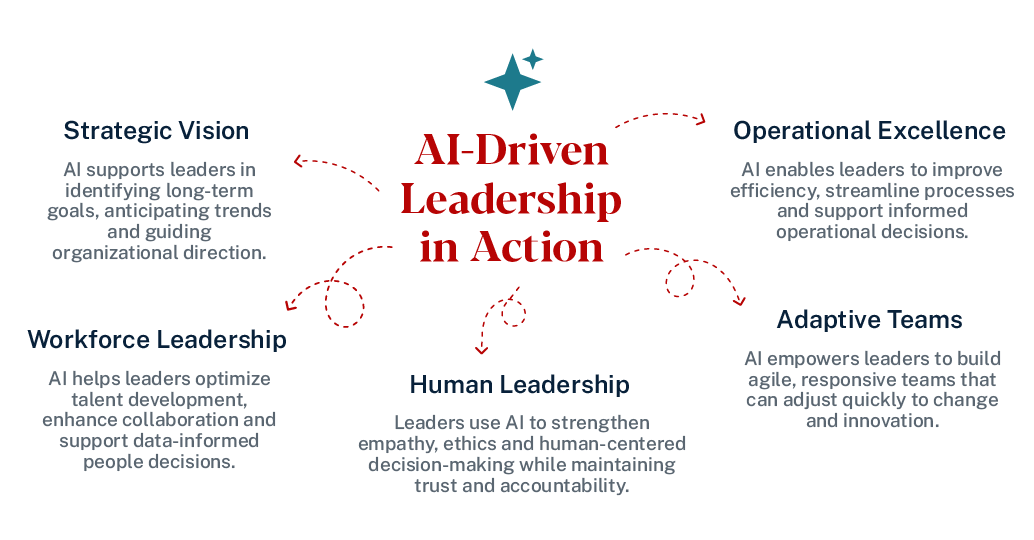
Future of AI-Driven Leadership
As workplaces continue to evolve, you may notice the future of AI in leadership becoming a defining expectation rather than an optional skill set. In this event, there’s a big chance AI literacy will be considered a foundational competency for employees and leaders alike, shaping how teams communicate, plan and solve problems.
Effective leaders will additionally pair emotional intelligence with technological understanding, ensuring AI enhances the human qualities that make organizations thrive. And as industries continue to innovate, companies that hesitate to integrate AI tools may struggle to keep pace with those that move forward confidently.
FAQs
What does AI-driven leadership mean?
AI-driven leadership refers to an approach grounded in encouraging teams to regularly use artificial intelligence tools to support their work. The focus is on shaping a culture where AI becomes a helpful resource rather than something intimidating or unclear.
What are the benefits of AI adoption in teams?
AI adoption helps teams work more efficiently, think more creatively and make decisions supported by strong data. When people use AI tools in their daily workflow, they can spend more time solving problems, serving customers and collaborating.
How can leaders overcome employee resistance to AI?
Leaders can listen to concerns, offer clear guidance and provide training to help employees feel confident with AI. Sharing positive examples of AI in action and creating safe spaces for practice can reduce fear and build trust.
Build Your Leadership Capacity With ACE
The future of AI-driven leadership belongs to those who choose to lead with clarity, curiosity and confidence. When leaders champion responsible AI adoption, they give their teams the skills and support needed to thrive in a world shaped by innovation. This mindset prepares organizations to adapt quickly and use artificial intelligence as a catalyst for progress. Now is the moment to step into that future with purpose.
If you want to develop your leadership skills and gain a deeper understanding of technology, American College of Education (ACE) offers programs that can help you move forward. Degrees like the M.S. in Organizational Leadership, MBA and Ed.D. in Leadership provide flexible pathways to becoming the leader your organization needs.