
Choosing where to teach is one of the most important decisions along your teacher career path. Just like students, teachers thrive in environments that align with their goals, values and teaching styles. With so many types of schools, it can be overwhelming to know where you’ll fit best.
This guide breaks down the major types of education systems, highlighting what makes them unique and what teachers can expect when working in them. This knowledge helps you find the right teaching opportunities.
Types of Schools Explained
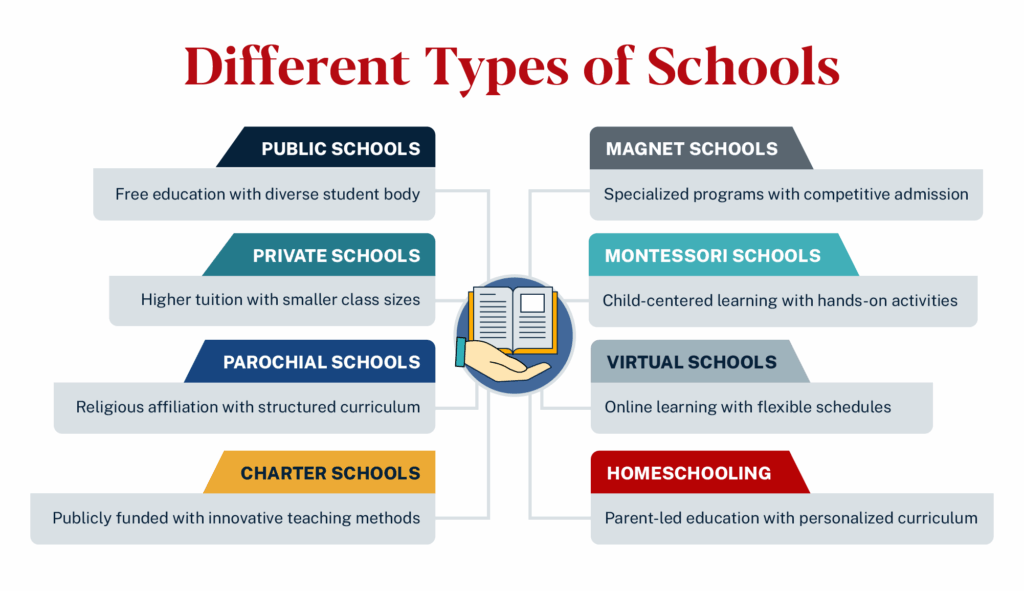
The landscape of education in the United States is incredibly diverse, offering a wide range of school systems designed to meet varying community needs, learning philosophies and student populations. Each type of school brings its own culture, expectations and opportunities for growth.
Public Schools
Public schools form the foundation of the American school system, serving most students across the country. Funded primarily through local, state and federal taxes, these schools operate under the oversight of district boards and the Department of Education. They provide equitable access to education for all children, regardless of socioeconomic background, making them a cornerstone of the nation’s commitment to public service and civic growth.
- Requirements to teach: Must hold state certification and licensure.
- Environment: Structured to emphasize accountability, standardized curriculum and adherence to state education standards.
- Curriculum: Strictly follows state standards, leaving little room for deviation.
- Class size: Larger than most, averaging 21–27 students.
- Compensation and job security: Standardized pay by district salary schedules. With unionized teaching jobs, public schools often provide the most job security and benefits.
- Instruction: Guided by clearly defined benchmarks that ensure consistency and fairness across schools.
- Students: Mirror the diversity of their local areas, exposing teachers to a wide range of student demographics, learning needs and cultural perspectives.
Private Schools
Private schools represent a diverse and independent segment of the education system, funded primarily through tuition, endowments and donations rather than public taxes. A significant difference between public versus private schools is the financial autonomy that allows them to establish distinct missions, philosophies and instructional models that often emphasize academic rigor, creativity or specialized education programs. Private school curriculum is also sometimes different than standardized approaches in public schools.
Many teachers find private schools deeply fulfilling due to the close-knit relationships with students, opportunities for creativity and the ability to shape learning experiences that reflect their personal teaching philosophy.
- Requirements to teach: Doesn’t always require state certification, but advanced subject expertise (like a master’s degree or Ph.D.) is often preferred.
- Environment: Independent day schools, boarding schools or college preparatory academies with strong community cultures that prioritize individualized attention and holistic student development.
- Curriculum: High degree of curriculum flexibility, allowing for innovation, interdisciplinary projects and customized learning experiences that align with the school’s mission.
- Class size: Smaller, with strong student–teacher interaction.
- Compensation and job security: Varies based on individual school budgets rather than standardized pay scales or union contracts.
Religious/Parochial Schools
Faith-based schooling, often referred to as parochial or religious education, blends academic learning with spiritual formation. These schools, such as Catholic, Protestant, Jewish, Islamic and other faith traditions, operate as private institutions that integrate moral values, religious studies and character development into the daily curriculum.
Students participate in religious instruction, community service and worship experiences that strengthen their sense of identity and belonging. For teachers, this environment often fosters a strong sense of purpose, as they contribute not only to academic success but also to students’ faith journeys and moral development.
- Requirements to teach: May need state certification, depending on the institution’s affiliation and accreditation standards. Hiring practices often emphasize alignment with the school’s mission, personal faith commitment and subject-area expertise.
- Environment: Tight-knit community, shared values and holistic approach to education. Working in a religious or parochial school can offer a deeply meaningful and mission-driven career path.
- Curriculum: Integrates faith traditions and moral values with core academics.
- Class size: Tend to mirror those in private schools, small enough to allow individualized attention and a supportive classroom atmosphere.
- Compensation and job security: Often lower salaries than public schools but a strong sense of mission and close-knit community.
Charter Schools
Charter schools occupy a unique space in the education landscape, blending elements of both public and private education. These institutions get public funds but operate independently of traditional school districts, often under a performance-based contract, or “charter.” Charters outline their mission, goals and accountability standards. This autonomy allows charter school teachers to experiment with innovative teaching models, specialized curricula or alternative education approaches that might not fit within the rigid framework of a district-managed public school system.
Many charter schools focus on themes such as science, technology, engineering and mathematics (STEM), performing arts, or college preparation, and their missions often aim to address specific community needs or educational gaps.
- Requirements to teach: Certification requirements vary by state. Some allow teachers without licenses.
- Environment: Collaborative, dynamic and mission-driven environments that value innovation over routine.
- Curriculum: Tailor instruction and design project-based learning experiences to adapt quickly to student needs.
- Class size: Generally smaller than traditional public schools.
- Compensation and job security: Accountability pressures to meet performance goals with less long-term security. Teachers get evaluated on student performance and school outcomes, as the institution’s charter renewal depends on measurable success.
Magnet Schools
Magnet schools are specialized public schools designed to attract a diverse range of students from across districts by offering unique academic themes or focus areas. Originally developed in the 1970s as part of desegregation efforts, magnet schools’ programs now serve as innovation hubs within the public education system. They emphasize excellence in specific disciplines such as STEM, visual and performing arts, world languages or advanced humanities.
Because they remain part of the public school system, magnet schools adhere to state standards and accountability requirements, but their specialized programs and selective enrollment make them stand out as centers of academic distinction and creativity.
- Requirements to teach: State-certified teachers who possess deep expertise in a subject area or specialized training related to the school’s focus.
- Environment: Focuses on academic rigor, innovation and interdisciplinary learning, in a stimulating environment where creativity and high expectations meet.
- Curriculum: Follows state standards but emphasizes thematic, innovative instruction.
- Class size: Smaller class sizes, allowing for more individualized instruction and collaborative project-based learning.
- Compensation and job security: Resources are often more robust due to additional funding or community partnerships, which can enhance both compensation and instructional opportunities.
Montessori Schools
Montessori schools are rooted in the educational philosophy of Dr. Maria Montessori, who believed that children learn best through self-directed exploration and hands-on experiences. This approach redefines the traditional classroom, emphasizing independence, curiosity and intrinsic motivation.
In a Montessori environment, students move at their own pace through carefully prepared learning stations rather than following a rigid, teacher-led schedule. Many Montessori teachers find deep professional and personal fulfillment in helping students develop lifelong learning habits, self-discipline and confidence. For those drawn to nurturing autonomy and creativity rather than conformity, Montessori schools offer an inspiring and student-centered alternative education model.
- Requirements to teach: Specialized training and certification in Montessori education, which focuses on understanding child development and the psychology of learning.
- Environment: Calm, structured and deeply respectful of each child’s individuality, while emphasizing independence, concentration and uninterrupted work periods.
- Curriculum: Teachers act as guides rather than lecturers, setting up prepared environments and allowing students to choose activities.
- Class size: Multi-age classrooms encourage mentoring and collaboration.
- Compensation and job security: Varies by school type and location.
Online/Virtual Schools
Online and virtual schools have transformed the educational landscape by bringing learning beyond the physical classroom. These schools deliver instruction primarily through digital platforms, connecting teachers and students across cities, states and even countries.
Some are fully accredited public virtual schools operated through state or district programs, while others are private institutions or independent online learning platforms. The flexibility of online teaching appeals to a wide variety of students, those pursuing specialized programs, managing medical needs or seeking individualized pacing. This model opens new opportunities to reach students who might otherwise be underserved by traditional school systems.
- Requirements to teach: Must be adept at using technology to create engaging, interactive lessons while maintaining strong communication with students and parents through video conferencing, emails, discussion boards and digital assessments. While state certification is typically required for public virtual schools, private or international online academies may have more varied hiring standards.
- Environment: Work-from-home flexibility, though building relationships with students can be harder.
- Compensation and job security: Varies widely, with some roles offering full-time benefits and others functioning on a contract basis.
Homeschooling
Homeschooling represents one of the most personalized and flexible forms of education, where parents or guardians assume primary responsibility for their children’s instruction. What began as a niche movement has grown into a significant and respected educational option in the U.S., supported by curriculum flexibility for teachers, online learning platforms and community-based co-ops.
Families choose homeschooling methods for diverse reasons, ranging from a desire for faith-based or value-driven instruction to seeking alternatives for students who thrive outside traditional classroom structures. Homeschooling allows families to tailor pacing, content and learning methods to each child’s strengths, interests and needs, resulting in highly individualized educational experiences.
Many professional teachers serve as tutors, consultants or curriculum designers, helping families navigate academic planning, assessment and instructional strategies.
- Requirements to teach: Requires strong self-management, adaptability and comfort working directly with families rather than within a formal school structure
- Environment: Work with virtual homeschooling networks or hybrid programs that blend in-person and online learning.
- Curriculum: Flexibility and the chance to focus on mastery-based learning rather than standardized testing.
- Compensation and job security: Varies widely, depending on whether the role is independent or affiliated with a program or platform.
Key Differences for Teachers Across School Types
- Class sizes and workload: Public schools often have larger classes, while private, charter and Montessori schools maintain smaller sizes that reduce grading loads.
- Curriculum and freedom: Public schools prioritize state standards, while private and charter schools allow flexibility. Montessori schools emphasize student-led learning, while magnet schools blend creativity with standards.
- Job security and pay: Unionized teaching jobs in public schools offer stability. Private schools may pay less but offer curriculum freedom. Online schools and charter schools provide flexibility but may lack long-term stability.
- Community expectations: Teachers in religious schools navigate faith-based expectations, while charter and magnet schools often face pressure to meet specific performance benchmarks.
- Professional growth: Magnet and Montessori schools often provide strong training, while public schools offer predictable career paths through district structures.
FAQs
What are the different types of schools teachers can work in?
Public, private, religious, charter, magnet, Montessori, homeschooling and online/virtual schools.
Which type of school is best for teachers starting their careers?
Public schools provide strong foundations with training, certification and structured systems.
Do teachers get paid more in private or public schools?
Salary in public vs. private schools is generally higher with stronger benefits, though high-end private schools may compete.
Can teachers transition between different school types easily?
Yes, though requirements vary between education jobs. For example, moving from private to public may require state licensure.
Whether you’re an aspiring teacher or a current one looking to advance your skills, American College of Education offers fully online, quality and affordable programs.