American College of Education (ACE) is deeply proud of its graduates and their accomplishments. This blog is inspired by alumna Dr. Mindy Montano’s dissertation research. You may also read it in full.
Despite ongoing efforts to promote equitable learning environments, students with disabilities continue to experience persistent achievement gaps compared to their nondisabled peers. Inclusion classrooms are designed to provide access to grade-level content for all students, yet educators often face challenges in delivering instruction that meets diverse academic needs while maintaining engagement across the classroom.
As digital learning environments expand, many schools are turning to learning management systems (LMS) and Universal Design for Learning (UDL) frameworks to support more flexible, accessible instruction. UDL emphasizes proactive lesson design that offers multiple means of engagement, representation and expression, while LMS platforms provide tools that can organize content, personalize learning pathways and increase student access to materials. Together, these approaches may offer new opportunities to support students in inclusive settings.
However, less is known about how the combined use of UDL and LMS tools influences student outcomes and classroom engagement from the educator’s perspective. Understanding teacher experiences is essential as schools continue investing in instructional technologies and inclusive practices.
Montano’s research examined how pairing UDL with an LMS framework may influence academic progress and engagement for students in inclusion classrooms. To better understand these dynamics, Montano’s study sought to answer the following questions:
- Research Question 1: What is the relationship between the application of UDL with an LMS in the academic progress of middle and high school students in inclusion classrooms?
- Research Question 2: What are the instructor’s perceived educational benefits of an LMS when paired with a UDL curriculum framework to improve engagement in the learning process?
Addressing the Achievement Gap in Inclusion Classrooms
Inclusion classrooms are designed to provide students with disabilities access to the same academic content as their nondisabled peers. However, despite policy efforts and instructional reforms, achievement gaps between these student groups continue to persist. Educators are increasingly expected to differentiate instruction, integrate technology and maintain engagement for diverse learners, often within the same classroom environment.
The problem explored in Montano’s study is that students with disabilities in inclusion settings may not experience the same level of academic progress and engagement as their peers, even when digital tools and inclusive frameworks are available. While Universal Design for Learning and learning management systems are widely promoted as strategies to support accessibility and differentiation, educators may lack clear evidence of how the combined use of these approaches influences student outcomes in real classroom settings.
The purpose of Montano’s qualitative exploratory case study was to examine the relationship between the application of UDL and the use of an LMS in supporting academic progress and engagement among middle and high school students in inclusion classrooms. By exploring instructors’ perceptions of these tools and frameworks, the study aimed to provide insight for educators, instructional leaders and policymakers seeking to strengthen inclusive instructional practices.
Previous Studies: UDL, LMS and Inclusive Instruction
Montano conducted extensive secondary research to examine what scholars and practitioners already understand about Universal Design for Learning, learning management systems and instructional practices in inclusion classrooms. While the literature highlights the promise of these approaches for improving accessibility and engagement, it also points to ongoing challenges in implementation, consistency and measurable impact for students with disabilities.
Universal Design for Learning and Inclusive Access
Prior research emphasizes Universal Design for Learning as a proactive instructional framework intended to remove barriers to learning before they occur. UDL encourages educators to provide multiple means of engagement, representation and expression so that students with diverse learning needs can access content more effectively. Studies suggest that when UDL principles are applied consistently, students with disabilities may experience improved access to curriculum and increased opportunities to demonstrate understanding.
However, the literature also notes that successful UDL implementation depends heavily on teacher preparation, planning time and institutional support. Without these elements, UDL may be applied inconsistently across classrooms.
The Expanding Role of Learning Management Systems
Learning management systems have become increasingly common in middle and high school settings as schools expand digital learning environments. Research indicates that LMS platforms can support organization of instructional materials, increase student access to content and provide opportunities for differentiated instruction. Features such as flexible pacing, digital feedback and accessible course materials may be particularly beneficial for students in inclusion classrooms.
At the same time, studies suggest that the effectiveness of LMS tools depends on how intentionally they are integrated into instruction. Simply adopting a platform does not guarantee improved learning outcomes.
Combining UDL and LMS for Student Engagement
Montano’s literature review highlights growing interest in pairing UDL with LMS platforms to create more responsive and accessible learning environments. Researchers suggest that the structured flexibility of an LMS may support UDL implementation by making it easier to provide multiple pathways for students to access and demonstrate learning.
Even so, the literature indicates that more research is needed to understand how this combination affects academic progress and engagement, particularly from the instructor’s perspective in real-world inclusion classrooms.
Persistent Gaps in Outcomes for Students With Disabilities
Across the research, a consistent concern remains: Students with disabilities continue to experience achievement gaps despite the availability of inclusive frameworks and digital tools. Scholars point to variability in implementation, teacher training and instructional design as contributing factors. These gaps underscore the importance of examining how educators actually experience and use UDL and LMS tools in practice.
Discovering Educator Experiences With UDL and LMS
Montano’s qualitative study followed an exploratory case study design, an approach used to investigate how instructional practices function within a specific educational context. In this case, the study focused on instructors working in middle and high school inclusion classrooms who were using Universal Design for Learning principles alongside a learning management system.
Participants were selected using established inclusion criteria and represented educators with experience implementing both UDL strategies and LMS tools in their instructional environments. Data were collected through semi-structured interviews, which allowed instructors to share detailed perspectives on how these approaches influenced student academic progress and engagement. The interview protocol included guiding questions while also allowing flexibility for participants to elaborate on their classroom experiences.
Montano prepared the collected data and applied a systematic qualitative analysis process to identify patterns and recurring insights across participant responses. To strengthen the trustworthiness of the study, she followed established qualitative research procedures and ensured alignment between the research questions, data collection methods and analysis process.
Data Analysis: How UDL and LMS Shape Inclusion Classroom Outcomes
Montano analyzed participant responses using a qualitative thematic analysis process. Interview data were carefully reviewed, coded and compared to identify recurring patterns across instructors’ experiences in inclusion classrooms.
Several overarching themes emerged from the analysis, reflecting how educators perceive the combined use of UDL and LMS. These themes centered on improved accessibility, increased student engagement, differentiated instructional opportunities and ongoing implementation challenges. Together, they illustrate how instructors are using UDL and LMS tools to support diverse learners while navigating practical classroom constraints.
Research Question 1: Academic Progress in Inclusion Classrooms
The first research question examined the relationship between the application of UDL with an LMS and the academic progress of middle and high school students in inclusion classrooms. Participants generally reported that the combined use of these approaches created more flexible learning environments that allowed students with disabilities to access content in multiple ways.
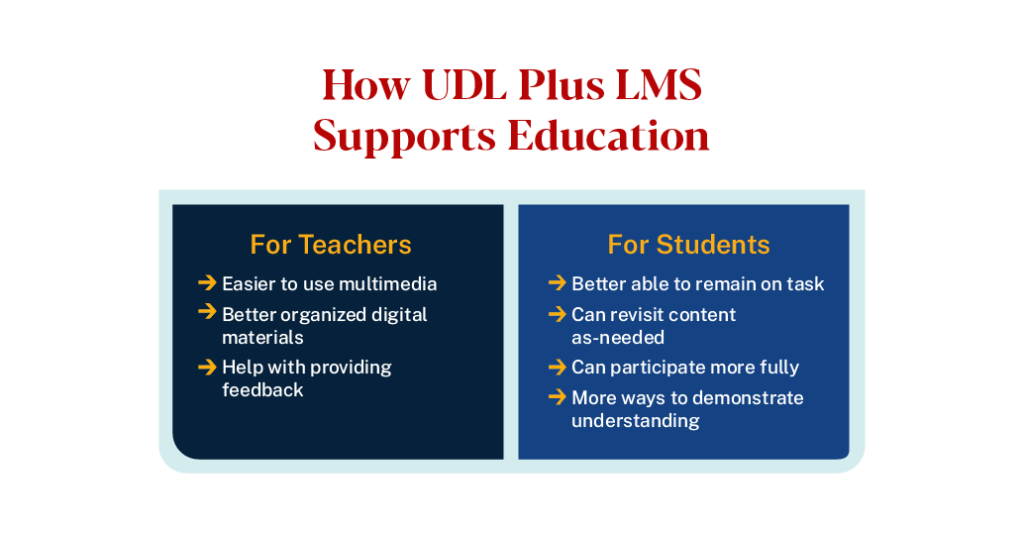
Educators described how LMS features such as organized digital materials, flexible pacing and varied assignment formats supported UDL principles by giving students more options for engaging with and demonstrating their learning. Many instructors perceived that these structures helped students remain on task, revisit content as needed and participate more fully in classroom activities.
At the same time, participants noted that the effectiveness of UDL and LMS integration depended on thoughtful instructional design and consistent implementation. While the tools created new opportunities for differentiation, teachers emphasized that technology alone did not guarantee improved academic outcomes without intentional planning and support.
Research Question 2: Instructor Perceptions of Engagement Benefits
The second research question focused on instructors’ perceived educational benefits of pairing an LMS with a UDL curriculum framework to improve engagement in the learning process. Participants consistently reported that the combination supported higher levels of student participation, particularly for students who benefited from multiple modes of interaction.
Educators observed that digital platforms made it easier to incorporate multimedia resources, provide timely feedback and offer alternative ways for students to demonstrate understanding. These options aligned closely with UDL’s emphasis on multiple means of engagement and expression. Many instructors perceived that students who previously struggled in traditional formats showed increased motivation when given more flexible pathways for learning.
However, participants also identified practical challenges, including the time required to design UDL-aligned materials, varying levels of student technology skills and the need for ongoing professional support. These findings suggest that while the UDL and LMS pairing holds promise for improving engagement, successful implementation depends on sustained instructional planning and institutional backing.
Strengthening Inclusive Instruction Through UDL and LMS
Montano determined that pairing Universal Design for Learning with a learning management system shows promise for supporting students in inclusion classrooms, particularly in promoting accessibility and engagement. Instructors reported that these approaches created more flexible learning environments and offered students multiple pathways to interact with content and demonstrate understanding. However, the perceived benefits were closely tied to thoughtful instructional design, consistent implementation and adequate institutional support.
Because this study focused on a specific group of middle and high school instructors, the findings may not reflect all inclusion classroom contexts or technology environments. Montano recommends future research that examines the long-term impact of UDL and LMS integration across diverse school settings and explores how professional development and instructional support influence sustained implementation.
For the future of inclusive education, Montano recommends continued investment in UDL-aligned instructional planning, targeted professional development and strategic use of learning management systems to support differentiated learning. She emphasizes that technology and instructional frameworks are most effective when paired with intentional educator support and clear implementation practices. By strengthening these areas, schools can take meaningful steps toward reducing achievement gaps for students with disabilities.
American College of Education (ACE) can help you drive the future of education technology through our M.Ed. in Instructional Design and Educational Technology or our Ed.D. in Educational Technology. Explore those programs or our other online doctorates in education.