
Online Education vs. In-Person Enrollment
It’s no secret that the COVID-19 pandemic left a significant mark on program delivery in higher education institutions. The difference between now and then is that institutions aren’t shifting to online learning without notice or preparation. Instead, they’re responding to an increasing student demand for flexible learning, a prediction made earlier this year.
Surveys in the 10th annual Changing Landscape of Online Education (CHLOE) report prove such demand from various groups, including undergraduate and graduate students, as well as adult learners. Unfortunately, the majority of faculty feel the familiar sting of uncertainty when it comes to teaching fully online courses. The pandemic should have inspired institutions to develop e-learning approaches, but many are lagging behind and missing out on enrollment numbers as a result.
The shift in higher education trends and student demand is here to stay, and the future of the industry depends heavily on it. Prospective students are increasingly leaning toward online learning. If we want to keep higher education active and innovative, we must put student-centered missions into practice by acknowledging the power of virtual classrooms as effective avenues to quality education.
As a fully online college, American College of Education (ACE) never faced emergency digital transformation because we’ve been offering online degree programs since day one. Our two decades of success speak volumes to the great opportunity that colleges and universities have to respond to this major shift in higher education.
Trends in Higher Education Driving Online Growth
Online programs are no longer just convenient, occasional offerings. They’re now a deciding factor for student enrollment as demand for flexible and accessible learning increases, according to the CHLOE report. It’s also worth noting that digital learning extends accessibility on a global level, creating opportunities for students who are unable to attend in person.
With online course designs on the rise, we’re seeing on-campus enrollment as the less likely choice due to a variety of causes:
- Tainted perceptions of higher education
- Less interest in degrees and greater affinity for skills and non-degree programs
- Lack of alignment with program offerings and students’ desires
- Traditional classroom environments with minimal flexibility and higher tuition
We’re seeing remote education trends growing in popularity due to their flexibility and affordability, like those we offer at ACE. Further, we’re seeing an increase in adult and part-time students who are working professionals desiring more education in a way that fits their schedules and budgets.
Most notably, artificial intelligence (AI) is now a household name that must be integrated into higher education. The CHLOE report’s findings indicate that only 23% of the surveyed institutions have a unified AI strategy. This means that a large number of colleges and universities are not adapting and evolving to meet the needs of today’s students.
ACE created an AI policy as swiftly as possible, and not only does it impact how we operate as a college, but it also gives students clear boundaries so they can gain the skills and knowledge they need while using the latest technology appropriately.
Challenges Facing Institutions in Online Education
Even though experts predict that the number of online students will surpass traditional students, online education is not without flaws, and it’s up to educational leaders to address these challenges in a student-first manner.
- Institutions without appropriate online course designs may see poor student engagement in online discussion versus in-person collaboration.
- Faculty lack adequate training that equips them to successfully create course materials and implement lesson plans.
- When an institution offers online programming but doesn’t support it with the necessary funding, infrastructural strain results.
- Online learning requires institutions to allocate funding to support virtual instructional design.
These challenges are solvable if institutions commit to not only offering online degree programs but doing it well. When we prioritize student needs and adapt to the idiosyncrasies of higher ed technology, we make education more accessible to today’s students.
Why Institutions Must Invest in Instructional Design
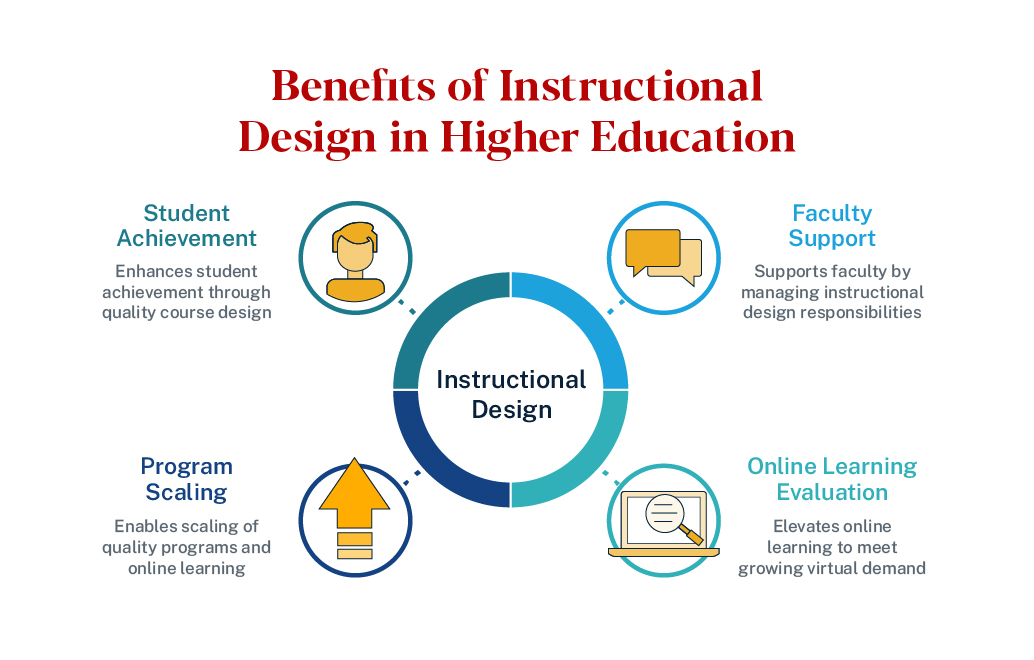
Colleges and universities ask students to invest in their studies, but we must first invest in the quality academic experience they’re paying for. Reallocating funds to hire instructional designers is an invaluable investment, as it contributes significantly to student achievement.
Further, instructional designers create engaging online course content suitable for various learning styles. Bringing these kinds of experts in and supporting them with a quality learning management system (LMS) sets your academic experience up for success.
Instructional design is a strategic pillar at ACE, and not only supports our students, but also our faculty. Shifting instructional design responsibilities over to designated personnel allows faculty to do what they do best: teach.
Additionally, it opens space for scaling quality while expanding programs. An investment with such significant benefits ought to be a priority for colleges and universities. It has the power to contribute to the elevation of online learning and ultimately respond to the growing demand for quality virtual learning. Instructional designers hold the key to student-centric learning, program outcome alignment, engagement and iterative development.
Harvard University executed implementing instructional design well when they created virtual classrooms amid the pandemic. The design focused on interactive learning, feedback mechanisms and personalized content via AI-driven platforms.
It’s success stories like these that prove that institutions that originated with in-person learning can offer degree programs online successfully.
Building Institutional Efficiencies for Online Education
To provide quality online degree programs, it’s critical to thoughtfully approach student expectations versus institutional readiness. Components to consider include:
- Does your institution have the LMS needed for effective instructional design?
- Are your faculty equipped to conduct online courses?
- Are the programs you’re offering online in high demand?
- Does your allocation of funding support strong online programs?
- Do you offer online support services for students who are unable to access on-campus resources?
While there are many more considerations to make, you can start by talking through these questions and their implications to determine what institutional changes need to happen to offer online learning effectively.
At ACE, we prioritize institutional efficiency through various avenues. It may sound counterintuitive to a student-first approach, but it’s actually a pathway to ensuring students get a quality, career-oriented education without sacrificing their commitments or accruing unpayable debt. A few examples that have contributed to our success include, but are not limited to:
- Streamlined workflows within departments and across teams
- Open, transparent communication from our executive teams to our faculty and staff
- Robust support systems for faculty and students
- Specialized personnel who perform research and gather data analytics that inform our decisions
- Regular student surveys that demonstrate our academic experience from a student’s perspective
- Integration of AI tools in all our departments, encouraging efficiency and relevance in our operations
Among these components are data analytics, and their importance can’t be stressed enough. Making data-informed decisions closes opportunities for unnecessary risk that can disrupt student experiences.
Infrastructure for the Future of Online Learning
Looking ahead, there are promising practices and tools designed to support online learning infrastructure as educational technology continues to evolve.
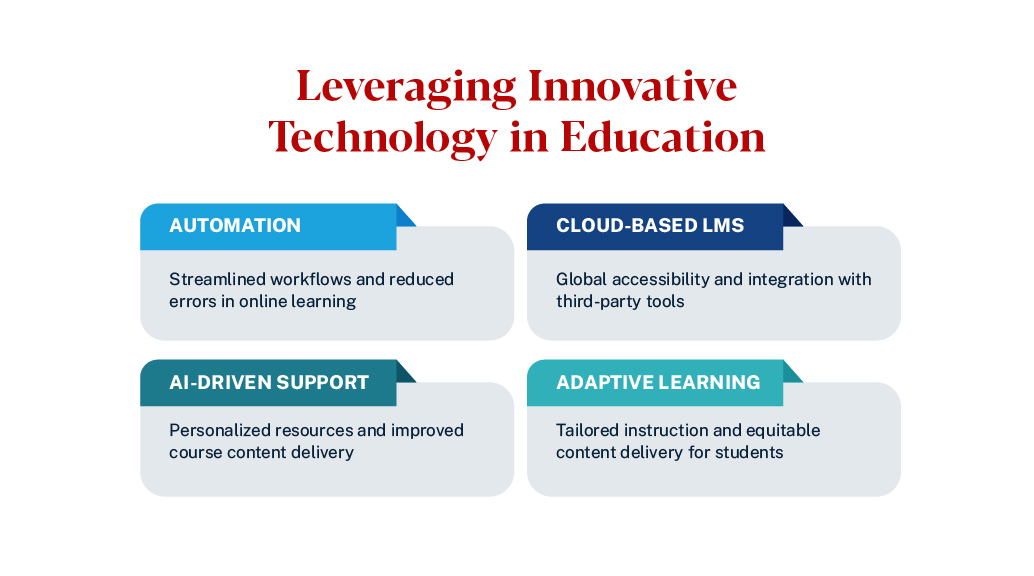
- Automation offers streamlined workflows, reduced human error, faster response times and scalability. For example, faculty can utilize automated plagiarism detection tools.
- Cloud-based LMS makes online learning more accessible globally because faculty and students can access coursework from any location with an internet connection. Additionally, these platforms integrate with third-party tools and reduce information technology burden.
- AI-driven support resources serve as key efficiency tools, from pointing students to tools that can improve their performance to predicting outcomes and customizing course content delivery.
- Adaptive learning platforms boost accessibility in online learning because they adjust content delivery and tailor instruction based on student needs. They also optimize instructional design to be more equitable.
ACE: Quality Online Learning Exemplified
There’s no one-size-fits-all approach to ensuring quality in online classrooms matches or exceeds in-person learning. However, the rapidly evolving educational technology landscape no longer recommends a strong online learning infrastructure but demands it. The key to virtual learning success requires attentive monitoring of student needs, continuous optimization and appropriate resource allocation.
Cloud-based LMS, automation and AI were initiated into ACE’s infrastructure as soon as the need arose. Leaders swiftly responded to prioritize orchestrating how the college would apply these tools in optimal ways that not only supported operational efficiencies but also student success.
It’s not a one-and-done initiative but, instead, an ongoing evolution. ACE’s leaders routinely seek opportunities to expand using these tools. For example, reviewing and piloting AI products enables the college to assess market and technology trends while also hand-selecting tools that support ACE student, faculty and staff needs. We additionally prioritize gathering student and employer partner feedback for a deeper understanding of how to best support our stakeholders.
The Future of Online Education: What’s Next?
Over the next five years and beyond, higher education must align with today’s workforce demand and technology advancement. The past five years give us evidence of feasible predictions to keep in mind:
- Increasing demand from consumers for high-quality online education
- Growing enrollment for institutions that offer a strong return on investment (ROI) and tuition that aligns with the cost of delivery
- Implementing AI-enabled learning resources for students and faculty
- Offering programs that generate the skills needed by employers
FAQs
What are the biggest challenges in online education today?
Some of the challenges online education is currently facing include inaccessible course designs that don’t create quality or engaging learning experiences, inadequate training for faculty to teach online, and funding needed to offer virtual programs and resources.
Why is instructional design important for online programs?
Instructional design often shapes the student’s experience and affects the quality of online programs. Thus, it’s critical that course development and delivery align with what students are seeking to learn.
What trends will shape the future of higher education?
The growing demand for online learning is becoming more influential as time goes on. It will be interesting to see how it can shape the future of higher education, especially as we see technology continue to evolve so rapidly.
Discover the power of fully online learning and explore the programs offered at American College of Education.