
Burnout, fast-moving technology and ongoing economic uncertainty are changing how Americans think about their careers. For many working adults, experience alone no longer feels like enough to stay secure or satisfied at work. Going back to school is becoming a practical way to regain confidence, explore new directions and stay relevant in a shifting job market.
This article draws from a questionnaire conducted on behalf of American College of Education, focused on adults who chose to return to school within the past two years. Respondents were enrolled in graduate or certification programs and represented a range of generations, job levels and career stages. Their responses offer a clear picture of how education fits into real-life career decisions today.
Key Takeaways
- 60% of Americans returned to school primarily for higher pay, while 20% did so due to concerns about job instability
- More than half (57%) said online or hybrid learning was essential to making their return possible
- Concerns about AI and automation influenced 34% of Americans to return to school
- Fully online programs are the most popular format at 38%, followed by hybrid (33%) and in-person (29%)
Why Americans Are Going Back to School
Adults return to school for many reasons, often shaped by where they are in their careers and what they want next. While better pay matters, many respondents pointed to deeper concerns around fulfillment, stability and long-term opportunity.
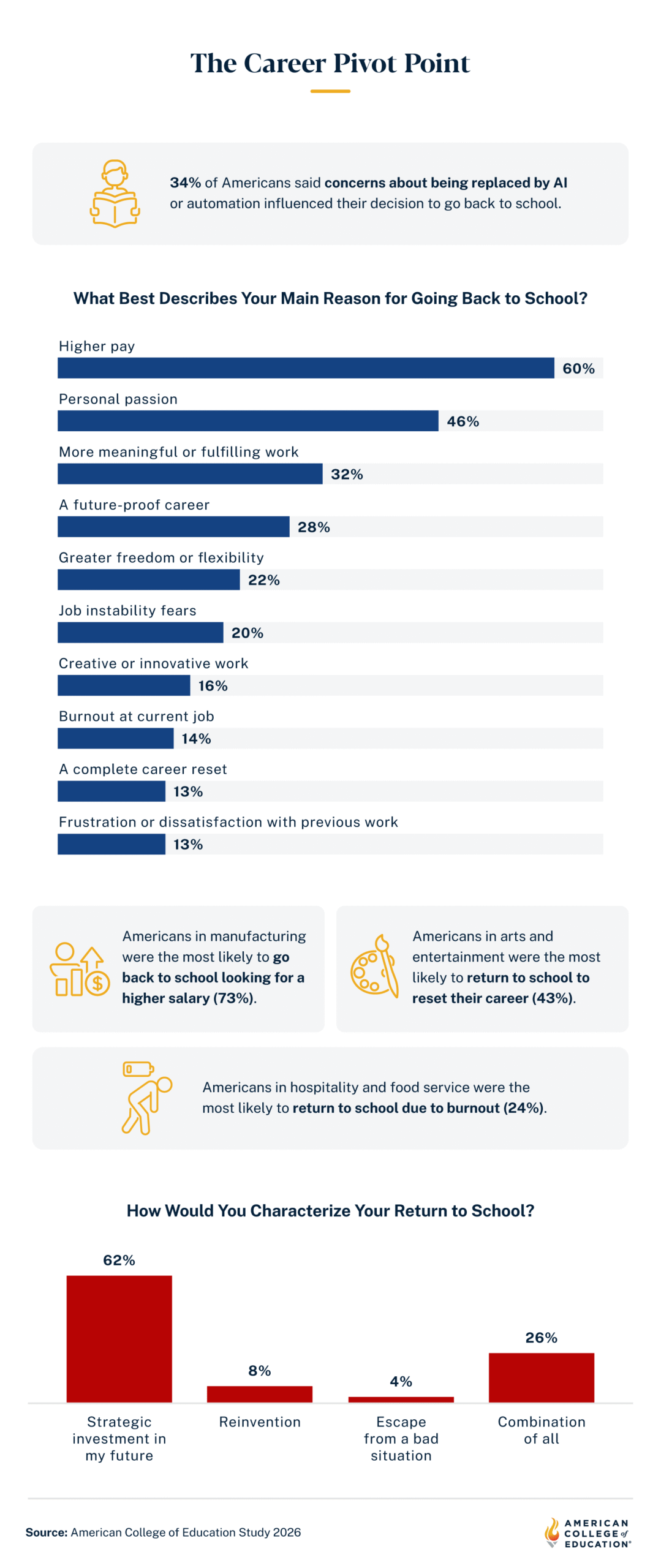
Earning a higher salary was the most common reason for returning to school, cited by 60% of respondents. Job uncertainty also weighed heavily, with one in five adults saying concerns about job stability influenced their decision. Worries about being replaced by AI or automation affected 34% of respondents, especially executives or business owners (43%) and those in management or leadership positions (42%).
Career stage played a role in how respondents described their decision. Early-career professionals most often viewed returning to school as a strategic investment in their future (69%). Long-tenured professionals with 10 or more years of experience were most likely to see re-enrollment as a form of reinvention (12%).
Most Common Reasons for Returning to School, by Job Level
- Individual contributors
- A higher salary (60%)
- Following personal passion (43%)
- Wanted more meaningful or fulfilling work (33%)
- Management or leadership
- A higher salary (69%)
- Following personal passion (41%)
- Wanted freedom or flexibility (26%)
- Executive or business owner
- Following personal passion (68%)
- A higher salary (44%)
- Wanted creative or innovative work (41%)
- Not currently employed
- Following personal passion (61%)
- Wanted more meaningful or fulfilling work (54%)
- A higher salary (46%)
Most Common Reasons for Returning to School, by Job Tenure
- Early-career professionals (three years or less)
- Following personal passion (56%)
- A higher salary (56%)
- Wanted more meaningful or fulfilling work (41%)
- Mid-career professionals (4 to 10 years)
- A higher salary (61%)
- Following personal passion (47%)
- Wanted more meaningful or fulfilling work (34%)
- Long-tenured professionals (10+ years)
- A higher salary (63%)
- Following personal passion (37%)
- Wanted freedom or flexibility (25%)
How Americans Are Going Back to School
Choosing the right program format can make or break the decision to return to school. For many adults, flexibility is not a nice-to-have. It is essential.
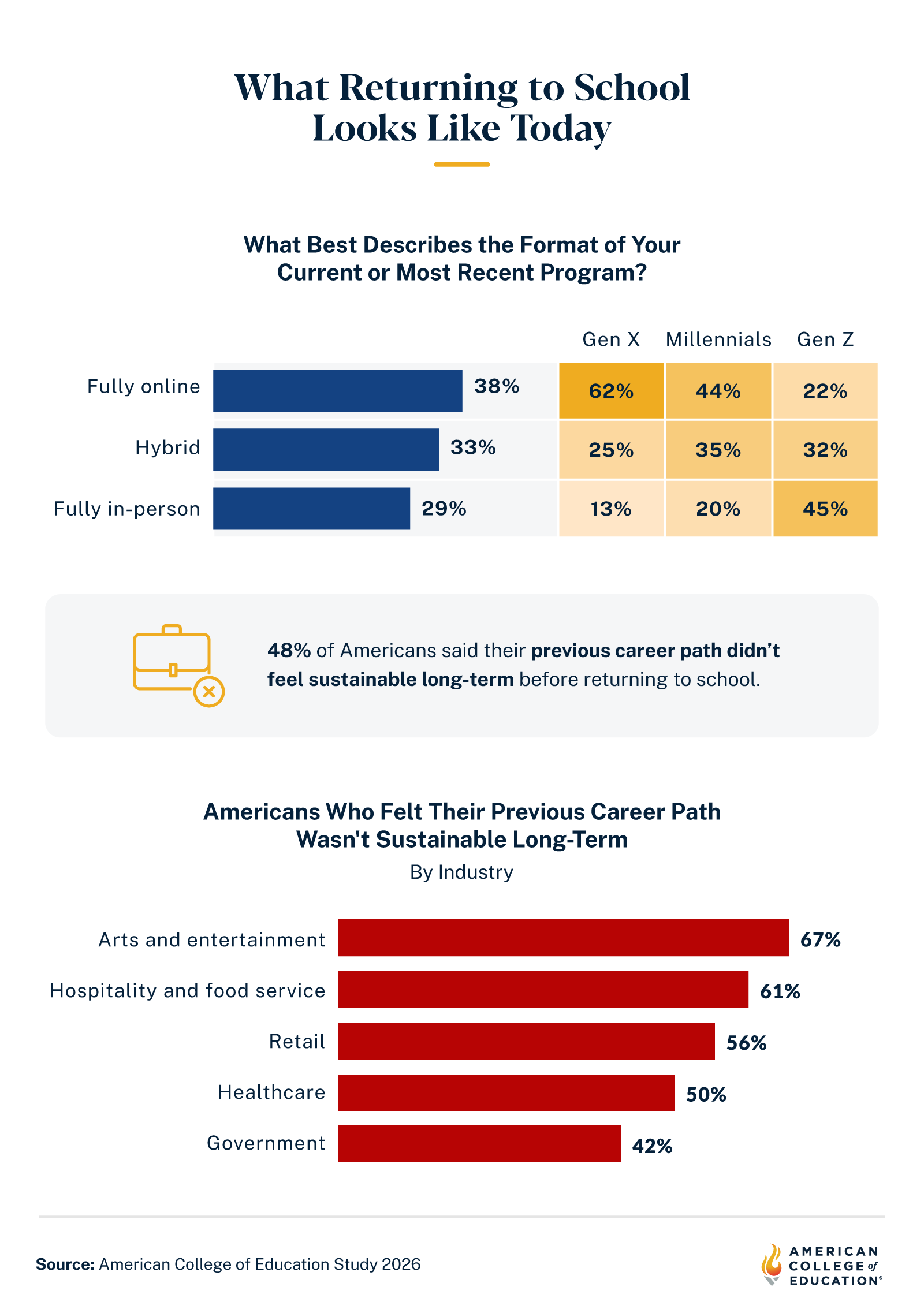
Fully online programs were the most common option, chosen by 38% of respondents. Another 33% enrolled in hybrid programs that blend online and in-person learning. These formats allow adults to continue working, manage family responsibilities and stay on track without putting their lives on hold.
Sustainability was another key factor driving re-enrollment. Nearly half of the respondents (48%) said their previous career path did not feel sustainable in the long term before returning to school. This feeling was especially common among those working in the arts and entertainment (67%), hospitality and food service (61%), and retail (56%) sectors.
The Online Advantage
Flexible learning options continue to lower barriers for adults who want to return to school. Online and hybrid programs make it easier to fit education into busy schedules while reducing financial and personal strain.
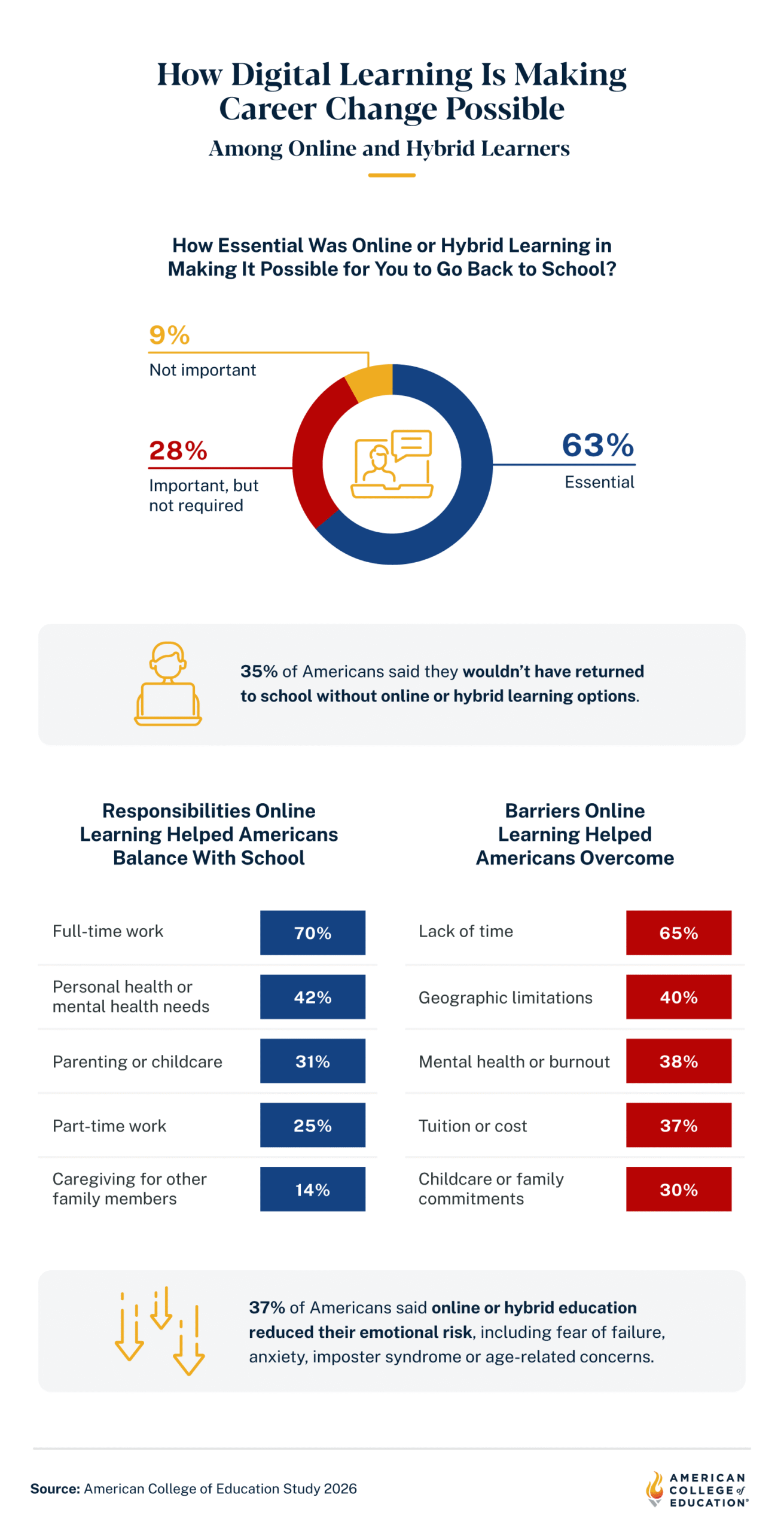
More than half of respondents (52%) said online or hybrid learning reduced their financial risk, including helping them stay employed while studying or lowering overall costs. Access also mattered, with 63% saying these formats were essential to their decision to return to school. Another 35% said they would not have re-enrolled without online or hybrid options. These responses highlight how program design can support adults who are balancing education with work, family and other responsibilities.
Education as a Practical Career Reset
For many adults, returning to school is about building options, not starting over. The decision often reflects a desire for better pay, more meaningful work and confidence in long-term career stability. Whether early in a career or years into one, education can serve as a practical way to adapt to change and stay competitive.
Prospective students considering a return to school may benefit from starting with clear goals and flexible programs that fit real life. Exploring online program options, evaluating how a credential aligns with long-term plans and choosing a college designed for working adults can help make the transition more manageable. With the right program, re-enrollment can be a step toward greater resilience and career momentum.
Methodology
A survey of 726 Americans who returned to school within the past two years was conducted on behalf of American College of Education. To qualify, respondents had to have enrolled in a graduate or certification program during that timeframe. The generational breakdown was Gen Z (41%), millennials (43%), Gen X (14%) and baby boomers (1%). Data was collected in January 2026.
About American College of Education
American College of Education (ACE) is an accredited, fully online college specializing in high-quality, affordable programs in education, business, leadership, healthcare and nursing. Headquartered in Indianapolis, ACE offers more than 60 innovative and engaging programs for adult students to pursue a doctorate, specialist, master’s or bachelor’s degree, along with graduate-level certificate programs.
Fair Use Statement
The information in this article may be used for noncommercial purposes only. If shared, a link with proper attribution to American College of Education must be provided.