

Maria is an addiction counselor who listens intently to each person who enters her office. She comforts and reassures people that recovery is possible, and in the early days, she left work feeling hopeful. But over the years, something changed, and clients’ tears didn’t affect her the way they used to. Before sessions, she felt heaviness in her chest. At night, she sometimes would lie awake and wonder how much longer she could do this.
Maria’s experience has a name. People are familiar with compassion fatigue, and it’s something that can happen to anyone who cares for others as part of their work. Nurses know it all too well, shouldering the weight of life and death situations during long shifts. Addiction counselors, teachers, social workers, chaplains and funeral directors experience it too.
I’ve seen it up close in the funeral world, where I lived for more than two decades as the wife of a funeral director. Later, I saw how often spiritual leaders carry invisible burdens. Compassion fatigue can touch anyone who gives of themselves repeatedly.
What Is Compassion Fatigue?
A common compassion fatigue definition is the price you pay for caring. It’s not just feeling like you are tired at the end of a shift. It is a more profound sense of exhaustion that builds gradually over time when you shoulder the burden of other people’s suffering for too long.
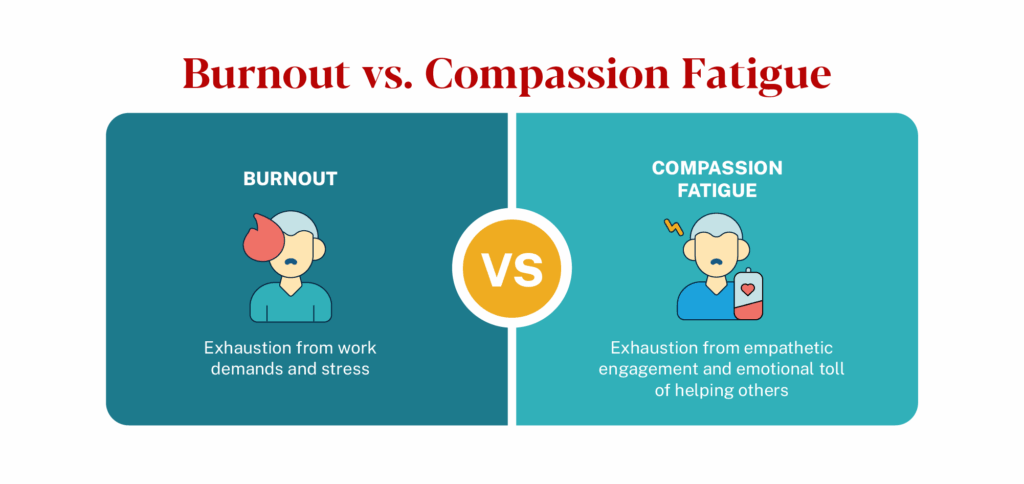
Many people mistake it for burnout, but it’s not quite the same. Burnout usually results from long hours, heavy workloads and a lack of resources. Compassion fatigue results from emotional overload without time to refill your own cup.
The clinical definition is a form of secondary traumatic stress. Caregivers take on the pain, trauma or grief of others, and it eventually begins to have an impact. The accumulated weight of those stories and struggles becomes more difficult to shoulder over time.
People may call it empathy exhaustion, empathy fatigue, compassion exhaustion or compassion burnout. The terms may differ, but they all refer to the same phenomenon. It is the kind of fatigue that sleep does not fix because it results from the emotional and psychological weight of giving, giving and giving some more.
Health professionals have studied compassion fatigue in nursing for several decades. Nurses often experience it after long periods of exposure to illness, patient loss and the pressure of long shifts. Addiction counselors and social workers may experience it after sitting with clients through relapses or deep despair in life. Teachers encounter it as they attempt to guide and support a classroom full of students with their own challenges. Funeral directors and chaplains often find it in their lives as they journey alongside families with deep grief. These jobs are vitally important, but without the proper care, they can leave a caregiver depleted.
Repeated exposure to another’s trauma can create what is known as a trauma exposure response, a form of secondary trauma that can affect both personal and professional well-being. In these cases, a person’s body and mind begin to react as though they experienced the trauma themselves. This internal response is part of what makes compassion fatigue so powerful and hard to ignore.
Who Is at Risk of Compassion Fatigue?
Anyone who spends the day pouring into the lives of others is at risk for compassion fatigue. It doesn’t matter how tough, competent or dedicated they are.
Nurses are particularly at risk. Their job demands both sustained attention and genuine compassion, often in a crisis. Add to this the reality that most also try to juggle their own family needs once the shift is over. The weight of all this can become too much over time.
The circle widens beyond nursing.
- Addiction counselors, therapists, social workers and other mental health professionals often sit with people in crisis or grief, and that takes a toll.
- First responders face it as they run from one emergency to another.
- Teachers know it when they try to support classrooms full of children, each with their own struggles.
- Family caregivers may feel it even more acutely because they often work without training, recognition or any sense of a break. Many people call this kind of exhaustion caregiver fatigue.
- Funeral directors and chaplains also carry it. Their job is to hold steady for others in the middle of loss.
For more than two decades, I stood beside my husband in the funeral profession and later walked with people in ministry. I saw compassion fatigue creep in slowly for those who kept trying to be the strong ones.
Past experiences make a difference as well. People who have lived through vicarious trauma or who do not have steady support are more likely to experience it. Most do not even recognize what is happening until the signs of compassion fatigue are already present.
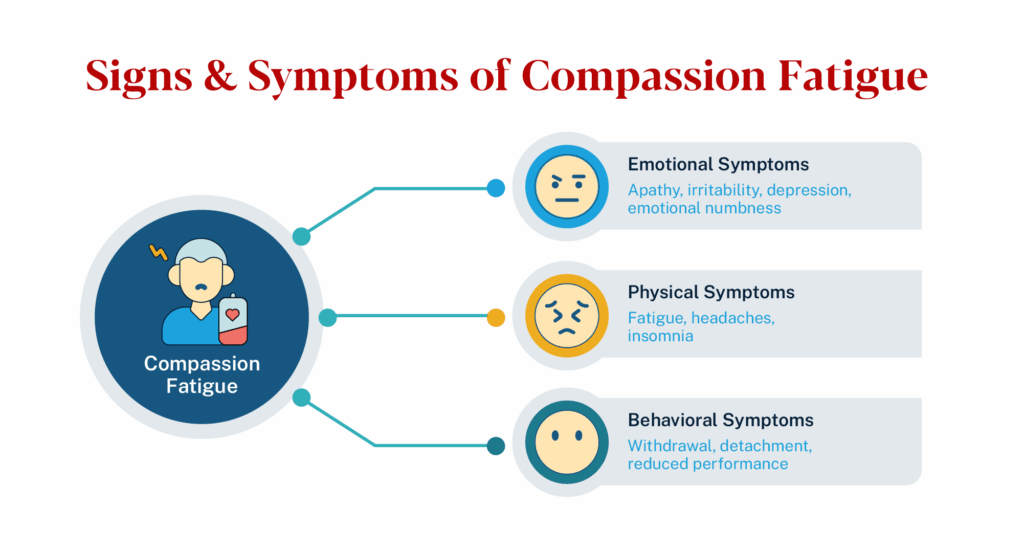
Compassion Fatigue Symptoms and Signs
Compassion fatigue does not happen overnight. It creeps up on you, usually so subtly you don’t notice until you’ve been carrying a heavy load.
- Emotionally: You may feel irritable, sad or disconnected. People say they feel numb or “gone.”
- Physically: The body expresses itself, sometimes with headaches, stomach aches, disrupted sleep or lack of energy, even after a good night’s rest.
- Behaviorally: You may pull away from friends or colleagues, miss social gatherings or avoid conversations.
Work that once gave you a sense of meaning can begin to feel hollow or meaningless. Over time, cynicism can replace empathy that used to come naturally.
These are symptoms of compassion fatigue, and you may notice that they are similar to the symptoms of burnout. The two conditions can coexist, but burnout has its roots in the stress of long hours and limited resources. Developing compassion fatigue is a byproduct of the inner tensions of empathy. The distinction is important because compassion fatigue can’t be solved by taking time off or slowing down.
Others have described compassion fatigue in stages, beginning with energy and excitement about helping. As repeated exposure to suffering continues, irritability or detachment can set in. If that shift isn’t addressed, the symptoms can deepen into hopelessness. Recognizing where you are in this process is one of the first steps toward healing and treating compassion fatigue.
How to Manage Compassion Fatigue
The best way to deal with compassion fatigue is not to let it get ahead of you. It comes on slowly. By the time you notice, you may already feel worn out physically and mentally. The point is to act sooner. Self-care for caregivers involves simple strategies you can apply each day to help protect you from sliding into empathy overload.
Quick Care Strategies for Compassion Fatigue Prevention
- Take a moment to breathe, sit still or pray.
- Write down a thought or two at the end of the day.
- Call a friend and talk about how you’re feeling.
- Get real rest, eat food that fuels you and move your body when you can.
These things may look small, but they are what keep you steady enough to keep showing up. Try different activities and discover a coping strategy that helps you manage stress. Don’t be afraid to lean on friends and family for a support system.
Combatting Compassion Fatigue at Work
Workplaces matter. Hospitals and agencies that admit how heavy caregiving can be are able to build systems of support. That may look like:
- Stress management for nurses.
- Wellness programs.
- Access to counseling.
- Time set aside for staff to talk through tough cases.
When leaders give permission to be honest about stress, caregivers have space to recover instead of pushing it down.
Peers matter just as much. Talking with someone who has been there helps. Experienced professionals can pass along what they know and steady those who are new. Mentorship supports the newcomers, but it also strengthens the ones offering it.
In the end, prevention is about protecting your heart. Notice the early signs. Stay grounded. That is how you keep caring for others without losing yourself.
You Can Care for Others Without Losing Yourself
Compassion fatigue is real, but it doesn’t have to be the story of your work. As an integrative health and wellness coach, I work with caregivers every day who think the solution is to do more and go faster.
The truth is that real strength is found when we give ourselves permission to pause and refuel. By spotting the signs of compassion fatigue early, you can stop yourself from sliding into compassion overload or a place of deep emotional burnout.
For nurses, counselors, teachers, chaplains, funeral directors and family caregivers, your work will always be meaningful, but your well-being matters too. Join a support group, reach out to trusted colleagues or put simple strategies for self-care into practice every day. Creating space for rest, movement, journaling or prayer is not selfish. These are things that keep you going so you can give to others without sacrificing yourself.
When you take care of your own mental health, you are protecting the heart of your work. You can’t pour from an empty cup, and the care you are able to give others will always be better when you care for yourself first. Remember, you are worth it!
At American College of Education, we offer flexible, asynchronous programs so you can advance your career with time leftover for self-care.