
When you think of healthcare and its many hospitals, clinics and doctor’s offices, it’s impossible not to think of nurses. After all, they are the embodiment of care, who listen when patients are scared, who bring calm to stressful situations and who provide the steady care that communities rely on every single day. They are the backbone of our healthcare system and a trusted presence in the moments that matter most.
It’s no wonder that so many people feel called to become a registered nurse (RN). After all, the chance to make a difference in someone’s life, often during their most vulnerable moments, is a powerful motivator.
If you are considering this path, you have likely come across terms that sound similar but mean different things: BSN and RN. A BSN is a Bachelor of Science in Nursing degree, while RN is the term for a registered nurse with a professional RN license. Let’s take a closer look at the differences between BSN vs. RN as we help you understand the BSN degree meaning and highlight the career opportunities that a BSN can unlock.
Table of Contents
What Is a BSN?
A BSN is an undergraduate degree that prepares students for a professional career in nursing. Most BSN programs take four years to complete and provide a broad foundation in both science and nursing practice. Students study anatomy, microbiology, psychology, community health and other subjects that connect scientific knowledge to real-world patient care.
Unlike an Associate Degree in Nursing (ADN), which can also qualify students to sit for the NCLEX-RN exam, a BSN program covers a wider range of topics and prepares graduates for roles that involve leadership, specialized care or preparation for graduate-level study. For those who want to become a nurse practitioner or pursue a Master of Science in Nursing (MSN), a BSN is the first step.
In today’s healthcare system, a BSN is not only valuable but often necessary. Many hospitals prefer hiring BSN-prepared nurses, and organizations such as the American Association of Colleges of Nursing emphasize the connection between BSN education and improved patient outcomes.
BSN vs. RN: What’s the Difference?
Although people often use the terms interchangeably, a BSN and an RN are not the same. A BSN is an academic degree, while RN is a professional title earned after passing the NCLEX-RN exam and meeting requirements set by state boards of nursing.
To help clarify the distinctions, here is a side-by-side look at BSN vs. RN differences. For an in-depth breakdown of degree levels in the nursing profession, visit our guide to nursing pathways.
H3 Key Differences Between RN and BSN
| Feature | RN (Registered Nurse) | BSN (Bachelor of Science in Nursing) |
|---|---|---|
| Education Requirements | Can be obtained with an ADN (Associate Degree in Nursing) or BSN | Requires a four-year BSN program |
| Career Opportunities | Entry-level nursing jobs | Leadership roles, specialized nursing careers |
| Salary Potential | Lower | Higher salary and better job prospects |
| Further Education | Limited options | Can pursue MSN (Master of Science in Nursing) or DNP (Doctor of Nursing Practice) |
| Employer Preference | Some hospitals hire ADNs, but many require BSNs | Preferred by hospitals and required for Magnet status |
As you continue to evaluate your career options in the nursing profession, consider the key takeaway: RN is a license, not a degree. To become an RN, you need to complete either an ADN or BSN and pass the NCLEX-RN exam. Earning a BSN gives you access to a broader range of career paths and more opportunities for advancement in the nursing field.
How to Get a BSN Degree
There are two primary routes to earning a BSN – keep in mind your best option will likely depend on where you’re starting from:
- Traditional BSN program: Designed for students who are new to nursing, these programs typically take four years to complete. They include general education courses, nursing theory and supervised clinical practice in healthcare settings.
- RN to BSN program: Created for practicing nurses who already hold an ADN and an RN license. These programs build on existing knowledge and allow students to earn a BSN in about one to two years, depending on transfer credits and enrollment pace. American College of Education’s (ACE) RN to BSN program is one option for working nurses who need flexibility.
To prepare for a BSN program, students usually complete prerequisite courses in subjects such as anatomy, microbiology and psychology. Clinical experiences in hospitals or community health environments are also essential, as they provide hands-on practice and exposure to real patient care.
Online BSN programs are increasingly popular, especially for students looking to balance work, family and other responsibilities. These programs provide the same quality education while offering more flexible scheduling and lower costs compared to traditional in-person options.
BSN Career Opportunities & Benefits
Graduating with a BSN degree opens the door to a variety of nursing careers. While all registered nurses provide patient care, many advanced and specialized roles either require or strongly prefer a BSN.
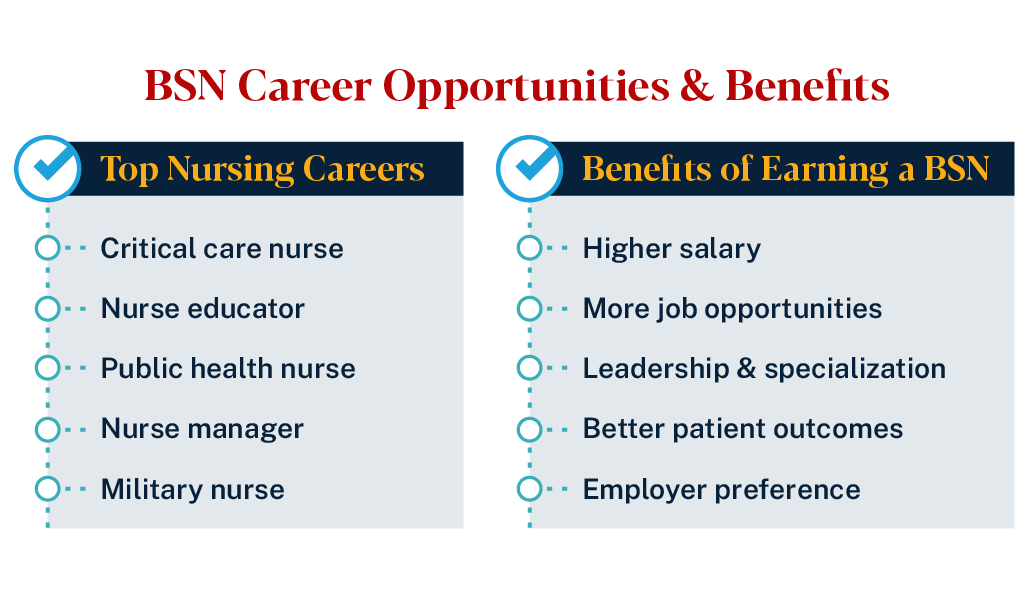
Top Nursing Careers That Require or Prefer a BSN
Before reviewing the career paths, it helps to note that BSN-prepared nurses are often eligible for positions with greater responsibility and leadership potential. Some of the most common options include:
- Critical care nurse: Works with patients in intensive care units, often handling life-threatening conditions.
- Nurse educator: Trains the next generation of nurses in colleges, universities or healthcare facilities.
- Public health nurse: Focuses on community wellness, preventive care and education.
- Nurse manager: Leads teams of nurses and coordinates operations within a healthcare unit.
- Military nurse: Provides care to service members and their families in military settings.
Benefits of Earning a BSN
The advantages of earning a BSN extend beyond individual career paths. Nurses who hold this degree enjoy professional and personal benefits that last throughout their careers:
- Higher salary: According to the Bureau of Labor Statistics (BLS), registered nurses earn a median salary of over $93,600 annually. BSN-prepared nurses are often positioned at the higher end of this range.
- More job opportunities: Hospitals, research centers and clinics often require or strongly prefer BSNs for nursing roles.
- Leadership and specialization: A BSN provides the foundation for advanced practice roles such as nurse practitioner or nurse anesthetist.
- Better patient outcomes: Studies consistently show that healthcare organizations with more BSN-prepared nurses see improved patient outcomes, including lower mortality rates.
- Employer preference: Many hospitals require a BSN to achieve Magnet status certification, a recognition of nursing excellence.
For nurses who want to remain competitive and continue advancing, earning a BSN is often the most direct way to do so. For additional context on long-term professional growth, see our blog post on continuing education in nursing.
Is a BSN Worth It?
If you’re exploring nursing careers, the decision to pursue a BSN will involve considering cost, time commitment and career goals. While an ADN may provide a faster path to RN licensure, the BSN offers long-term advantages that can outweigh the initial investment.
Here are some important considerations when weighing the value of a BSN:
- Higher earning potential: BSN-prepared nurses earn more over the course of their careers, and their salary prospects grow further with advanced roles.
- Job security: Healthcare employers are increasingly preferring candidates with a BSN.
- Graduate education opportunities: A BSN is required to pursue graduate-level nursing degrees such as a BSN to MSN or doctoral-level degree, like an Ed.D. in Nursing Education or Doctor of Nursing Practice (DNP).
The BLS projects strong growth for the nursing profession, with more than 165,000 openings for registered nurses each year through 2034. Given this demand, investing in a BSN can position you for stability, mobility and leadership in the nursing field.
FAQs About BSN Degrees
Is a BSN better than an RN?
A BSN is a degree, while RN is a professional title. A BSN does not replace an RN license but supports stronger job prospects and higher salaries.
Can you become an RN without a BSN?
Yes. You can become an RN with an ADN or BSN, but a BSN offers more career advancement opportunities.
Do hospitals require BSNs?
Many hospitals prefer or require BSNs, especially for Magnet status certification.
How long does it take to get a BSN?
A traditional BSN program takes about four years. An RN to BSN program can be completed in one to two years, depending on transfer credits and pace.
Is a BSN harder than an ADN?
A BSN requires more coursework and in-depth study compared to an ADN. The additional preparation often translates into greater career flexibility and opportunities.
The BSN Advantage: Build a Career That Lasts
Understanding the meaning of the BSN degree and how it differs from the RN license is an important step for anyone considering a nursing career. While an RN credential qualifies you to practice as a nurse, a BSN provides the academic foundation for higher pay, greater responsibility and more specialized opportunities.
If you are ready to take the next step in your nursing career, American College of Education’s flexible RN to BSN program and advanced nursing degrees prepare practicing nurses for leadership, public health, education and beyond.