If you’re looking for a career that offers a wide variety of opportunities within an industry projected to grow, the nursing profession fits that bill. Not only are there a ton of nursing career paths based on your area of interest, education and work setting, but the United States Bureau of Labor Statistics (BLS) reports an anticipated growth need of at least 189,000 new nurses each year between 2024 and 2034.
According to the American Association of Colleges of Nursing (AACN), this need is based on the U.S. population living longer, requiring care, and the anticipation of nurses leaving or retiring over the next several years.
Let’s explore some of the different types of registered nurses, the education requirements, and the roles and settings in which nurses provide care.
What Are the Different Types of Nurses?
In 2024, AACN found that registered nurses (RN) make up the largest group of healthcare professionals in the U.S. There are 4.7 million RNs who serve as the primary providers of care to hospitalized patients.
Within the profession, there’s a hierarchy of nursing roles dependent on required nurse certifications. It spans from unlicensed roles – like nurse aides, nurse technicians and certified nursing assistants – to licensed roles such as practical/vocational nurses and RNs.
There’s also a spectrum of entry-level nursing jobs to advanced, which is typically defined by educational preparation. In an entry-level RN program, RN students gain enough education to have the skills needed to supervise patient care. However, adding subsequent levels of education like a Bachelor of Science in Nursing (BSN) or a Master of Science in Nursing (MSN), allows those same RNs access to leadership or administrative roles.
Despite this hierarchy, you don’t have to start as a certified nursing assistant or a licensed practical/vocational nurse in order to advance to an RN. For an in-depth breakdown of how to become an RN, see our career guide.
Why Choosing the Right Nursing Specialty Matters
The fact that there are so many RN specialties is a great thing. This allows RNs the opportunity to build a fulfilling career that aligns with their interests and strengths.
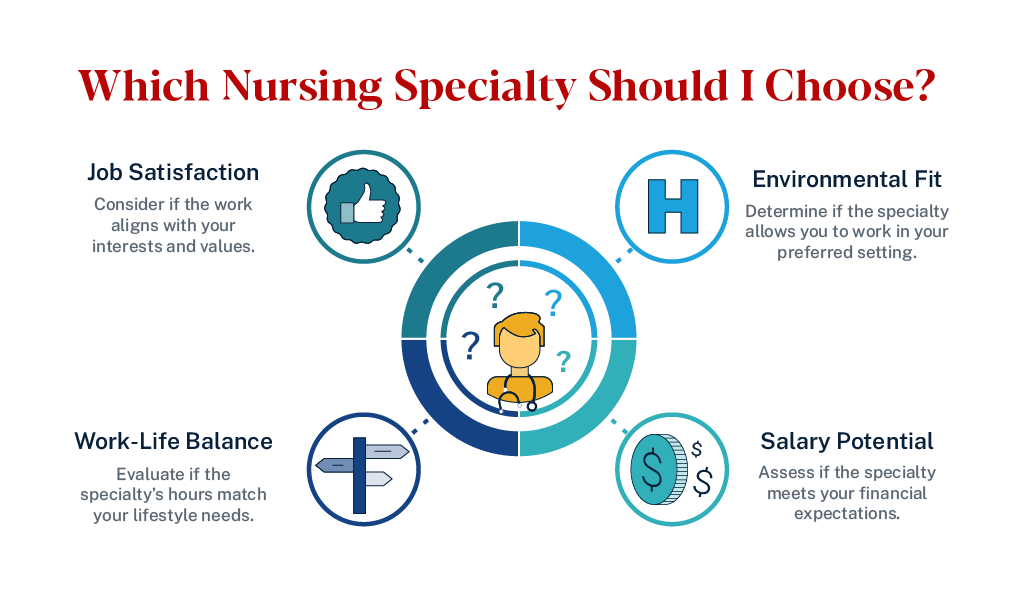
When deciding on a specialty to pursue, nurses should consider the following:
Job satisfaction: Do you find the work or the field interesting? Does it align with your values?
Work-life balance: Different specialties see different work hours. Ensure the work-life balance of your specialty matches your needs to ensure you preserve your well-being.
Salary potential: Different specialties have different salaries. Understanding the salary expectations of each specialty can help you know which ones satisfy your financial needs.
Environment fit: RNs can work in hospitals, outpatient clinics, home healthcare agencies, colleges/universities, K-12 schools and nursing care facilities. If there’s a specific setting in which you want to work, ensure the specialty you choose is applicable.
Entry-Level Nursing Roles
These roles are the crucial backbone of patient care. Let’s review their education requirements, responsibilities, work settings and opportunities for advancement.
Certified Nursing Assistant (CNA)
Certified nursing assistants typically hold a high school diploma or equivalent and participate in a state-approved program that is typically about six months in length, with a required number of instructional hours as defined and regulated by each state. CNAs provide care to patients to meet their activities of daily living (e.g. bathing, eating, mobility, dressing), and work in nursing/residential care facilities, hospitals and home health. They can advance their careers by becoming a restorative assistant and/or returning to school for a nursing program. According to the BLS, the median income in 2024 for a CNA was $39,430.
The licensed practical nurse, or licensed vocational nurse as it’s known in California and Texas, is educated in a state-approved program that is typically one year in length. To become licensed, you must pass the NCLEX-PN exam. Often, LPNs/LVNs are employed in nursing/residential care facilities, hospitals, home health and outpatient clinics. They can advance their careers by returning to school for a nursing program, such as an LPN/LVN to RN program. According to the BLS, the median income in 2024 for an LPN/LVN was $62,340.
Registered Nurse (RN) and Variation
Different RNs may have different roles and responsibilities depending on the level of their education.
RN (Associate or Bachelor’s Degree)
A registered nurse is a licensed nurse who must complete an RN program. Those programs can vary by degree level. One option is an Associate Degree in Nursing (ADN) program, which typically takes two years to complete at a community college. Another option is to earn a BSN, which takes three to four years to complete at a university or college. For more on the differences between these two pathways, see our ASN vs. BSN breakdown.
Regardless of degree pathway, prospective nurses must take the NCLEX-RN exam to receive their RN license. They are employed in hospitals, ambulatory care, community settings and schools. For more on how long it typically takes to become an RN, see our guide.
RNs have the opportunity to advance their careers in several ways through certifications and advanced degrees. For example, RNs with an ADN often enroll in RN to BSN programs to prepare for other practice opportunities. Additionally, RNs with a BSN can further their education through a BSN to MSN program to become advanced practice nurses, nurse educators or nurse leaders.
According to the BLS, the median income in 2024 for an RN was $93,600 and increases based on degree level.
Travel Nurse
Travel nurses are RNs who take on short-term assignments at hospitals or other settings across the country, sometimes even the world. Their jobs are usually arranged through a travel nurse staffing agency, and they often involve filling in at healthcare facilities with staffing shortages.
Travel nurses often enjoy the flexibility of choosing when and where they want to work. They also often enjoy higher salaries due to the high need and urgency of their role. To demonstrate their knowledge and preparedness for this specific role, RNs can consider completing related continuing education, such as a Certificate in Professional Skills in Travel Nursing.
For a full breakdown of the pros, cons and requirements of travel nursing, see our career guide.
Advanced Practice Registered Nurses (APRNs)
APRNs are registered nurses who have additional education at the certification level to perform certain nursing actions. APRNs have MSNs or doctorate degrees, such as a Doctor of Nursing Practice (DNP) or Doctor of Nursing Education (DNE). According to the BLS, the median income in 2024 for an APRN was $132,050 and increases based on degree level. APRN roles are among the highest-paying nursing jobs in the profession. Let’s go over some APRN specialties.
Nurse Practitioner (NP)
Becoming a nurse practitioner involves participating in a state-approved NP program based on the practice area you want to specialize in (e.g. family NP, psychiatric mental health NP, adult-gerontology NP, etc.) and completing clinical practice hours (500-750 hours). At the end of the program, prospective NPs must take a national certification examination and seek licensure in the state where they will practice. They also have ongoing continuing education requirements to maintain certification, which also typically includes needing at least 100 contact hours every five years.
NPs work in a variety of settings, including nursing/residential care facilities, ambulatory clinics and hospitals. NPs provide primary, acute and specialty healthcare services.
Clinical Nurse Specialist (CNS)
Clinical nurse specialists must participate in a state-approved CNS program and seek licensure as an APRN in the state where they will practice. In most states, a CNS can diagnose health conditions, prescribe medications and treat patients across their life span. CNSs may take certification exams in adult/gerontology, pediatrics or neonatal to demonstrate their competency in caring for that population.
Certified Nurse Midwife (CNM)
CNMs are RNs who hold a BSN degree and participate in an accredited midwifery education program at the graduate level. At the end of the program, they take and successfully pass a national certification exam to provide primary, sexual and reproductive care to their patients and can work in multiple settings, including clinics, hospitals, birthing centers and homes.
Certified Registered Nurse Anesthetist (CRNA)
CRNAs are RNs with a minimum of one year of full-time work experience and approximately eight and a half calendar years of education, including initial RN licensure. CRNAs should have a minimum of a master’s degree from a nurse anesthesia educational program accredited by the Council on Accreditation of Nurse Anesthesia Educational Programs. CRNAS work in any setting where anesthesia service is needed.
Nursing Specialties by Role Function
Nursing specializations are commonly categorized according to their role function, such as clinical care, community and population, leadership and administration, education and professional development, and consulting and systems roles. The following list of nursing specialties is organized by role function, illustrating the diverse ways nurses contribute to patient care.
Clinical Care Roles
These nurses provide direct patient care in many settings, such as hospitals, nursing/residential care facilities and specialty areas. Types of clinical nurses include:
Primary care nurses: Nurses who work in physician practices
Acute care nurses: Medical-surgical nurses, surgical recovery nurses
Critical care nurses: Intensive care unit (ICU) nurses, emergency room (ER) nurses
Specialty/certified nurses: Oncology nurses, pediatric nurses, wound care nurses
Community and Population Roles
These nurses provide services such as health promotion, prevention and care across different populations.
School nurses: RNs who provide healthcare, promote nutrition and enhance student well-being with preventative health screenings in K-12 school settings
Public health nurses: RNs who work in health departments, outreach services or prevention programs
Population health nurses: RNs who focus on care coordination, health outcomes and wellness for defined groups
Leadership and Administrative Roles
These nurses typically have two or more years of nursing practice experience and focus on oversight, management and organizational leadership. An MSN specializing in nurse administration can help RNs qualify for these types of roles.
Nurse manager/hospital supervisor: RNs who oversee unit-level or facility-wide operations and staffing, as well as monitor quality metrics
Director of nursing/chief nursing officer: RNs with a focus on higher-level administrative leadership in a hospital or clinic system
Education and Professional Development Roles
These nurses have several years of nursing practice experience and focus on teaching, training, and professional growth of nurses and students. To become a nurse educator, you typically need at least an MSN, preferably one with a nurse educator specialization.
Academic nurse educator: RNs who teach in a school of nursing, typically with an MSN or doctoral-level degree
Clinical nurse educator/staff development nurse: RNs who provide education and training within hospitals and health systems, typically with a bachelor’s degree or higher
Consulting and Systems Roles
These nurses focus on systems improvement, specialized expertise and interprofessional collaboration.
Quality improvement nurse: RNs who analyze processes and implement best practices to provide continuous improvement in patient outcomes
Informatics nurse: RNs who optimize electronic health records and data through the integration of the principles of nursing and computer science to influence system-level outcomes
Nurse case manager: RNs who coordinate patient care across multiple settings to ensure care is efficient and tailored to the patient’s needs, while decreasing gaps in services
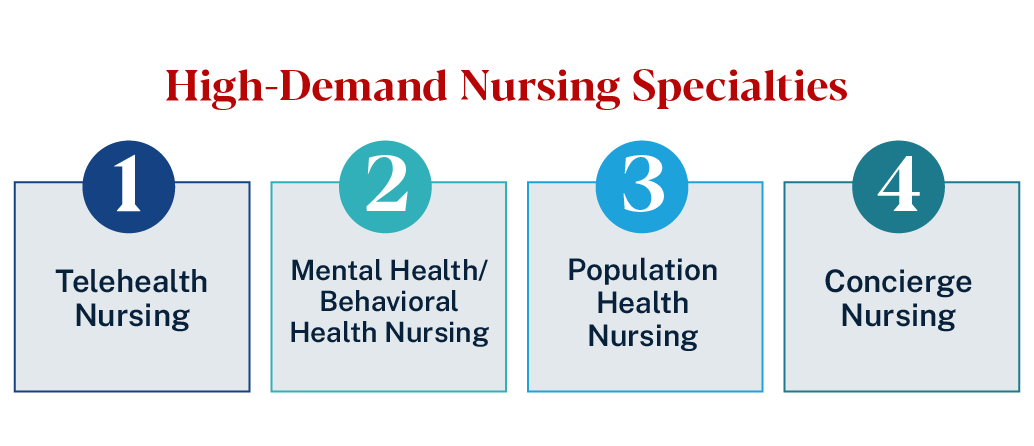
High-Demand Nursing Specialties to Watch in 2025-2026
As the U.S. population continues to live longer, productive lives, RNs can work in innovative and emerging nursing roles.
Telehealth Registered Nurses
The demand for RNs with technological skills to provide telehealth services continues to grow. Telehealth services provide technology-assisted care, allowing patients to more easily access healthcare specialists to monitor chronic conditions, assess symptoms and support care coordination.
The need for telehealth registered nurses is greatest in rural or underserved communities to reduce hospital readmissions. These nurses have the opportunity to combine clinical knowledge with technology to improve patient outcomes.
Mental Health/Behavioral Health Registered Nurses
There’s a high need for RNs – as well as psychiatric-mental health nurse practitioners (PMHNPs) – to provide crisis intervention, patient education and promote overall well-being. These nurses can provide therapeutic communication to assess patient needs, support patients through treatment and provide recovery services, helping their patients achieve mental/behavioral stability.
Population Health Registered Nurses
As patient care services shift outside of hospitals, healthcare systems are opting to engage the services of population health RNs to focus on health outcomes for groups of patients. These nurses identify health trends and disparities within communities and collaborate with organizations like health agencies, community organizations and health systems to develop strategies to improve overall wellness.
Concierge Registered Nurses
As the U.S. population continues to become more health-conscious, the need for personalized, on-demand care continues to grow. RNs and APRNs are able to provide that care. Concierge nursing services may include helping patients navigate complex healthcare systems, managing follow-up care or preventative care, and serving as health advocates. This model of healthcare requires nurses to build a strong relationship with their patients, providing them with convenience and accessibility to healthcare services.
Your Nursing Path: Factors to Consider
Nurses have multiple professional options to choose from when deciding on a career path. So, how do you choose the right path for you?
We’ve already talked about some factors to consider, like personal interest, passion for a population, salary and job outlook, and a work environment that cultivates your preferred work-life balance. But you should also consider opportunities for career growth and advancement.
RNs can enter the profession with an ADN, but earning more nurse degrees can open up doors to specific career paths. BSNs and MSNs are essential to progress in some areas of practice (e.g. education, administration, leadership). Doctoral-level degrees allow RNs even more advanced levels of practice or leadership. You should evaluate opportunities for growth and advancement in a chosen path and determine if the education and experience meet your future professional goals.
The diversity and impact of the nursing profession make it a remarkable and exciting field in which to build a rewarding career. Aspiring and current nurses should explore it as much as possible to find their niche!
FAQs
What’s the difference between an RN and NP?
RNs provide general care. NPs are RNs with additional education in a specialized area and an additional certification. They can diagnose and prescribe medications.
Can I change specialties later?
Absolutely. If you decide that you’d prefer to work in a different nursing specialty, you can make the switch as long as you have the necessary experience or certifications required.
When you’re ready to amplify your nursing career, explore American College of Education’s online nursing programs.
Disclaimer: The views and opinions expressed in this article are those of the author and do not necessarily reflect the official policy or position of American College of Education.
Dr. Lisa Hawthorne worked as a medical-surgical nurse and public health nurse with a community clinic. For the past 18 years, she has taught nursing at the certification, bachelor's and master's level for various colleges and universities. She has also served as director of nursing for several nursing programs and colleges. She's served on the board of the Texas Nurses Association, on the strategic planning committee of the Texas League of Nursing and is currently serving on the nominating committee for the Organization for Associate Degree Nursing.