

Educational Leadership
Explore the career you could build with this skill.
What Is Educational Leadership?
Schools and educational organizations rely on strong leaders to create positive learning environments, support educators and guide meaningful change. From K-12 schools and districts to higher education institutions and training organizations, effective leadership plays an important role in shaping educational experiences and improving outcomes for students and communities. As education continues to evolve, there is a growing need for professionals who can lead with vision, collaboration and purpose.
Educational leadership focuses on the skills and strategies needed to lead educational organizations and support student success. Educational leaders help guide decision-making, manage teams, develop programs and foster environments where students and educators can thrive. If you’re interested in developing the skills that help schools and educational organizations grow and adapt, you’re interested in educational leadership.


Recent Trends in Educational Leadership
Educational leaders are navigating a rapidly changing landscape shaped by new technologies, evolving student needs and increased expectations for school performance and accountability. Many schools are placing greater emphasis on collaborative leadership, data-informed decision-making and creating supportive learning environments that help both students and educators succeed.
There is also growing recognition that effective leadership extends beyond administrative responsibilities. School leadership courses, principal preparation courses and teacher leadership courses can help educators develop the skills needed to lead change, build strong school communities and support continuous improvement across educational settings.
Educational Leadership Courses
American College of Education (ACE) offers standalone courses that can help you develop your skills in this area.
Educational Leadership Careers
Learn more about the career paths you can pursue with this skill on your resume. Please note that some careers listed may require state licensure, certification or additional qualifications.
Course Stackability
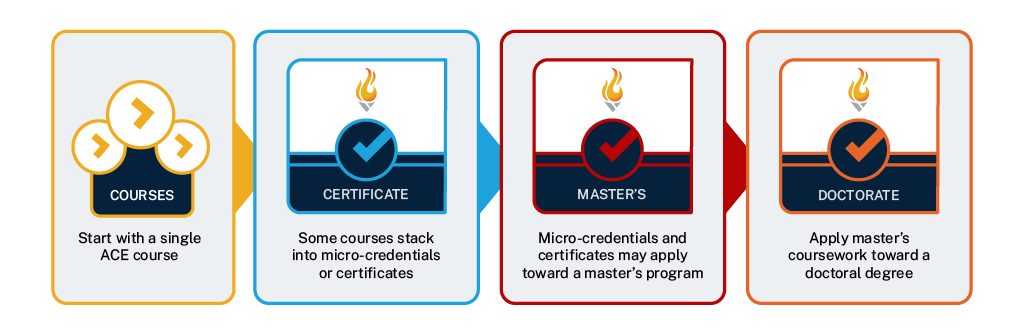
We want our students to get the most out of their hard work. That’s why we design our courses and programs with stackability in mind. Some courses can be applied toward a micro-credential or certificate, which can in turn be applied toward a master’s degree, subject to program requirements. That master’s degree coursework could then be applied toward a doctorate. Even by taking a single course at ACE, you're taking a smart step toward a larger educational future.
Related Degrees
The courses you take in this skill area can earn you academic credit that you can apply to these ACE degrees.
Course Admissions
For students taking single courses without enrolling in a program, admission requirements will depend on the level of the course. Students must meet ACE’s general admission requirements and be admitted to the college before signing up for a stand-alone class.
Bachelor’s Level
- At least 30 semester credits
- Minimum GPA of 1.75
Master’s Level
- A bachelor’s or highest post-baccalaureate degree
- Minimum GPA of 2.5*
Doctoral Level
- A master’s or doctoral degree
- Minimum GPA of 3.0
*Applicants whose overall GPA is between 2.0-2.49 may be considered for admission if their degree was conferred more than 10 years from the start date at ACE or the applicant has five or more years of experience in the field appropriate for intended courses.
Educational Leadership FAQs
What skills can I develop through educational leadership courses online?
Educational leadership courses online can help you develop skills in communication, strategic planning, organizational leadership, decision-making, team management and data-informed problem-solving. These skills can prepare you to lead educational initiatives and support student and staff success.
How do school leadership courses prepare educators for administrative roles?
School leadership courses introduce you to the responsibilities of educational leaders, including managing operations, supporting teachers, improving school culture and making strategic decisions that benefit students and communities.
What is covered in principal preparation courses?
Principal preparation courses often cover topics such as instructional leadership, school law, budgeting, personnel management, organizational change and strategies for creating positive learning environments.
Can teacher leadership courses help educators advance their careers?
Definitely. Teacher leadership courses create and optimize skills that may prepare you for roles with additional responsibilities, such as instructional coach, department chair, curriculum specialist or school administrator.
What are the benefits of leadership training in education?
Leadership training in education can help you strengthen your communication, problem-solving and management skills while preparing you to support teachers, guide change and contribute to school improvement efforts.
How do educational leadership programs support school improvement efforts?
Educational leadership programs can help you develop strategies for setting goals, using data effectively, fostering collaboration and implementing initiatives that improve teaching, learning and organizational effectiveness.