

Data Analytics Skills
Explore the career you could build with this skill.
What Is Data Analytics?
In our digitally and technologically driven world, data is nearly everything. From start-ups to Fortune 500 companies, schools to retail, data is used to inform organizational strategy, decisions and goals in every industry.
Because there’s such a premium placed on data, knowing how to collect, understand and analyze it for actionable insights is a valuable and highly sought-after skill. If you’re seeking to develop that skill, you’re interested in data analytics.
Recent Trends in Data Analytics
What started as a field specializing in manual data collection and retrospective reporting has evolved into a fast-paced, AI-driven landscape bursting with potential opportunities and applications. Data analytics grew from Excel spreadsheets to cloud data warehouses, from periodic reporting to near-instantaneous updates, and AI is now contributing to predictive analytics at an unprecedented level.
Data analysts today have access to a wide range of software, applications and AI tools to assist them with routine analysis. As a result, data analytics is now more about how well you’re able to use those tools to generate insights, validate the results, and then apply expertise and judgment to determine the best strategy, priorities or direction to pursue.

Data Analytics Courses
American College of Education (ACE) offers standalone courses that can help you develop your skills in this area.
Data Analytics Careers
Learn more about the career paths you can pursue with this skill on your resume.
Course Stackability
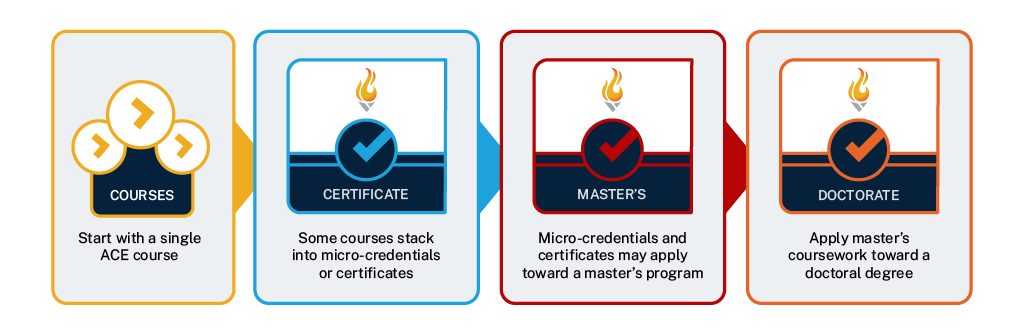
We want our students to get the most out of their hard work. That’s why we design our courses and programs with stackability in mind. Some courses can be applied toward a micro-credential or certificate, which can in turn be applied toward a master’s degree, subject to program requirements. That master’s degree coursework could then be applied toward a doctorate. Even by taking a single course at ACE, you're making a smart investment toward a larger educational future.
Course Admissions
For students taking single courses without enrolling in a program, admission requirements will depend on the level of the course. Students must meet ACE’s general admission requirements and be admitted to the college before signing up for a stand-alone class.
Bachelor’s Level
- At least 30 semester credits
- Minimum GPA of 1.75
Master’s Level
- A bachelor’s or highest post-baccalaureate degree
- Minimum GPA of 2.5*
Doctoral Level
- A master’s or doctoral degree
- Minimum GPA of 3.0
*Applicants whose overall GPA is between 2.0-2.49 may be considered for admission if their degree was conferred more than 10 years from the start date at ACE or the applicant has five or more years of experience in the field appropriate for intended courses.
Data Analytics FAQs
How can I improve my data analytics skills?
The best way to improve your data analytics skills is to ensure you have a solid understanding of the components involved. Work on your data literacy (e.g. reading charts, understanding metrics, etc.), proficiency in statistics and spreadsheet skills. Then, familiarize yourself with tools commonly used to track, report, manipulate and visualize data. Finally, put everything together by practicing on real datasets. Examine the data for missing values or inconsistencies, determine what questions it can answer, and present your insights in a clear, concise way.
If you want to strengthen your knowledge in any of the areas related to data analytics or want to practice applying data analytics to real-world scenarios, online courses like the ones at ACE are a great resource to turn to.
Is data analytics a dying skill?
With the advent of large language models and AI that can quickly process large amounts of data, it can seem as if data analytics is a dying skill. But that’s not the case. The human expertise and judgment that data analysts bring to the table are more important than ever. AI is a tool like any other – data analysts are the ones who guide it by asking the right questions and then use the results to develop the best actionable strategy for their organization.
Do you need to have a strong background in math to learn data analytics?
A common misconception is that you have to be good at math to learn data analytics. That’s not, however, the case. While you do need some basic math knowledge – like simple arithmetic, averages, percentages and ratios – and an introductory understanding of statistics, data analytics is less about calculating numbers and more about interpreting results. Logical thinking, comfort with data sets and clear communication are more important to data analytics than math.