

If you’ve looked into business careers, you’ve probably come across the term “business analysis,” but what does it actually mean? Is it the same as data analysis? Is it project management? The confusion is understandable because business analysis touches on multiple disciplines.
A simple business analysis definition from the International Institute of Business Analysis (IIBA) says it’s the practice of enabling change in an organizational context by defining needs and recommending solutions that deliver value to stakeholders.
If you’re weighing whether to get an MBA or wondering what you can do with a business degree, learning about business analysis could point you toward a solid career path. Let’s break down what this field is all about.
What Is Business Analysis?
Business analysis is a research-based discipline focused on understanding how organizations work and figuring out what they need to reach their goals. It involves understanding how organizations function to accomplish their purposes and defining the capabilities an organization requires to provide products and services to external stakeholders.
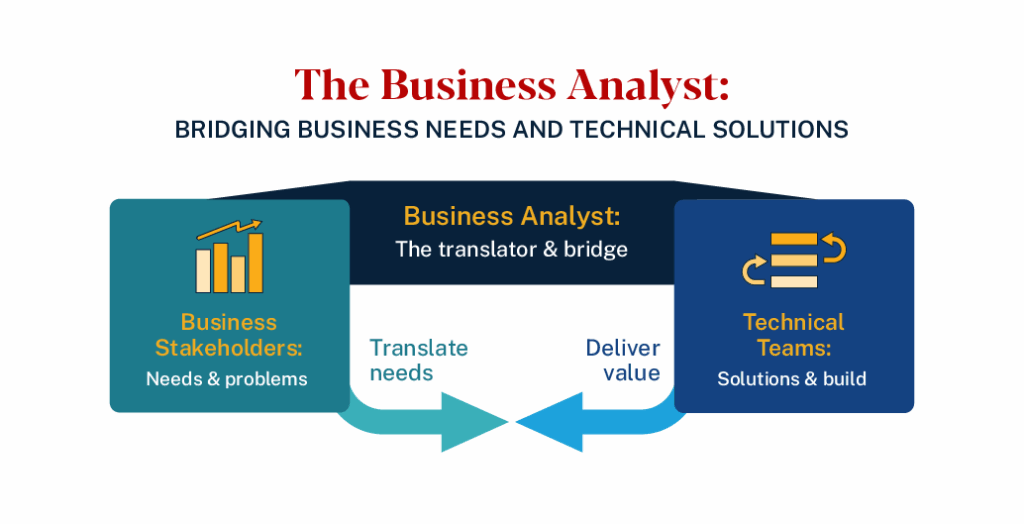
Think of business analysis as the connection between what a company wants to achieve and how it operates on a daily basis. Business analysts often act as a “translator” between business units and IT departments, making sure both sides understand each other.
Business analysis connects how a company plans, how it runs and what technology it uses. It’s closely tied to business operations and helps organizations work better and smarter.
Why Business Analysis Matters
Companies today face constant pressure for business improvements, whether that’s adopting new technology, keeping up with competitors or meeting shifting customer expectations. Business analysis gives organizations a way to handle these challenges without flying blind.
Here’s why it matters:
- Better decisions: Business analysis helps organizations move past gut feelings and make data-driven decisions
- Cost savings: By spotting inefficiencies and fixing them, business analysts help companies save money and use resources more wisely
- Smoother operations: Process improvements and technology upgrades guided by business analysis enhance organizational efficiency
- Effective business and technology integration: When companies bring in new technology, business analysts make sure those investments pay off
- Team alignment: Business analysis keeps different departments talking to each other and working toward the same goals
What Does a Business Analyst Do?
A business analyst is a data expert who looks at how businesses perform and turns those findings into solutions that make money. They collect and analyze data to find growth opportunities that technology can support.
Day-to-day responsibilities include:
- Information gathering: Collecting what the business needs through interviews, workshops and watching how work gets done
- Stakeholder management: Keeping communication flowing between business units, IT and leadership
- Process modeling: Drawing out how work currently flows and how it should flow in the future
- Documentation: Writing up specs, reports and recommendations
- Solution design: Working with technology teams to build solutions that fit what the business needs
- Quality assurance: Making sure the final product does what it’s supposed to do
Business Analysis Skills for Success
Good business analysts mix number-crunching abilities with people skills. The BABOK Guide lays out six core knowledge areas and describes what skills, deliverables and techniques business analysis professionals need to get results.
Business analyst skills include:
- Analytical thinking: Being able to look at business data objectively, interpret what you find and turn it into action items people can actually use.
- Data analysis: Getting accurate insights from data in order to drive decisions that affect the bottom line.
- Communication: Explaining things clearly so other departments can work with you instead of around you.
- SQL: A programming language used to pull data from databases. Knowing it helps you run queries, manipulate data and analyze what’s stored in company systems.
- Quality assurance: Meeting standards for accuracy, reliability and usability when you build data-based models.
Types of Business Analytics
Business analysis covers several specialized areas, each focused on different parts of how organizations improve:
- Strategy analysis: Looking at where a company stands against competitors and where it should head long-term
- Process analysis: Examining and fixing business processes so they run better
- IT/systems analysis: Figuring out what technology a company needs and designing solutions that generate digital transformation
- Data analysis: Digging into data to pull out insights that help with decision-making
- Market analysis: Studying trends, competitors and what customers want
Common Business Analysis Techniques
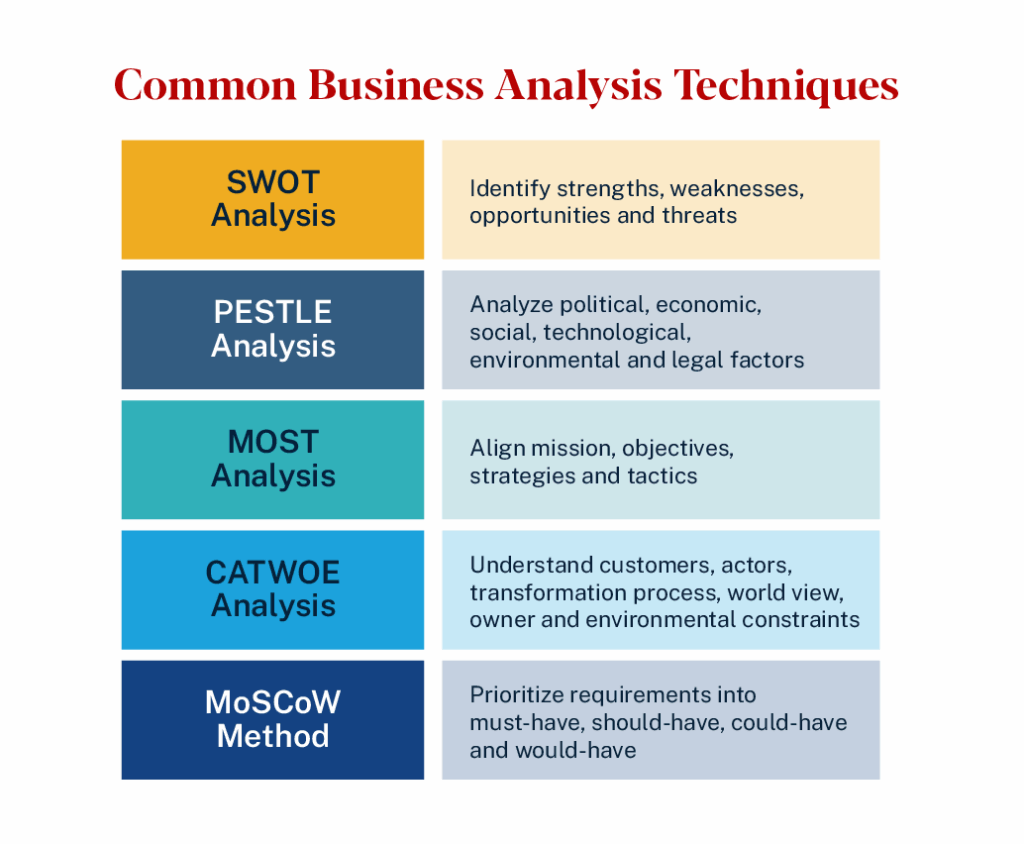
Business analysts use different techniques to gather information, analyze situations and come up with recommendations. There are many techniques. Here are a few you’ll see often:
SWOT Analysis
SWOT looks at strengths, weaknesses, opportunities and threats. It’s useful for planning because it helps you see what’s working inside the company and what external factors could affect success.
PESTLE Analysis
PESTLE examines political, economic, sociological, technological, legal and environmental factors that affect an organization. This helps companies understand the bigger forces affecting their industry.
MOST Analysis
MOST stands for mission, objectives, strategies and tactics. It makes sure what a company does day-to-day lines up with what it’s trying to accomplish overall.
CATWOE
CATWOE (customers, actors, transformation process, world view, owner, environmental constraints) helps you understand how different stakeholders see a problem or proposed change.
MoSCoW Method
This prioritization technique sorts requirements into must have, should have, could have or won’t have (this time). It helps teams put resources where they matter most.
Steps to Business Analysis
While the exact approach depends on the project, business analysis processes usually follow these steps:
- Needs assessment: Identifying and understanding the business problem or opportunity
- Research and discovery: Gathering information through interviews, observation and reviewing documents
- Requirements gathering: Documenting what stakeholders need from a solution
- Solution design: Developing recommendations that address the identified needs
- Implementation support: Helping with deployment and managing change
- Review and optimization: Evaluating results and finding more ways to improve
Business Analysis vs. Business Analytics
People mix these terms up all the time, but they’re different fields. If you’re thinking about a career in either one, it helps to know the distinction.
Business analysis focuses on understanding what an organization needs, defining requirements and problem solving with innovative solutions. It deals with the “what” and “why” of business problems.
Business analytics uses statistics, data mining and modeling to analyze large datasets and find patterns. It answers “what happened” and “what might happen next.”
Business analysis tends to be more qualitative and process-focused, while business analytics is more about the numbers. That said, the two fields overlap significantly, and many professionals build skills in both.
Tools Used in Business Analysis
Business analysts use several software tools to get their work done. The most commonly used BA tools include:
- Microsoft Excel: Used for spreadsheets and calculations. Advanced Excel knowledge lets you manage data more effectively.
- Microsoft Power BI: A data visualization tool that pulls data from different sources and turns it into visual reports.
- Tableau: A business intelligence tool with a user-friendly interface for data analysis and building visual dashboards.
- SQL: For pulling and analyzing data from databases.
- Diagramming tools: Microsoft Visio, Lucidchart and similar programs for creating process flows and system diagrams.
Careers in Business Analysis
Demand for business analysts keeps growing across almost every industry. According to the United States Bureau of Labor Statistics, employment of management analysts (which includes business analyst roles) is projected to grow 9% from 2024 to 2034. That’s much faster than average. About 98,100 openings are expected each year over that decade.
The median annual salary for management analysts was $101,190 as of May 2024. Pay varies based on industry, location and experience. Entry-level positions typically start around $60,000 to $70,000, while senior analysts with over ten years under their belt can earn $110,000 or more.
Common job titles include:
- Business analyst
- Business systems analyst
- Requirements analyst
- Process analyst
- Senior business analyst
- Business intelligence manager
- Chief data officer
How to Become a Business Analyst
Education
A bachelor’s degree in business administration, management or a related field gives you what you need to get started. Many professionals add a Master of Business Administration (MBA) or a specialized master’s like an M.S. in Organizational Leadership to move up.
If you want to build leadership skills that go well with business analysis, programs like an Ed.D. in Leadership or B.S. in Business Administration & Leadership are worth a look. Adult learners wanting more generalized knowledge might consider a B.A. in Professional Studies.
Certifications
The IIBA offers business analysis certifications recognized around the world that prove your expertise:
- ECBA (Entry Certificate in Business Analysis): For people just starting out who want to build their skills
- CCBA (Certification of Capability in Business Analysis): For professionals with two to three years of hands-on experience
- CBAP (Certified Business Analysis Professional): For experienced professionals with over five years in the field
- PMI-PBA (PMI Professional in Business Analysis): Offered by the Project Management Institute
FAQs About Business Analysis
What is business analysis?
Business analysis is the practice of enabling change in an organization by identifying business needs and determining solutions that deliver value to stakeholders. It involves analyzing processes, systems and data to help organizations make better decisions and perform better.
What does a business analyst actually do?
Business analysts gather requirements, document processes, keep stakeholders talking, create business models, analyze data and recommend solutions to organizational problems. They often play a central role in making sure business needs line up with what IT delivers.
What skills do you need for business analysis?
You’ll need analytical thinking, data analysis abilities, good communication, familiarity with tools like SQL and Excel, and the ability to ensure quality in your work. Being able to document and present your findings clearly also matters.
Is business analysis IT or business?
It’s both. Business analysts often work closely with IT teams on technology projects, but the job is really about solving business problems. Plenty of BAs work on non-technical projects involving process improvement, planning and organizational change.
Is a business analyst career path a good choice?
Yes. According to the Bureau of Labor Statistics, the field is growing 9% from 2024 to 2034, which is much faster than average. The median salary is $101,190, and there’s a clear path from entry-level analyst to senior positions and leadership roles.
Final Thoughts
Business analysis helps organizations figure out what’s wrong, what could be better and how to fix it. Whether you’re interested in improving processes, working on technology projects or using data to help companies make smarter decisions, business analysis offers real opportunities to make an impact.
As companies rely more on data and technology, they’ll need more people who can do this work. Building the right mix of analytical, technical and people skills, plus getting the right education and certifications, can set you up for a solid career.
Explore the fully online business programs at American College of Education, where you can launch or advance your career in business analysis.