
In today’s diverse educational landscape, the school a child attends plays a significant role in shaping their learning experience. From busy city classrooms to quiet country ones, the setting influences academic opportunities, social life and community ties. Understanding how urban and rural schools differ and where they overlap helps families, teachers and policymakers support students everywhere. While city and country schools might seem worlds apart, they are connected by shared goals and common challenges that affect millions of students across the United States.
What Are Urban and Rural Schools?
Urban Schools
Urban schools, also known as inner-city schools, are in large, densely populated cities, where there is a high level of cultural and economic activity. They serve thousands of students across big districts that often include many campuses. Urban schools often reflect their surroundings, which are vibrant, fast-paced and diverse.
Rural Schools
Rural education systems serve small and often isolated communities with lower population density. Community engagement in rural schools often fosters connections across generations of families. The United States Department of Education defines rural schools as those located outside urbanized areas and clusters, including farming regions, small towns and remote communities.
Rural areas house small-town schools that historically lacked diversity, but that is slowly changing. Funding remains a major challenge as rural school districts often depend on small tax bases and receive limited state or federal support.
Differences Between Urban and Rural Schools
When considering urban versus rural schools, there are noticeable differences that can result in education gaps. This can impact students’ desire for higher education. According to the National Center for Education Statistics, more rural high school freshmen (23%) than those who attended high schools in cities in suburban areas (18% each) reported neither taking nor planning to take postsecondary classes.
Student Populations and Class Sizes
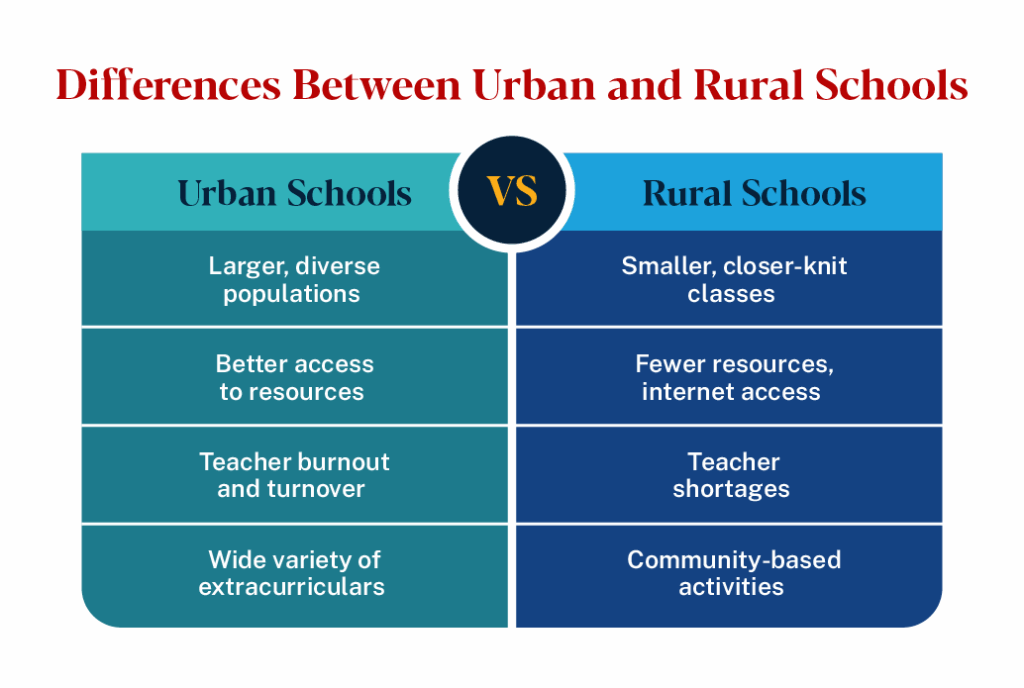
Urban schools often enroll thousands of students, resulting in large classes and limited personal interaction between teachers and students. Overcrowding can make it challenging for teachers to provide individualized attention or build strong relationships.
In contrast, rural schools usually have small classes and fewer total students. Many children grow up with the same classmates from kindergarten through high school, which fosters close friendships but limits exposure to diverse perspectives. Teachers often know students’ families personally, which helps them tailor learning to individual needs.
Resources and Technology
Urban schools often have greater access to resources, although this varies significantly. Wealthier city schools may have advanced science labs, libraries and art programs, while others lack basic supplies.
Rural school systems face a different challenge involving technology access in education. Many of these areas still struggle with slow or unreliable internet, which means students have a harder time completing online assignments or participating in virtual learning, widening the digital divide.
Teacher Availability and Retention
Rural districts often struggle to recruit and retain qualified teachers, especially in specialized subjects like advanced math or foreign languages. Teachers in these areas may cover multiple subjects or grade levels, which stretches their time and expertise.
Urban education systems have easier access to teacher pipelines but face high turnover rates due to stress, large class sizes and challenging working conditions. Frequent staff changes make it difficult to maintain consistency and strong relationships with students.
Extracurriculars and Academic Opportunities
City schools typically offer a wide range of electives, advanced placement (AP) classes and extracurriculars such as robotics, theater and music programs. Students have access to specialized academies and facilities that prepare them for college and careers.
Schools in rural areas typically offer fewer programs due to smaller enrollments and limited budgets. However, they often provide unique community-based opportunities such as agricultural clubs, outdoor learning and local history projects. Students can also assume leadership roles earlier since competition is less intense.
Similarities Between Rural and Urban Schools
Despite their differences, urban and rural areas face similar struggles in some contexts.
Shared Challenges
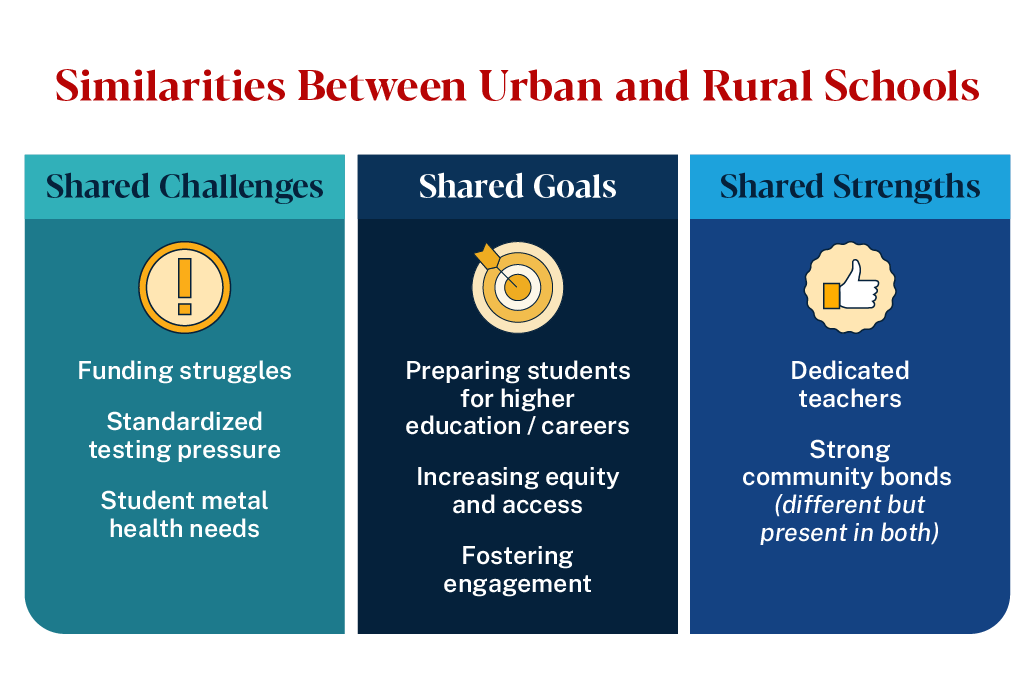
- Funding inequalities: From low tax bases in rural areas or complex distribution formulas in cities
- Standardized testing pressure: Teaching for the test rather than focusing on creative learning and academic performance
- Mental health concerns: Anxiety, depression and trauma affecting students regardless of where they live
- Poverty: Major barrier to success for many families
Shared Goals
- Student success: Cultivating impactful teaching and learning environments
- Student preparation: Promoting college readiness, career education and equity
- Community engagement: Involving families and local organizations, whether through local mentorships or parent partnerships
Shared Strengths
- Dedicated teachers: Working tirelessly to meet student needs and build meaningful relationships
- Support networks: Leveraging the community and partnerships to encourage learning and growth
- Student development: Going above and beyond academics, serving as mentors, advocates and role models who shape students’ confidence and aspirations
Challenges and Advantages of Urban Schools
Challenges
- Often overcrowded schools whose high student-teacher ratios strain facilities and teachers
- Logistical issues like scheduling and space management that can result in potential safety concerns
- Security measures like metal detectors or on-site officers aim to keep students safe, but feel less welcoming
- High competition for limited funding requires constant application for grants or partnerships
Advantages
- Offer unmatched program diversity
- Magnet schools and career academies allow specialization in areas such as performing arts, engineering or healthcare
- Proximity to businesses, universities and cultural institutions offers valuable college and career preparation opportunities
- Opportunities for internships, dual enrollment and mentoring programs
- Rich cultural exposure through museums, theaters, restaurants and public events
Challenges and Advantages of Rural Schools
Challenges
- Isolation due to long bus rides and remote locations limit access to extracurriculars, field trips and partnerships with businesses or colleges
- Limited extracurricular activities restrict students’ experiences, making it more challenging to explore interests or prepare for diverse career paths
- Lacking dedicated art or science teachers leaves existing staff to juggle multiple roles
- Difficulty offering teacher professional development when located hours away
Advantages
- Personalized attention and stronger relationships with teachers allow educators to track individual progress closely and adapt lessons to meet specific needs
- Safe, family-oriented environments with lower crime rates and strong community ties
- Strong community involvement, as local businesses and families often volunteer or donate to schools
Bridging the Gap Between Rural and Urban Schools
Creating equity across school settings requires thoughtful policy changes and collaboration. Funding systems should address the distinct needs of both types of schools by considering poverty levels, population size and local cost of living, rather than relying solely on enrollment numbers.
Technology can help bridge gaps too. Virtual learning allows rural students to access advanced courses and urban students to experience cultural growth through digital exchanges. Collaborative projects between schools can broaden students’ perspectives and encourage mutual understanding.
Teacher exchange programs and shared professional development can further strengthen both settings. When educators share ideas and strategies, students in both environments benefit, especially with such significant teacher shortages in the U.S. Ultimately, every student, regardless of their location, deserves access to high-quality teachers, impactful learning opportunities and strong community support.
FAQs
What makes rural schools different from urban schools?
Rural schools serve smaller, more dispersed populations with stronger community ties, while urban schools educate large and diverse groups in densely populated areas. Rural schools typically have smaller classes and fewer resources, while urban schools often offer a wider range of programs, but face challenges related to overcrowding and funding.
What challenges do both urban and rural schools face?
Both face funding shortages, teacher retention problems, mental health concerns and pressure with standardized testing. Students from low-income families, whether in cities or rural areas, often face the steepest obstacles to success.
How can rural and urban schools learn from each other?
Each has valuable lessons to share. Urban schools can learn from rural communities’ close relationships and personalized teaching approaches, while rural schools can benefit from urban strategies for program diversity and effective technology use. Virtual collaborations can connect students across different environments, helping them appreciate varied American experiences while working toward shared educational goals.
No matter the location, educators and educational leaders are needed to create positive, successful learning environments. Explore the fully online, affordable education programs at American College of Education.