

In today’s hyper-connected corporate world, the clock always seems to be ticking faster than we can keep up with. Between a never-ending influx of emails, back-to-back meetings and shifting company goals, managing your schedule can feel like a full-time job in itself. That is why mastering time management in business is no longer just a helpful habit but one of the most critical professional drivers of long-term operational growth.
Regardless of your role in business, how you protect your schedule can dictate your entire trajectory. Implementing effective time management strategies allows professionals to systematically optimize their daily output. When you learn how to control your calendar, you naturally generate increased productivity, reduce stress and make more consistent progress toward your most ambitious operational objectives.
In this comprehensive guide, we will break down some key practical and actionable time management tips with advanced scheduling structures that you can implement immediately to regain control of your workday.
Why Time Management Is Essential in Business
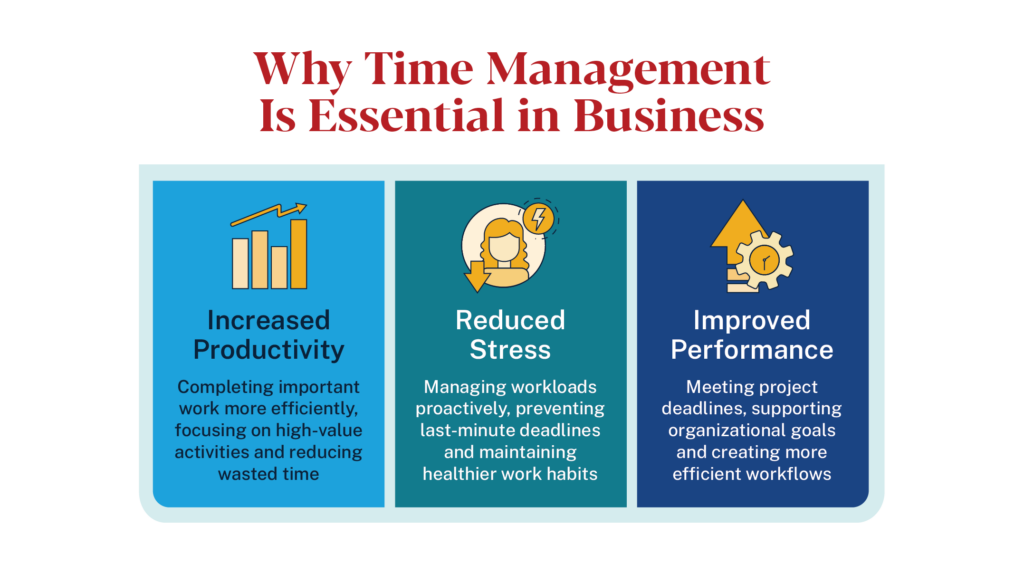
Managing time effectively is absolutely critical in modern, fast-paced corporate environments. Business professionals rarely have the luxury of focusing on a single project at a time. Instead, they are constantly required to balance competing priorities, stakeholder meetings, cross-departmental projects and intensive leadership responsibilities. Connecting good time management to your daily routine is a reliable way to support organizational success while maintaining your personal output.
Increase Productivity
When you apply structured time management strategies, you can complete important work much more efficiently. True efficiency is not about working longer hours; it is about focusing your energy entirely on high-value activities that actively move the needle. Systematically reducing wasted time allows you to achieve better results in fewer calendar hours.
Reduce Stress and Avoid Burnout
Constantly rushing to meet last-minute deadlines is a primary driver of corporate exhaustion. Managing workloads proactively allows professionals to reduce stress before it becomes unmanageable. Maintaining healthier work habits ensures that you can sustain high-level performance without sacrificing your personal well-being.
Improve Business Performance
Time management has a direct ripple effect on your entire team. Consistently meeting project deadlines and supporting organizational goals requires structured, predictable workflows. The entire organization can pivot quickly and execute strategies with greater precision when processes are highly optimized.
Prioritizing High-Value Work
One of the hardest truths to accept in business is that not every task on your to-do list deserves the same amount of your time or attention. Treating every incoming request as an emergency is a fast track to operational stagnation. True prioritization is widely recognized as one of the most effective time management strategies an executive can develop.
Identify Your Most Important Tasks
To optimize your schedule, you must ruthlessly focus on top business priorities. Every morning, ask yourself which tasks directly align with your broader organizational objectives. If a task does not support those core goals, it is a low value activity that should not be allowed to distract you from your real responsibilities.
Separate Urgent From Important Work
Urgent tasks demand immediate attention, like a ringing phone or a sudden message, but they are rarely the tasks that drive long term business growth. Successful professionals evaluate deadlines carefully to plan proactively. Shifting away from reactive decision-making ensures that you are dictating your day, rather than letting your inbox dictate it for you.
Review Priorities Daily
A rigid schedule will inevitably break in a dynamic corporate climate. It is vital to review your priorities daily and adjust your upcoming schedules as operational goals shift. Preparing consistently for unexpected business needs allows you to maintain the flexibility required to navigate sudden market challenges.
Proven Time Management Techniques
Developing strong time management skills requires moving past abstract concepts and adopting concrete, tactical habits. There are several proven time management techniques used by top executives to optimize their daily output.
Time Blocking
Rather than working from a disorganized, running to-do list, try utilizing time blocking. This strategy involves dedicating specific, uninterrupted focus periods on your calendar to separate, individual responsibilities. Protecting these blocks ensures that your most vital strategic work receives your absolute best mental energy.
Minimize Distractions
The single biggest time leak in modern knowledge work is context switching and notification overload. Every time you stop a project to check a sudden text or email, your brain suffers a severe cognitive cost that drains your momentum. Minimizing these constant interruptions is essential for maintaining deep professional focus.
Batch Similar Tasks
Grouping similar administrative work together prevents your brain from constantly needing to recalibrate throughout the day. For example, instead of checking emails continuously, schedule two or three specific blocks during the day to respond to messages. You can apply this same rule by grouping your weekly meetings together into designated afternoons.
Use the Eisenhower Matrix
The Eisenhower Matrix is a legendary framework that forces you to prioritize tasks based on their urgency and importance. It splits your workload into four distinct quadrants, helping you make quick, strategic decisions:
| Urgency / Importance | Important | Not Important |
|---|---|---|
| Urgent | Do: Address high-value tasks with pressing deadlines | Delegate: Pass these minor tasks to a team member |
| Not Urgent | Schedule: Plan dedicated time to focus on this strategic work | Eliminate: Drop these low-value items completely |
How to Delegate Tasks Effectively
You cannot scale a department or a business if you refuse to share the workload. Learning how to delegate tasks effectively is not just about clearing your own calendar; it is a fundamental leadership skill that strengthens your entire team. Successful businesses and time management must coexist seamlessly for optimal productivity.
Focus on High-Impact Responsibilities
When you successfully hand off routine administrative assignments, you immediately free up mental bandwidth to spend on high-impact leadership activities. Avoiding the trap of becoming overwhelmed by routine work allows you to guide your department with much greater clarity.
Match Tasks to Team Members
Effective time management for managers involves delegation and strategic alignment. Always delegate specific tasks based on the individual strengths, technical skills and career goals of your team members. This targeted approach naturally boosts team productivity while building long-term employee confidence.
Trust Your Team
The quickest way to destroy the benefits of delegation is to slide backward into micromanagement. Once you have assigned a task, trust your staff to execute it, encourage individual accountability and let them take ownership of the workflow.
Managing Time During Meetings
Meetings are notorious for consuming a massive chunk of the corporate workday, often leaving professionals wondering when they will find time to do their actual job. For managers especially, protecting your calendar is mostly about learning what requests to decline.
True boundary-setting means pushing back on low value asks and negotiating unrealistic deadlines rather than automatically overcommitting your schedule. When a meeting is truly necessary, use these strategies to keep it efficient:
Set Clear Agendas
Never accept or host a meeting that does not have a defined objective. A strict agenda keeps the conversation focused on core business priorities and reduces unnecessary discussion.
Invite Only Necessary Participants
Respect your employees’ time by only inviting individuals who are directly vital to the decision-making process. Smaller groups naturally improve meeting efficiency and increase professional engagement.
End With Action Items
Never let a meeting wrap up without clearly assigning ongoing responsibilities and establishing concrete deadlines to maintain team accountability.
Time Management Tools for Business Professionals
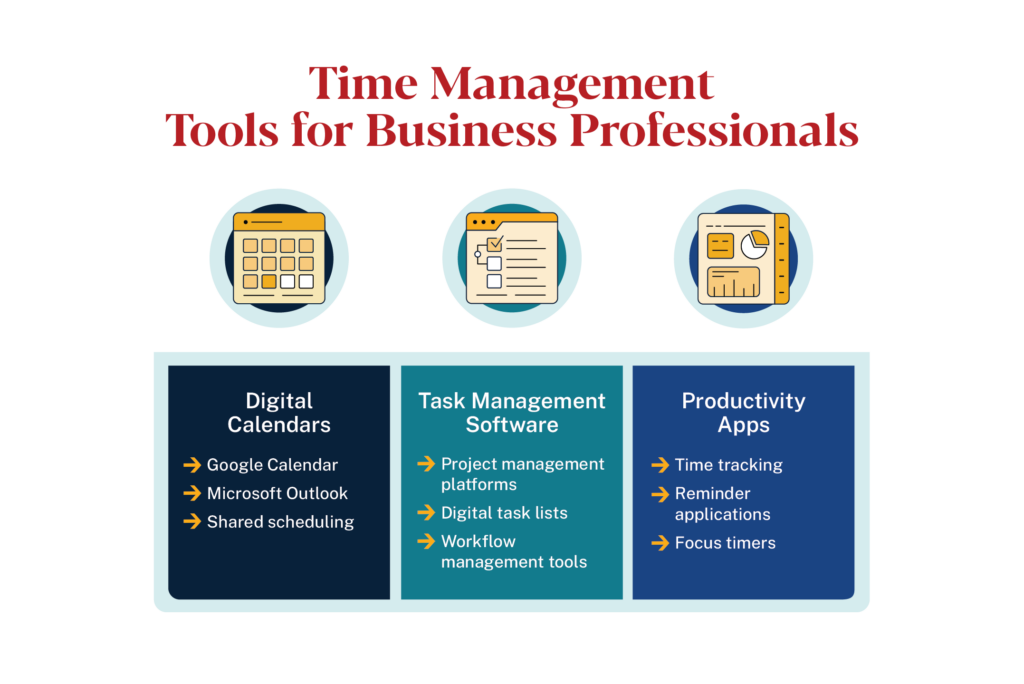
Developing sustainable organizational systems can be easier with modern technology. Incorporating specialized digital platforms can help you streamline your daily tracking and reinforce your workflow.
Digital Calendars
Platforms like Google Calendar and Microsoft Outlook are core pillars of modern scheduling. Utilize shared scheduling options to make collaboration seamless and explicitly block out personal workspace directly on your calendar so others cannot claim it.
Task Management Software
Ditch the paper to-do lists for dedicated project management platforms and digital task lists. Digital workflow tools allow you to track long term project metrics, set automated reminders and view your deadlines through clean visual dashboards.
Productivity Apps
If you struggle with maintaining focus, consider using automated time tracking applications and reminder platforms. Using physical or digital focus timers, such as the Pomodoro technique, forces your brain to stay locked into a project for dedicated, highly efficient sprints.
How Setting Goals Can Support Better Time Management
There is an absolute, direct connection between clear goal setting and everyday productivity. If you do not know exactly what you are trying to achieve, it becomes impossible to manage your schedule effectively. When you intentionally set goals, you create an objective map for your time.
Establish Daily Priorities
Every morning, identify the specific daily objectives that will bring you closest to your quarterly metrics. This intentional focus ensures your core energy is spent on truly meaningful work rather than busy work.
Break Large Projects Into Smaller Tasks
Massive organizational initiatives can easily lead to operational paralysis. Successful professionals prevent overwhelm by breaking large milestones down into highly specific, bite-sized tasks. Think of the old adage, “How do you eat an elephant?” One bite at a time. This drastically improves your daily progress tracking while keeping your motivation high.
Review Progress Regularly
Make it a consistent habit to step back and measure your actual productivity metrics. Reviewing your output allows you to celebrate team milestones and quickly adjust your upcoming project plans when market parameters shift.
Time Management for Business Owners and Managers
Leaders face unique schedule hurdles that standard staff members rarely encounter. Developing specialized approaches to time management for business owners and managers is essential for keeping a company stable.
Balance Strategic and Operational Responsibilities
Leaders often find themselves trapped in a reactive loop, spending their entire day putting out immediate fires. You must protect dedicated time for long-term strategic planning while managing daily business operations.
Build Strong Business Systems
The best way to eliminate unnecessary repetitive work is to standardize your recurring corporate processes. Building clear, automated operational systems drastically improves efficiency across your entire department.
Lead by Example
Your staff will naturally mirror your personal schedule habits. By consistently demonstrating effective time management and protecting your boundaries, you foster a highly productive corporate culture across the entire company.
Common Time Management Mistakes to Avoid
Sometimes, improving efficiency is less about adopting new habits and more about eliminating the behaviors that are quietly sabotaging your workday.
Trying to Do Everything Yourself
Failing to delegate routine tasks is a primary reason leaders face burnout. When an executive insists on controlling every minor operational decision, they quickly become a massive corporate bottleneck that severely limits internal team growth.
Constantly Reacting Instead of Planning
Working without clear, predefined daily priorities forces you into a defensive posture. If you allow every text, email or minor interruption to dictate the direction of your morning, you will inevitably lose focus on your long-term strategic goals.
Overcommitting Your Schedule
Filling every single hour of your calendar with back-to-back meetings leaves absolutely no room for operational flexibility. Taking on an unrealistic workload inevitably leads to missed deadlines, poor quality output and immense professional anxiety.
How ACE’s Online Business Programs Help Working Professionals Manage Their Time
Refining your time management approach often means stepping away from daily operations to sharpen your foundational skill set. However, for a busy business manager, adding higher education to an already packed schedule can feel completely impossible.
This is exactly where the flexibility of online learning becomes invaluable. ACE offers affordable, fully online business degree programs specifically for working professionals. By allowing you to access coursework whenever and wherever it fits your schedule, these interactive programs empower you to advance your education while effectively balancing your full-time career and personal responsibilities.
FAQs
Why is time management considered a leadership skill?
Managing time efficiently is a core leadership quality because an executive’s personal organization dictates how effectively they can direct resources, support their team and execute high-level corporate strategies.
How can professionals stay productive when priorities change throughout the day?
Successful professionals maintain productivity during sudden shifts by reviewing their tasks daily, utilizing flexible digital tools and relying on frameworks like the Eisenhower Matrix to quickly recategorize emerging tasks.
What role does self-discipline play in effective time management?
Self-discipline serves as the essential internal driver needed to stick to your blocked calendar schedules, resist constant digital distractions and protect your workday boundaries.
How can better time management improve decision-making?
Proactive scheduling eliminates the chaotic stress of last-minute deadlines, providing leaders with the clear mental space needed to analyze data thoroughly and avoid reactive choices.
Can strong time management skills improve employee engagement?
Yes, because when leaders delegate tasks effectively and set clear agendas, team members feel trusted, face fewer systemic bottlenecks and experience a healthier workplace balance.
How can organizations create a culture that supports effective time management?
Companies can build an efficient culture by standardizing recurring operational systems, reducing unnecessary meetings and encouraging executives to openly lead by example.
If you are ready to master modern management styles, scale your operational systems and boost your career growth, explore the industry-aligned degree tracks at American College of Education: Bachelor of Science in Business Administration and Leadership, Master of Science in Organizational Leadership and Master of Business Administration.