

In education, earning a specialized degree can help you advance into educational leadership positions or advanced teaching roles. Educational leaders are students first, and there are various avenues to taking your career to the next level. In this blog, we’ll dive into all you need to know about specialized degrees, including what they are and how they equip you to lead effectively and make a difference.
Understanding Specialized Degrees for Teachers and Administrators
Advanced academic programs provide focused knowledge and skills for teachers seeking career growth. This includes specializing in a certain area or subject as well as becoming an administrator or educational leader.
Formal training and well-established credential pathways support strong school districts who offer quality academic experiences. Advanced teaching degrees play a critical role in developing the key competencies teachers and leaders need. Program delivery has shifted over time to better meet the needs of education professionals through online course formats, accelerated completion times and affordable tuition models.
Amid their busy schedules, many teachers choose programs with online courses and local internships, like those offered at American College of Education (ACE). Depending on the role you’re preparing for and your level of education, you can build your knowledge with programs including a master of education (M.Ed.), education specialist (Ed.S.) or education doctoral degree.
School administrator qualifications have grown to reflect expanded accountability, greater demands and diverse student needs, leading teachers to pursue graduate programs. Similarly, as the needs of student populations shift, specialized preparation is needed for teachers and principals to navigate challenges and opportunities related to technology, curriculum, learning modalities, inclusion, data-driven decision-making, interventions and more.
Why Specialized Degrees Matter in Today’s School Systems
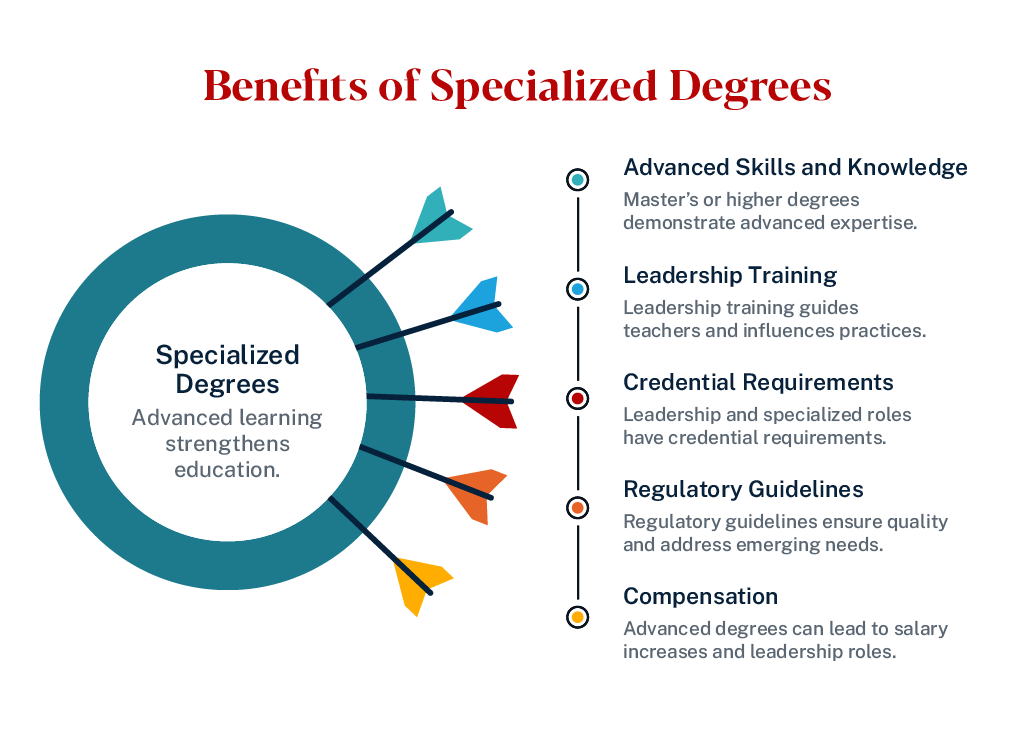
In many school systems, classroom experience alone may not meet qualification expectations for roles such as instructional coach, department chair or curriculum specialist. As a result, educators often pursue specialized graduate degrees to strengthen their credentials and demonstrate advanced competencies.
For example, to become an instructional leader, you need leadership training to guide other teachers, help design curriculum, and influence school-wide practices in areas like adult learning, change management and systemic thinking.
Leadership roles at the school level may require a master’s degree, while those at the district level likely prefer a specialist or doctoral degree. Seeking leadership opportunities within your school is a good start to apply best practices and take advantage of hands-on learning opportunities.
The Education Commission of the States reported that school leaders face higher credential requirements than in previous years. More districts and accrediting bodies are asking for specific credentials for leadership and specialized roles, and the credentials need to come from state-approved education programs.
Depending on the position, each state has degree requirements that address certain competency areas. Having regulatory guidelines helps maintain the quality and clarity of expectations across the enterprise, which requires programs to address emerging professional needs.
Compensation is also something to consider with specialized degrees. In many districts, salary schedules or collective bargaining agreements provide additional compensation for educators who earn advanced degrees. Higher education levels can also open the door to leadership roles that commonly lead to increased pay.
Master’s Degrees for Teachers: A Foundation for Professional Growth
Education master’s degree programs – master of education (M.Ed.), master of arts in teaching (MAT) and master of science in education (M.S.Ed.) – are designed to help teachers improve their teaching skills and knowledge and/or prepare for higher roles. While they may look similar, each type of master’s degree serves a different purpose and audience while equipping teachers with a specific set of skills and knowledge.
- M.Ed.: Often completed by educators who have taught for a long time but are looking to deepen their teaching skills or are ready to move to a leadership role
- MAT: Designed for career changers who already hold a bachelor’s degree, often not in education, and want to become educators
- M.S.Ed.: For individuals who want to continue their graduate studies and focus on research and practical skills
For historical context, teacher graduate programs were developed to raise standards in the teaching profession. These programs focused on research-based methods, teaching theory and reflection. There is value in learning on the job, but academic programs differ from field experience and student teaching. The focus is to learn beyond what works in the classroom to understand why and when it works, so it can be effectively incorporated into practice.
Master’s degrees have played an important role in helping teachers learn to teach. Opportunities offered within advanced teaching degrees invite teachers to self-reflect and apply the research they learn in their classes to know first-hand what works and what doesn’t.
A big objective educators accomplish in these programs is diving deeper into pedagogy, curriculum design and teaching strategies that enhance student engagement and real-world application. They cover different areas of teaching, providing comprehensive training rather than targeted professional development.
Common Specializations Within Master’s Programs
In my experience as a higher education instructor in education, I find that there are some master’s degree programs that are the most popular.
- Curriculum and instruction degrees: Focuses on instructional design, assessment and curriculum development for effective teaching
- Special education degrees: Emphasizes inclusive practices and instructional adaptations for students with disabilities in various learning environments
- Reading/Literacy education degrees: Prepares teachers to become reading specialists and literacy coaches who implement evidence-based interventions, conduct assessments and provide comprehensive literacy instruction across grade levels
- STEM education degrees: Integrates science, technology, engineering and mathematics through hands-on, inquiry-based learning experiences for students
- Educational technology degrees: Prepares teachers to leverage digital tools or become design technology integration specialists and digital learning coaches
Online Degrees for Educators: Flexibility Aligned With Standards
Teacher preparation has evolved to meet the needs of professionals while maintaining traditional academic standards and rigor. The growth of online master’s degree programs is exponential, as they minimize time, location and sometimes financial barriers.
Online education programs allow teachers to work at their own pace and/or complete coursework asynchronously, studying in the evening, summer or weekend while they work. The benefits go beyond the individual student as more working teachers earn higher credentials and contribute to a highly trained workforce.
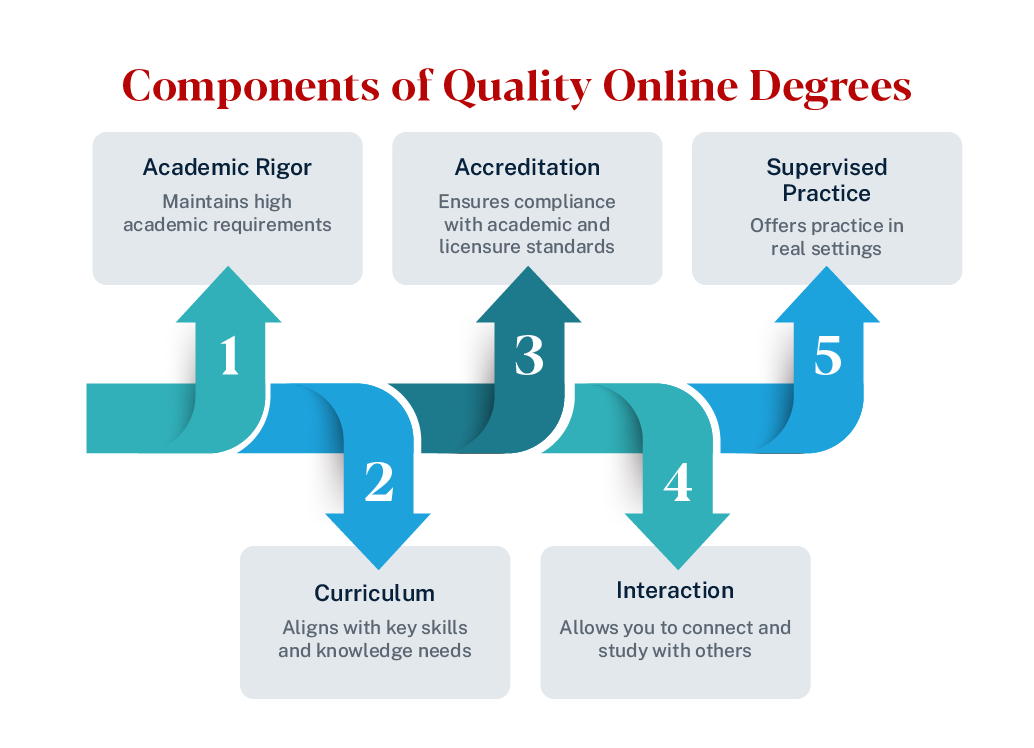
It’s important for online master’s for teachers to have academic rigor, curriculum and other factors. Quality programs are well designed, accredited, and aligned with licensure and district requirements. They should maintain the same academic standards and faculty requirements while creating ample opportunities to interact with others. This includes the supervised practice component for demonstrating competencies in real education settings.
Accredited teaching degrees ensure that your degree complies with academic and licensure standards. Accrediting bodies also review the transferability of credit for the programs, should you need to transfer your credits.
Popular Online Master’s Tracks for Teachers
Depending on your future goals, you want to choose an online master’s program tailored for advancement in the area you want to grow in. I’ve found the most popular pathways to include:
- M.Ed. in Curriculum and Instruction: For experienced teachers aiming for instructional leadership and effective curriculum design skills
- M.Ed. in Special Education: For qualified teachers focusing on individualized education and family collaboration
- M.Ed. in Educational Technology: For teachers who are integrating technology, enhancing digital learning and leading technology initiatives
Educational Leadership Degrees: Preparing Future Administrators
The purpose of educational leadership degrees is to provide the skills, training and necessary qualifications for teachers to become school principals, district leaders and instructional specialists. Rather than focusing on the instructional aspect of education, these programs emphasize systematic thinking, policy change, budget and organizational leadership.
The knowledge you build in educational leadership programs makes you versatile and equipped with skills in areas like strategic planning, resource management, personnel supervision, community engagement and instructional leadership. Aspiring and current leaders are trained through theory, practice and supervised experience.
Among one of the most impactful components of these programs is supervisory experience, as some programs allow you to apply your learning under a practitioner’s oversight. Through gradual release, you build leadership capacity that is often aligned with administrative licensure requirements. You might even consider a principal preparation program.
Each state has different licensure requirements, but many require completing an approved education administration degree program that includes supervised experience and performance assessments to ensure you’re ready for school leadership roles. These degrees are offered at various levels.
- Master’s programs: Include courses and supervised field experience to prepare aspiring principals and assistant principals
- Education specialist programs (Ed.S.): Focus on specialized training for experienced administrators or, in some cases, superintendent licensure
- Doctoral programs (Ed.D.): Designed to support practitioners to obtain high leadership roles
- Doctoral programs (Ph.D.): Focus on research and scholarship to become faculty, often in higher education
Core Subjects in Educational Leadership Programs
Educational leadership curricula typically address several essential areas that prepare teachers for the multifaceted demands of school and district administration, including:
- School law: Navigating legal requirements to protect schools
- Finance and budgeting: Managing largescale financial decisions and budgets
- Organizational leadership: Building effective school environments through collaboration
- Data-driven decision-making: Using data analysis for informed school improvement
- Community engagement: Mobilizing support through partnerships and communication
Administrative Career Paths Supported by Leadership Degrees
Educational administration programs equip teachers to become school and district administrators. Students learn through coursework, field experiences, and mentorship either online or in person. Many programs offer specialized paths for teachers who want to lead in specific areas, such as literacy, special education, student behavior, technology and more.
| Administrative Career Paths With an Educational Leadership Degree | ||
| School-Based Leadership | District-Level Administration | Higher Education and Nontraditional Administration |
| Assistant principal Principal Dean of students Instructional coach Multi-tiered system of supports (MTSS) coordinator Positive behavior interventions and supports (PBIS) coordinator Exceptional student education (ESE) coordinator Curriculum chair Department chair | Director of curriculum and instruction Instructional supervisor Instructional support specialist Curriculum specialist Content area coordinator Director of student services MTSS district coordinator PBIS district coordinator | Program director Program coordinator Assistant dean Education consultant District faculty Adjunct faculty Faculty supervisor Education program manager (nonprofit or government) Professional development coach Curriculum or program analyst (education-focused) |
Choosing the Right Specialized Degree
To choose the best next step of your educational journey, you should evaluate your goals to decide whether to focus on teaching and learning or organizational leadership. For example, if you’re passionate about creating programs and guiding material development, you may consider a curriculum design program. Here are some tips to keep in mind while you’re deciding:
- Review accreditation to ensure quality
- Explore faculty backgrounds to discover their expertise and leadership experience
- Check where alumni work and their roles to see real-world program outcomes
FAQs
What specialized degree is best for becoming a school administrator?
The specialized degree best suited for becoming a school administrator is a master’s degree or higher in educational leadership or education administration aligned with licensure standards. Each state has different requirements and approved programs.
Are online degrees for teachers respected by school districts?
Yes, online education degrees for teachers, aligned with licensure and district standards that are awarded by accredited institutions, are widely respected. The program’s quality, rigor, and faculty expertise are important for both traditional and online programs.
What is the difference between an M.Ed. and an Ed.D.?
An M.Ed. represents a master’s-level degree that prepares teachers to become school-based leaders, while an Ed.D. represents a doctoral degree for practitioners to prepare them to lead large-scale change across schools or systems.
How long do most educational leadership degrees take to complete?
An M.Ed. in educational leadership or education administration, when attended full-time, takes one to two years. Ed.S. programs usually require one to two additional years beyond the master’s degree. Ed.D. programs generally take three to five years, depending on structure and dissertation requirements.
If you’re a teacher looking to advance into educational leadership, American College of Education offers an affordable, quality M.Ed. in Educational Leadership program with fully online courses and a convenient local internship. Already have your master’s degree? We offer fully online Ed.S. and Ed.D. in Leadership programs to get you to the next level of your educational leadership career.